Engerhafe
For ten weeks in the autumn and winter of 1944, the bell of the Engerhafe church rang every time a prisoner died. The men kept count. By the end of December the bell had been struck at least 188 times, once for each person who would not walk out of the camp behind the village. The vast majority of them were Polish and Dutch men - resistance fighters, hostages, and forced laborers swept up in the desperate final months of a regime that had decided to dig a defensive ditch from the Netherlands to Denmark and would not stop digging even as everything around it collapsed.
Before the Camp
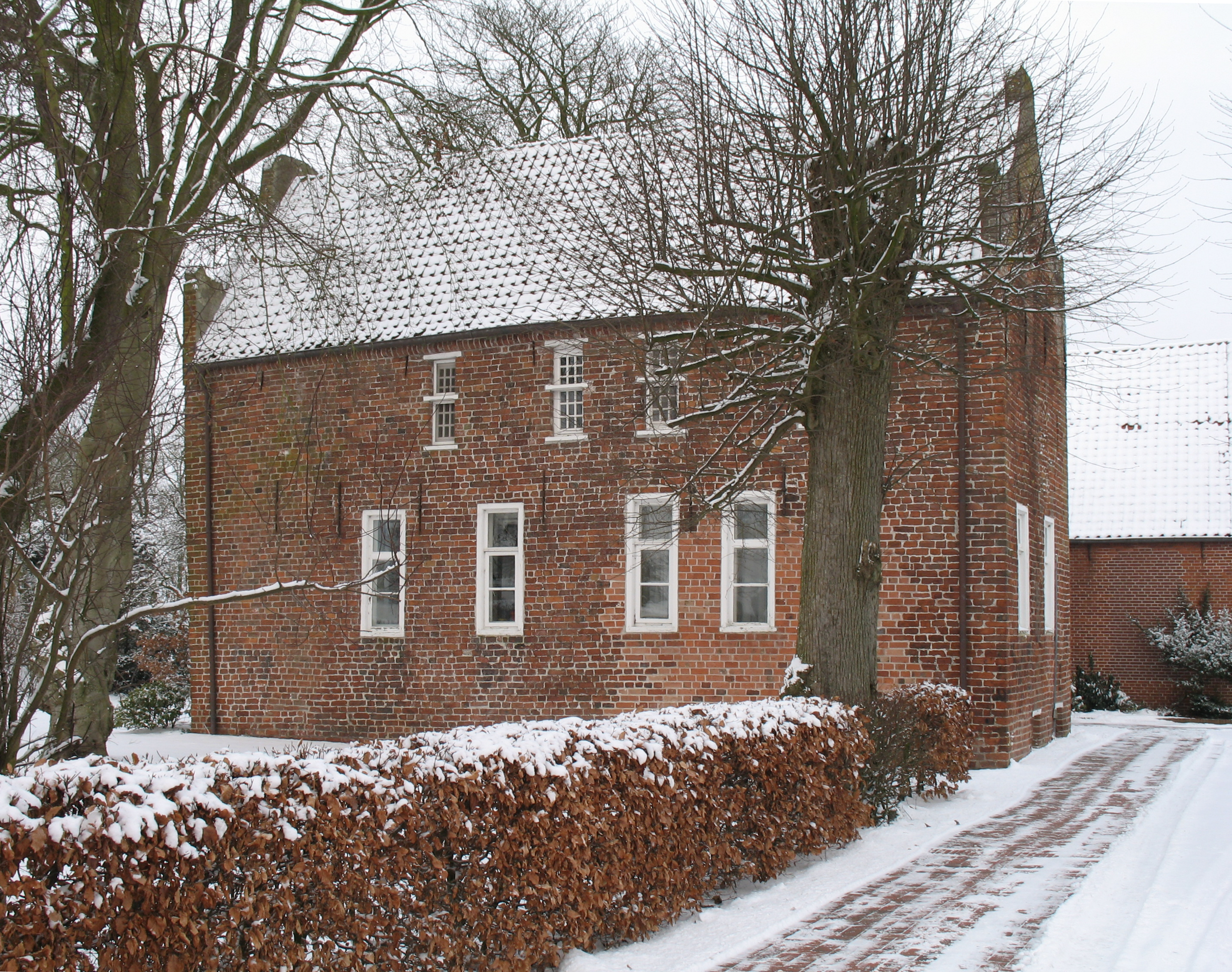
Engerhafe is an old village. It appears in the records between 1250 and 1276 under the names Buta-Ee - outside the Ee - and Uthengrahove, the second term referring to a court location. The 13th-century church, dedicated to John the Baptist, dates from this earliest period. It has a detached bell tower, the kind common across the East Frisian Geest, and a 15th-century borg that still serves as the rectory. For seven hundred years this was an ordinary place: a parish along a ridge of higher ground that runs through the middle of East Frisia, farmers working the surrounding fields, the rhythm of services and harvests and storms off the Wadden Sea. Then in October 1944 the SS arrived and made the village a place that would never again be only itself.
The Camp Behind the Church
The Engerhafe camp was a satellite of Neuengamme, the main Nazi concentration camp outside Hamburg. It opened in October 1944, late in the war, when Germany was running out of everything except cruelty. Approximately 2,000 people were held there. Most were Polish and Dutch men - resistance fighters and hostages rounded up in razzia sweeps - alongside forced laborers from across occupied Europe. They had not been tried. They had not been sentenced. They had been taken, transported, and assigned a number. The camp's existence had one purpose: to provide bodies for the Friesenwall, an emergency defensive line the Nazi command was rushing to build along the North Sea coast as part of the larger Atlantic Wall. The Friesenwall was a fantasy of dirt and concrete that would never see combat. The prisoners had to dig it anyway.
Two Hundred Names
At least 188 men did not survive the ten weeks the camp operated. They died of starvation, of cold, of beatings, of exhaustion, of pneumonia, of diseases that thrive in inhumane conditions. Survivors later described being marched through Engerhafe village to and from the worksites along the Friesenwall, watched by villagers who could not pretend they did not see. The dead were buried in the Engerhafe churchyard - first in a single mass arrangement, later, after the war, identified where possible and given individual graves. They had names: Cornelis, Hendrik, Jan, Pyotr, Aleksei, Stanislaw. They had wives and children and parents who did not know where they were. When the camp closed in December and the survivors were sent back to Neuengamme, the bodies stayed in the East Frisian soil they had been forced to dig.
What the Village Holds Now
Engerhafe today is small. Since 1938 it has been administratively bundled with Fehnhusen, Oldeborg and Upende into the municipality of Oldeborg, which since 1972 has been part of Südbrookmerland. About a thousand people live here. The 13th-century church still stands. The detached bell tower still rings. Behind the church, the cemetery contains a memorial site - a place that the villagers of Engerhafe themselves built and maintain, refusing to let the camp slip into the kind of forgetfulness that suits a country still working out what happened in its own backyard. The memorial does not list military losses or local notables. It names the men. It tells you they were Dutch, or Soviet, or Polish, or Belgian, or French. It tells you what was done to them, and where, and by whom. Two hundred deaths in ten weeks is not a footnote. It is a wound that the village has decided to keep tending, because the alternative - forgetting - was tried elsewhere, and it solved nothing.
From the Air
Located at 53.49°N, 7.31°E in the East Frisian Geest of Lower Saxony. The 13th-century church and its detached bell tower remain visible landmarks from the air, set above the surrounding marshland on a low ridge. Nearest airfields: Emden (EDWE) about 30 km south and Norden-Norddeich (EDWS) about 18 km northwest. Best viewed from 1,500-3,000 ft on clear days. The memorial site at the church marks the graves of the at least 188 prisoners who died in the Engerhafe camp in 1944.