ENIAC
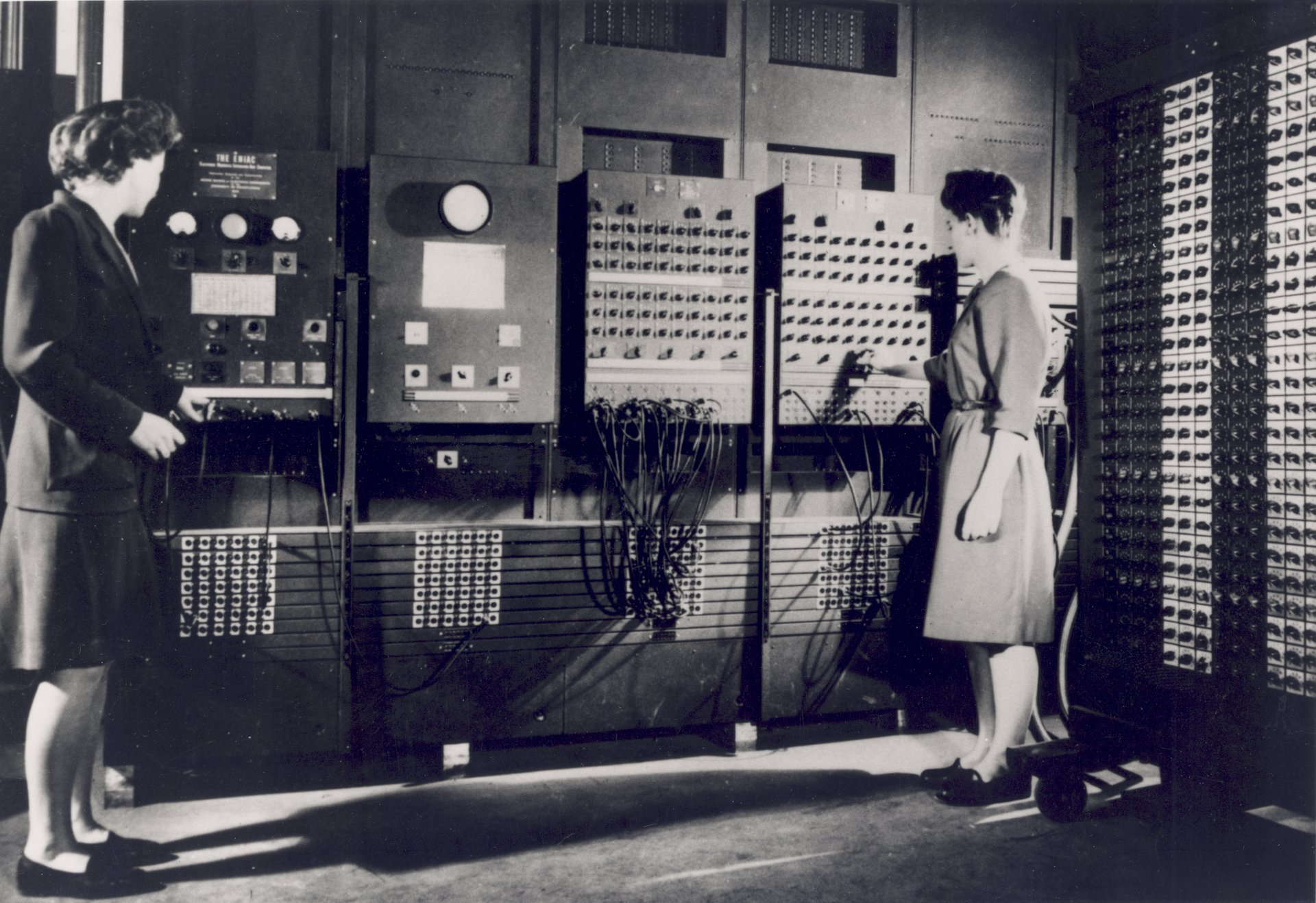
The press called it a "Giant Brain." When ENIAC was unveiled at the University of Pennsylvania on February 15, 1946, the assembled reporters struggled to convey what they were looking at: forty black panels arranged in a U-shape, filling an entire room, containing 18,000 vacuum tubes, 70,000 resistors, and roughly five million hand-soldered joints. It weighed more than 30 tons and consumed 150 kilowatts of electricity. Yet this massive machine could perform 5,000 additions per second -- a thousand times faster than any electromechanical calculator in existence. ENIAC was the first programmable, electronic, general-purpose digital computer, and it was born in Philadelphia.
Project PX
The idea for ENIAC took root in June 1941, when physicist John Mauchly watched graduate students hunched over Friden calculators, laboriously computing artillery firing tables for the U.S. Army. He wondered if electronics could do the job faster. Partnering with electrical engineer J. Presper Eckert at Penn's Moore School of Electrical Engineering, Mauchly proposed an all-electronic calculating machine in August 1942. The Army accepted, awarding an initial contract of $61,700. Construction began in secret the following year under the code name "Project PX," with the goal of computing ballistic trajectories that took human calculators weeks to finish. Assembly started in June 1944, and by May 1945 the machine was ready for testing. The final cost reached nearly $500,000 -- equivalent to roughly $8.5 million today.
The Women Who Programmed the Future
Six women -- Kay McNulty, Jean Jennings, Betty Snyder, Marlyn Wescoff, Fran Bilas, and Ruth Lichterman -- were selected from a pool of about two hundred female "computers" at the Moore School to become ENIAC's first programmers. They studied the machine's blueprints, logic, and physical circuitry to figure out how to translate mathematical problems into configurations of plugboard wires and switches. Programming languages did not yet exist. Despite holding professional degrees in mathematics, the women were classified as "subprofessionals" while men with the same qualifications were called "professionals." None were invited to the formal dedication ceremony. Their contributions went largely unrecognized for decades until researcher Kathryn Kleiman tracked them down in the 1990s. In 1997, all six were inducted into the Women in Technology International Hall of Fame.
A Machine That Changed Everything
ENIAC's first real task was not the artillery calculations it was designed for. Instead, John von Neumann commandeered the machine in December 1945 to run calculations for the hydrogen bomb program at Los Alamos. Von Neumann and Stanislaw Ulam also used ENIAC to pioneer the Monte Carlo method, demonstrating that its raw speed could transform scientific simulation. The machine proved that electronic computation was not merely faster than mechanical calculation -- it was a fundamentally different capability. After its public debut, ENIAC inspired a wave of computer-building projects worldwide, from EDSAC at Cambridge to SEAC at the U.S. Bureau of Standards. Eckert and Mauchly themselves left Penn to found the Eckert-Mauchly Computer Corporation, which produced the UNIVAC, the first commercial computer in America.
Tubes, Crashes, and Endurance
Running ENIAC was an act of perpetual maintenance. Several vacuum tubes burned out almost every day, rendering the machine nonfunctional roughly half the time in its early years. Engineers discovered that most failures occurred during warm-up and cool-down, when thermal stress was greatest, and developed protocols to reduce the failure rate to one tube every two days. "We had a tube fail about every two days and we could locate the problem within 15 minutes," Eckert recalled in a 1989 interview. By 1954, the machine achieved its longest uninterrupted run: 116 hours, nearly five days. Transferred to Aberdeen Proving Ground in Maryland in 1947, ENIAC ran continuously until 11:45 p.m. on October 2, 1955, when it was retired in favor of its successors, the EDVAC and ORDVAC.
Scattered Relics of the Giant Brain
Today, ENIAC's forty original panels are dispersed across institutions nationwide. The University of Pennsylvania holds four panels and a function table in its School of Engineering. The Smithsonian's National Museum of American History houses several more. The Computer History Museum in Mountain View, California, displays three panels on loan. Pieces reside at the University of Michigan, West Point, Fort Sill in Oklahoma, and the Heinz Nixdorf Museum in Paderborn, Germany. In 1996, for ENIAC's 50th anniversary, Penn engineers built "ENIAC-on-a-Chip" -- a silicon chip measuring just 7.44 by 5.29 millimeters that replicated the machine's full functionality. The city of Philadelphia declared February 15 as ENIAC Day in 2011, honoring the anniversary of the machine that proved a room full of vacuum tubes could think.
From the Air
ENIAC was built and first operated at the University of Pennsylvania's Moore School of Electrical Engineering in Philadelphia, at approximately 39.95N, 75.19W. The Penn campus sits along the west bank of the Schuylkill River in University City. Nearby airports include Philadelphia International Airport (KPHL) about 6 nm to the southwest and Northeast Philadelphia Airport (KPNE) about 10 nm to the northeast. At 3,000-4,000 feet AGL, the university campus and its distinctive quad layout are clearly visible along the river.