Enomoto Takeaki
On 27 January 1869, a former samurai declared himself president of a new country. Enomoto Takeaki, commanding Japan's most powerful fleet of eight steam warships, had sailed north from Edo to Hokkaido with the remnants of the Tokugawa Navy, a handful of French military advisers led by Jules Brunet, and a refusal to accept that the old order was finished. The Republic of Ezo lasted five months. When it collapsed after the Naval Battle of Hakodate, Enomoto was arrested for high treason. Within three years he was pardoned. Within a decade he was negotiating international treaties on behalf of the very government that had crushed him. His career is one of the strangest second acts in Japanese history.
A Samurai Who Learned Dutch
Enomoto was born into a samurai family directly serving the Tokugawa clan in the Shitaya district of Edo -- modern Taito, Tokyo. In the 1850s, as Japan reeled from Commodore Matthew Perry's forced opening of the country in 1854, Enomoto began studying Dutch, then the primary European language used in Japan's limited foreign contact. He trained at the shogunate's Naval Training Center in Nagasaki and the Tsukiji Warship Training Center in Edo. At age 26, the shogunate sent him to the Netherlands to study Western naval warfare and procure new technology. He stayed in Europe from 1862 to 1867, becoming fluent in both Dutch and English. While there, Enomoto grasped the potential of the telegraph and began planning a system to connect Edo and Yokohama. He returned to Japan aboard a steam warship purchased from the Dutch, and at 31 was promoted to the second-highest rank in the Tokugawa Navy.
The Republic That Lasted Five Months
When the Meiji Restoration toppled the Tokugawa shogunate in 1868, Enomoto refused to surrender his warships to the new government. He sailed to Hakodate in Hokkaido with the remnants of the Tokugawa Navy and his fleet of eight steam vessels -- the most powerful naval force in Japan at the time. Enomoto hoped to carve out an independent domain for the Tokugawa family on the northern island, but the Meiji government would not accept the partition of Japan. The Tokugawa loyalists declared the Republic of Ezo on 27 January 1869 and elected Enomoto its president. It was Asia's first attempt at a republic organized along Western democratic principles, complete with elections among the garrison. The experiment ended in blood. Meiji government forces engaged and defeated Enomoto's fleet in the Naval Battle of Hakodate in May 1869, and by June the republic had collapsed. Enomoto surrendered and was charged with high treason.
The Enemy They Could Not Waste
Enomoto sat in prison while the new government debated what to do with him. Kuroda Kiyotaka, one of the Meiji leaders, argued forcefully that a man of Enomoto's talents and knowledge was too valuable to execute. In 1872 Enomoto was pardoned, becoming one of the very few former Tokugawa loyalists to enter the new ruling elite. Meiji-era politics was dominated by men from the Choshu and Satsuma domains who had overthrown the shogunate and held deep suspicion of anyone from the old regime. Enomoto was the exception. He rose faster and higher than any other former Tokugawa retainer. In 1874 he received the rank of vice-admiral in the fledgling Imperial Japanese Navy -- the navy that had destroyed his fleet five years earlier. In 1875 he was sent to Russia as special envoy to negotiate the Treaty of St. Petersburg, a mission whose success was celebrated across Japan and taken as proof that the nation's former enemies could be reconciled.
From Rebel Admiral to Cabinet Minister
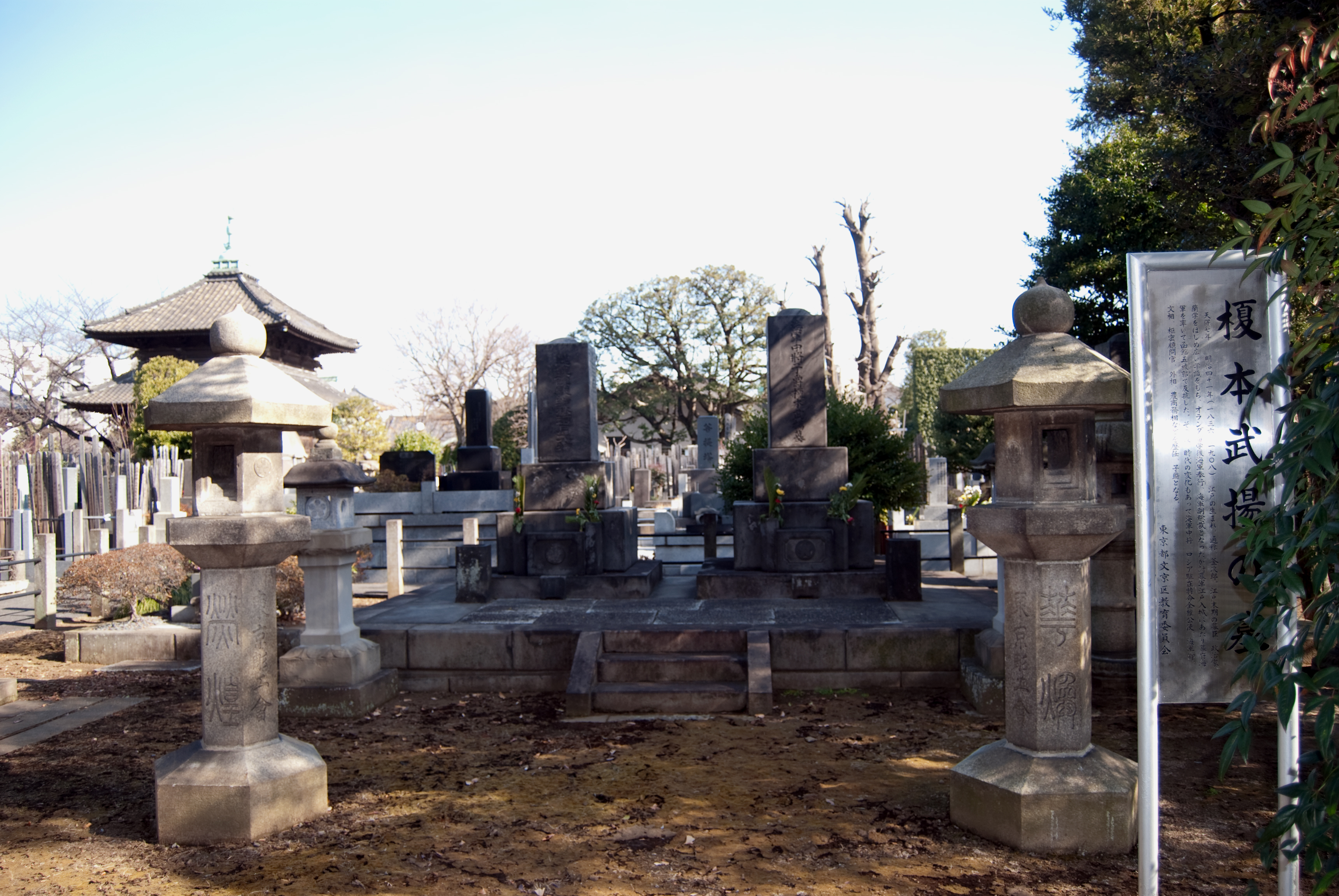
Enomoto's second career reads like a compressed history of Meiji Japan itself. In 1885, he assisted Ito Hirobumi in concluding the Convention of Tientsin with Qing China. That same year he became Japan's first Minister of Communications, a post he held until 1888. He later served as Minister of Education from 1889 to 1890, Foreign Minister from 1891 to 1892, and Minister of Agriculture and Commerce from 1894 to 1897. In 1887 he was ennobled as a viscount under the kazoku peerage system and appointed to the Privy Council. Enomoto was particularly active in promoting Japanese emigration to the Pacific, South America, and Central America. In 1891 he established an emigration section in the Foreign Ministry against the wishes of Prime Minister Matsukata Masayoshi, and after leaving government he founded the Colonial Association to promote overseas trade and settlement. He died in 1908 at 72 and was buried at the temple of Kissho-ji in Bunkyo, Tokyo -- a samurai rebel who ended his life as a viscount, having served the government he once tried to destroy.
From the Air
Enomoto Takeaki's story connects several locations across Tokyo and northern Japan. His birthplace in the Shitaya district corresponds to modern Taito, Tokyo, near 35.727N, 139.754E. A statue of Enomoto stands in the Mukojima area of Sumida, Tokyo. His grave is at Kissho-ji temple in Bunkyo. The Republic of Ezo was centered on Hakodate, Hokkaido (RJCH - Hakodate Airport), roughly 830 km north of Tokyo. For the Tokyo area, Haneda Airport (RJTT) is approximately 17 km south. Tokyo Skytree and the Sumida River provide strong visual references in the Taito-Sumida area.