Enoshima
Benzaiten, the goddess of music and entertainment, is said to have raised this island from the bottom of the sea in the sixth century. Whether or not you believe the origin story, something about Enoshima does feel conjured. The island is barely four kilometers in circumference, a hump of green rising from the mouth of the Katase River where it empties into Sagami Bay. Yet within that tiny footprint, you find Shinto shrines, wave-carved sea caves where Buddhist monks once trained, botanical gardens planted by a Victorian Englishman, a yacht harbor that has hosted two Olympic Games, and a winter light show that draws hundreds of thousands of visitors each year. Connected to the mainland city of Fujisawa by a long pedestrian bridge, Enoshima is the beating heart of the Shonan coast -- the closest real beach resort to Tokyo and Yokohama, and a place where ancient myth and modern leisure have been tangled together for over a thousand years.
The Goddess and Her Island
The monk Kokei wrote the Enoshima Engi in 1047 AD, recording the legends of the shrines that had already stood on the island for centuries. The entire island is dedicated to Benzaiten, and the shrine complex that bears the island's name climbs from the waterfront up through forested hillside in a series of steep stone stairways. For visitors who prefer not to climb, the Luminous Way -- a set of three escalators illuminated with atmospheric lighting -- ferries people from the shrine's base to the summit. At the top sits the Samuel Cocking Garden, and beyond it the Enoshima Sea Candle, an observation tower offering sweeping views of Sagami Bay and, on clear days, the unmistakable silhouette of Mount Fuji to the west. Hokusai captured this very view around 1830 in his famous series Thirty-six Views of Mount Fuji, and Hiroshige painted pilgrims streaming toward the cave shrine of Benzaiten around 1850. The island has been drawing visitors for a very long time.
A British Merchant's Garden
The story of Samuel Cocking reads like a novel someone forgot to write. A British merchant living in Yokohama, Cocking purchased much of Enoshima's uplands in 1880, registering the land in his Japanese wife's name. The timing was deliberate -- the new Meiji government's order separating Shinto and Buddhist properties had suddenly made temple land available. On his hilltop estate, Cocking built a power plant, laid out extensive botanical gardens, and constructed an enormous greenhouse that was, by contemporary accounts, a marvel of Victorian engineering. The 1923 Great Kanto earthquake destroyed the greenhouse, but the gardens survived. Today the Samuel Cocking Garden remains one of the island's main attractions, drawing over half a million visitors a year. Each winter, the garden hosts the Enoshima Illumination, a massive light show that runs from December through February, transforming the tropical plantings into a glittering spectacle.
Caves, Cats, and Padlocks
At the island's far tip, past the shrine complex and the gardens, the cliffs drop sharply to the sea. Here the Iwaya Caves burrow into the rock face -- two tunnels carved by centuries of wave erosion that have served as sites of Buddhist ascetic training since antiquity. The first cave stretches deeper than the second, and both are lit by candles that flicker in the damp salt air. Back up on the hillside, Lover's Hill and the Bell of Ryuren offer couples a place to post messages with padlocks, a Japanese variation on the love lock tradition. And everywhere on Enoshima, cats lounge on stone walls, doze on shrine steps, and stare impassively at passing tourists. The island is officially classified as one of Japan's cat islands, and the resident felines carry themselves with the serene authority of creatures who know they were here long before the tourists arrived.
Olympic Waters
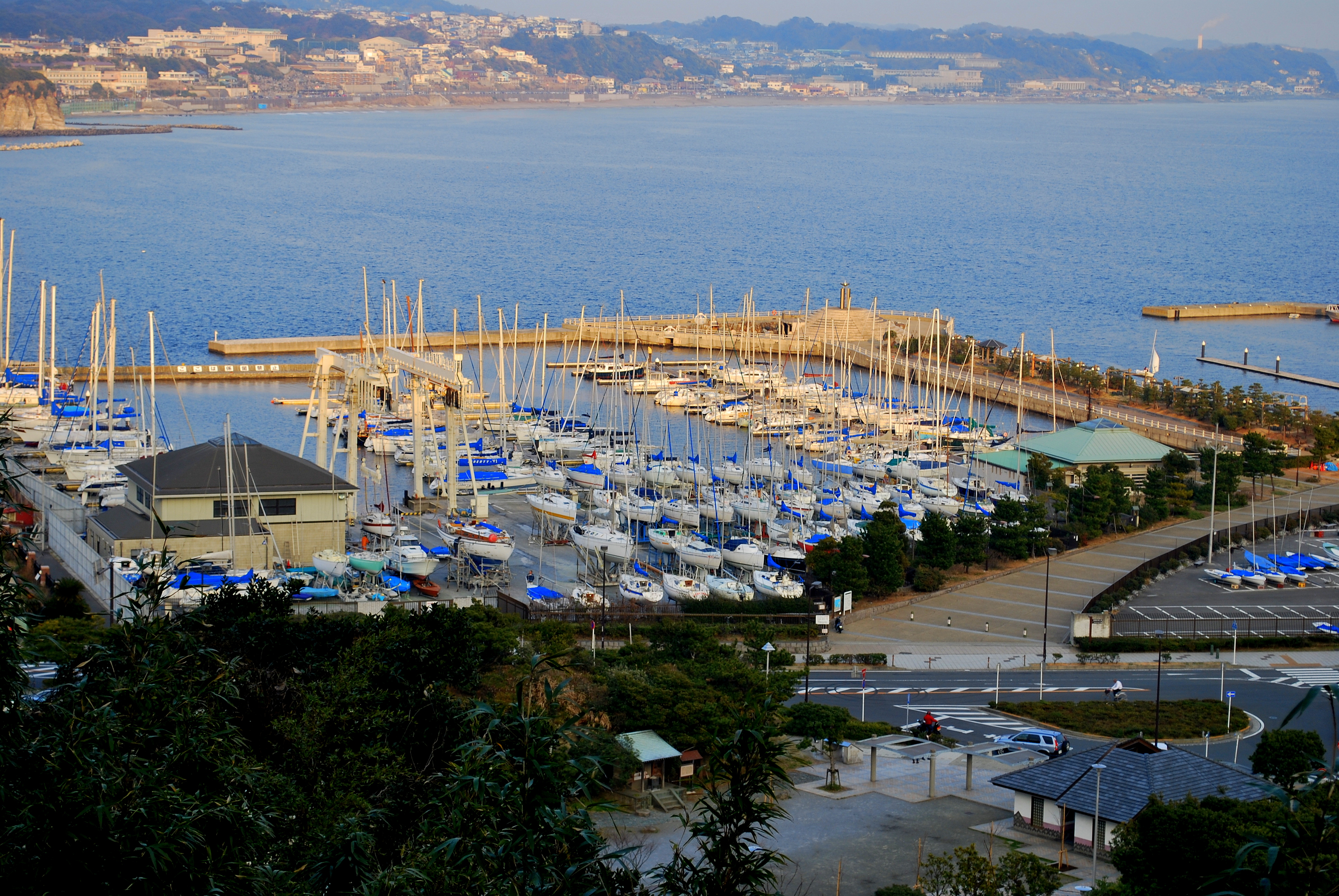
Enoshima's harbor has twice served as the stage for Olympic competition. In 1964, when Tokyo hosted its first Summer Games, the sailing events took place in the waters off Enoshima -- the island's position at the mouth of Sagami Bay providing the open water and reliable winds that competitive sailing demands. More than half a century later, the 2020 Tokyo Olympics returned to the same waters, with Enoshima once again hosting the sailing competition. The yacht harbor remains active between Games, and the sight of sailboats tacking across the bay against the backdrop of the island's green hills is one of the defining images of the Shonan coast. Three railway lines converge on the area -- the Odakyu Enoshima Line, the charming Enoden coastal railway, and the Shonan Monorail -- making this tiny island one of the best-connected resort destinations in the Tokyo metropolitan region.
From the Air
Enoshima sits at 35.30N, 139.48E, a small but distinct island visible at the mouth of the Katase River along Sagami Bay's coastline. From altitude, it appears as a green knob connected to the mainland by a thin bridge, with a yacht harbor on its east side. On clear days, Mount Fuji rises dramatically to the northwest. The Shonan coast stretches in both directions. Nearest airports: Tokyo Narita (RJAA) approximately 60nm northeast, Tokyo Haneda (RJTT) approximately 25nm northeast, Atsugi Naval Air Facility (RJTA) approximately 15nm north. Naval Air Facility Atsugi provides the closest ICAO reference. Expect coastal haze in summer; winter often brings the clearest views of Fuji.