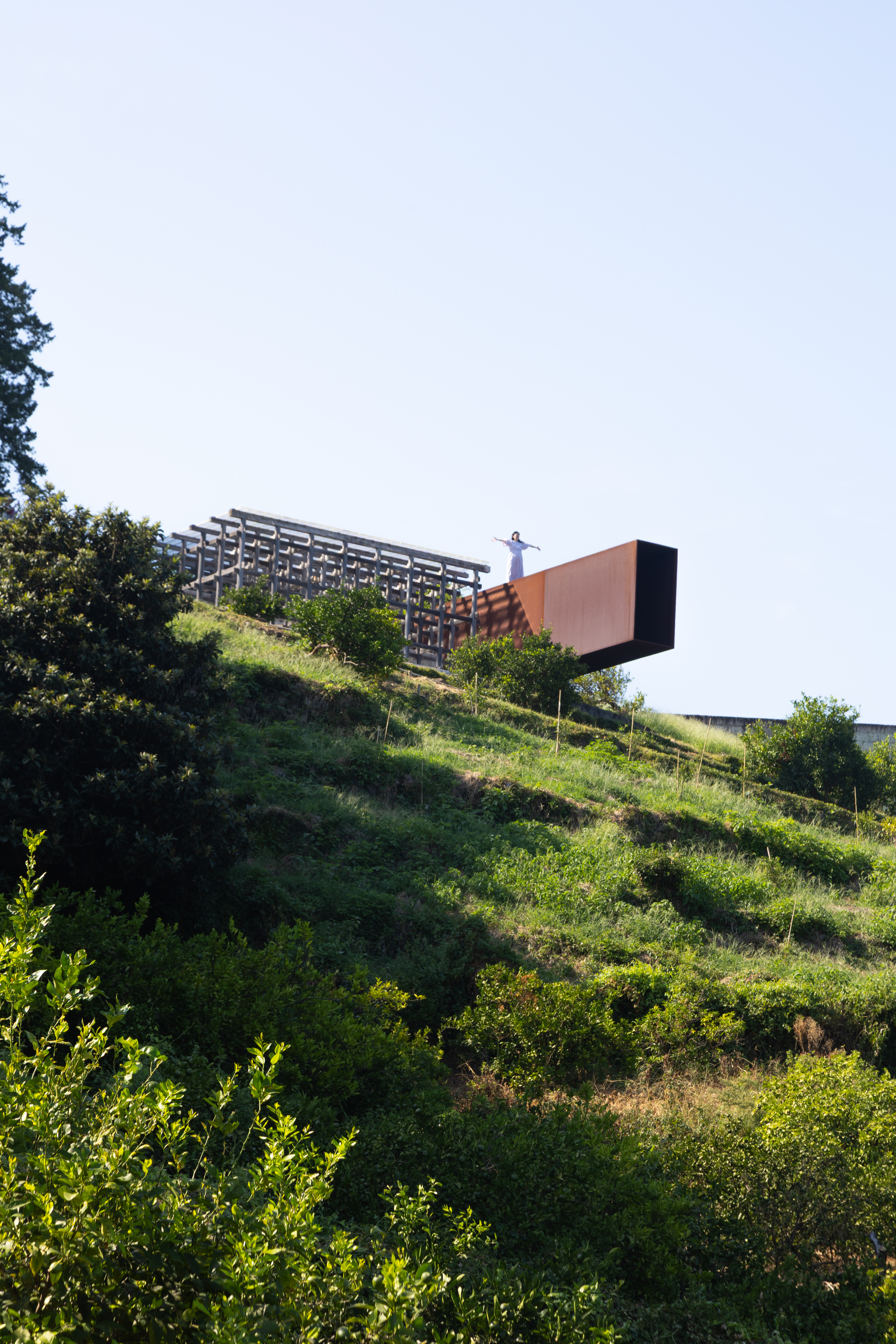
Enoura Observatory
On the morning of the summer solstice, a blade of sunlight enters one end of a 100-meter stone-and-glass gallery and takes several minutes to travel its full length, flooding the corridor in gold before spilling out over Sagami Bay. This is not an accident. Every angle, every surface, every sightline at Enoura Observatory was calibrated by photographer-turned-architect Hiroshi Sugimoto to frame humanity's oldest relationship: the one between stone, light, and time. Perched on a former mandarin orange grove above Odawara, the complex opened in 2017 after twenty years of planning, a monument designed not to resist decay but to age into beautiful ruin.
Architecture as Sundial
Enoura Observatory is, at its core, an instrument for measuring the sun. The Summer Solstice Worship Gallery stretches 100 meters along the hillside, its optical glass and rough-hewn stone walls oriented so the longest day's sunrise enters from the sea and crawls its entire length. At the opposite end of the calendar, the 70-meter Winter Solstice Tunnel, constructed entirely of metal, channels December's low-angle light through its dark passage to illuminate a large stone at the far end. Between them, the Optical Glass Stage, built from the same technical glass used in camera lenses, catches the equinox sunrise behind its cypress pillars. The stage is constructed in the kake-zukuri style, the same cantilevered technique that supports Kiyomizu-dera in Kyoto. Across 60,000 square meters of hillside, every structure serves double duty as functional architecture and astronomical alignment.
Fragments Rescued from Time
Sugimoto assembled Enoura from pieces of vanishing Japan. The Meigetsu Gate, originally built as the main gate of Meigetsuin Temple in Kamakura during the Muromachi period, had been dismantled and relocated multiple times over centuries before Sugimoto gave it a permanent home as the observatory's entrance. The Tensho-an tea ceremony room was revived using traditional methods that are in danger of being lost. Scattered along the walking paths are archaeological objects and stone installations that span millennia, each positioned to create dialogue between ancient craft and the surrounding landscape of Hakone's volcanic mountains. The mission, Sugimoto has said, is to revive traditional building methods and pass them on to future generations, even as modern Japan races forward.
The Photographer Who Became a Builder
Hiroshi Sugimoto first fell in love with this stretch of coast as a child, riding a now-defunct Tokaido rail line that ran between Odawara and the Pacific Ocean. Decades later, after becoming internationally renowned for his long-exposure photographs of seascapes and movie theaters, he returned with a different obsession. In 2008 he founded the New Material Research Laboratory; in 2009, the Odawara Art Foundation, dedicated to conveying Japanese art and culture to the widest possible audience. Working with architect Tomoyuki Sakakida, Sugimoto spent the next decade translating his photographic eye, that precise attention to horizon lines and the behavior of light, into built form. He has called Enoura the most holistic project of his career, the place where photography, architecture, performance, and garden design converge into a single statement.
Designed to Become Ruins
Most architects design against entropy. Sugimoto designed for it. He has expressed his hope that Enoura Observatory will, in the wake of civilizational collapse, devolve beautifully into ruins of stone. This is not nihilism but a deeply Japanese sensibility, rooted in the Heian-era garden principles that guided the complex's layout, where impermanence is not a flaw but the fundamental condition of beauty. The Noh stage hosts performances framed by the open sky. The strolling garden encourages slow, meditative wandering. Even the café and offices serve the foundation's broader goal of bringing awareness to ancient history. Standing on the hilltop, watching the Pacific stretch to the Boso Peninsula and Oshima Island, you sense Sugimoto's larger argument: that the oldest art form is simply paying attention to where the sun falls.
From the Air
Enoura Observatory sits at 35.188N, 139.135E on a hillside above Sagami Bay in Odawara, Kanagawa Prefecture. From the air, look for the terraced complex on the coastal hills between Hakone's volcanic peaks to the west and the bay to the east. The long glass gallery is oriented east-west and may glint in sunlight. Nearest airport is RJTT (Tokyo Haneda), approximately 75 km northeast. RJTY (Yokota Air Base) lies further north. Recommend viewing at 3,000-5,000 feet for detail of the site against the coastline. Clear mornings offer the best visibility across Sagami Bay to the Izu Peninsula.