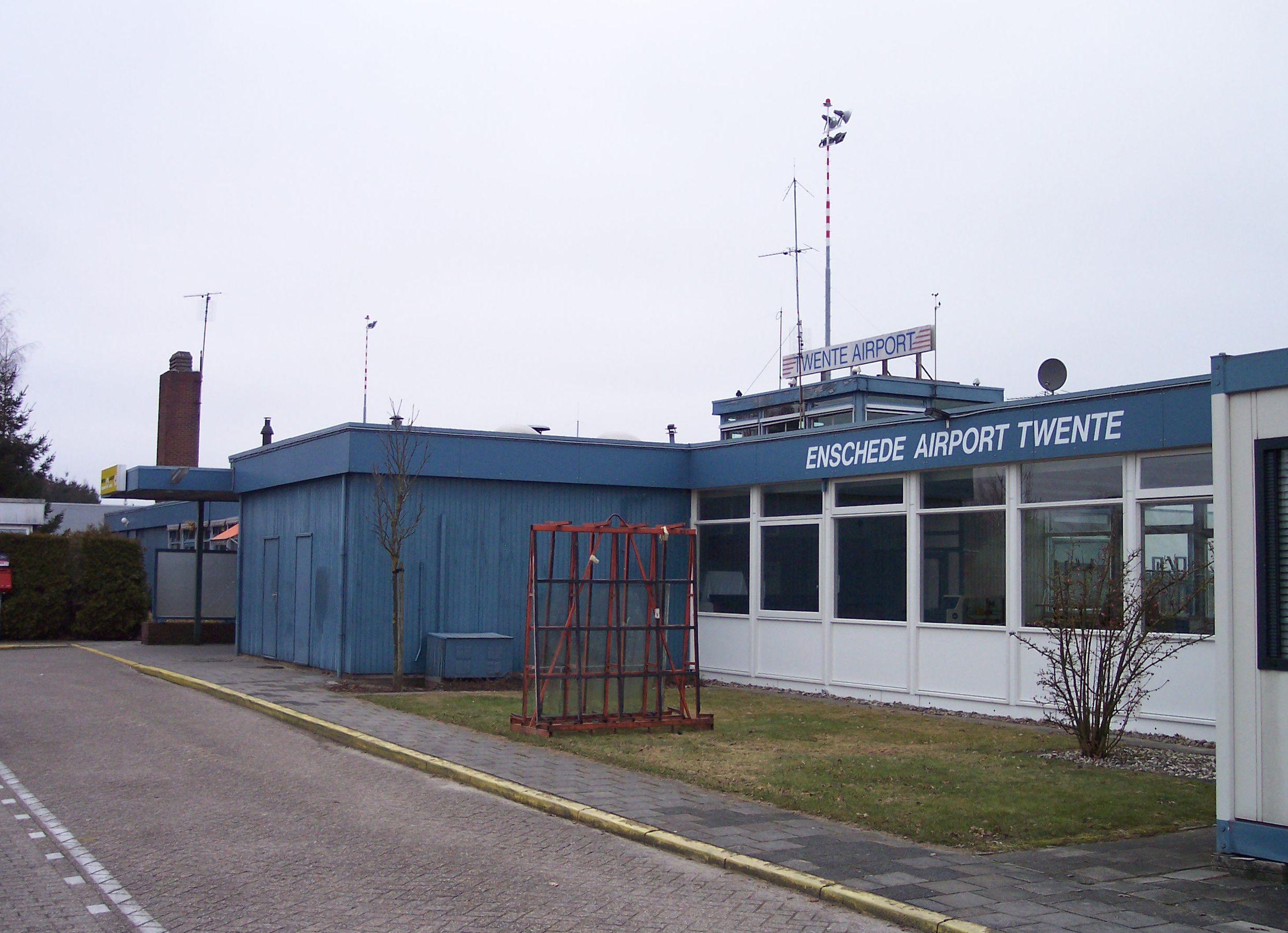
Enschede Airport Twente
An Airbus A340-300 lands at a Dutch airfield. Nobody is going anywhere. The aircraft, registered HB-JMK and once flown by Swiss International Air Lines, is here to be dismantled - to become parts, then scrap, then nothing. It was the first of many. Today Enschede Airport Twente - call sign EHTW, IATA code ENS - is one of the strangest civilian airports in Europe: a runway that retired airliners fly to in order to die. Lufthansa 747s have arrived for storage during the pandemic, then negotiated their way back out one by one. Eliud Kipchoge ran a 2:04:30 marathon on the taxiways in 2021. A local flying club still uses one corner of the field. The control tower watches over a sort of quiet, beautiful afterlife.
1931, and the Mayor Who Opened a Sky
Twente Airport opened in July 1931, with the mayor of Enschede, Edo Bergsma, doing the ceremonial honors. KLM started a scheduled service to Amsterdam in 1932, an early Dutch experiment in regional aviation that ran until 1939 when war shut it down. Then the Luftwaffe arrived. The Germans renamed the field Fliegerhorst Twente and used it as a military airbase through World War II. When Allied forces took the airport back in April 1945, the Dutch armed forces inherited it and renamed it B 106/Twente. A clerical mistake in the deed inserted an extra h - Twenthe - and that misspelling lived on for decades on official paperwork.
Cold War Iron
After the war the field became a joint civil and military airport, and for the next six decades, the noise that defined Twente was the sound of fast jets. The Gloster Meteor. The Lockheed T-33. The Hawker Hunter. The North American F-86K Sabre. The Lockheed F-104 Starfighter - the Cold War's beautiful, dangerous needle, photographs of which still circulate in Dutch aviation circles showing them lined up on the Twente ramp in the early 1960s. Then the Northrop NF-5 and finally the General Dynamics F-16 Fighting Falcon. RAF units had passed through in 1945; the Royal Netherlands Air Force stayed for fifty years. On 7 December 2007, the military closed the base. On 1 January 2008, the civilian operation closed too. The airport went silent.
Nobody Wanted It
What followed was a slow Dutch political wrangle over what to do with an empty airport. The province of Overijssel adopted a spatial plan in June 2010 that kept it as an airport. The Twente region and the city of Enschede took ownership in December that year. Three parties expressed interest in running the place commercially. None of them actually bid. By June 2014, both the province and Enschede had given up on commercial passenger flights - charter holidays to Las Palmas and Antalya and Faro were now history. In March 2013 the military briefly came back for an exercise called Cerberus Guard, which felt almost ceremonial. The terminal sat there with no one in it, its car park free of charge for visitors who arrived to see what an abandoned airport actually looks like.
The Place Where Airliners Go to Die
The second act began in 2015, when the Belgian recycling firm Aeronextlife proposed using Twente to scrap aircraft. Flights resumed on 1 May 2016 with a Cessna Citation Sovereign landing from Doncaster Sheffield. In November 2016, Aircraft End-of-Life Solutions took over the dismantling permit, and on 27 April 2017 the Swiss A340 arrived to become the first big airliner taken apart on the Twente ramp. KLM and Air France aircraft followed. Then came the pandemic. In June and July 2020, six Lufthansa Boeing 747-400s landed at Twente for storage - the kind of image that defined that strange summer. When Lufthansa later wanted to fly three of them to California for scrapping, Dutch environmental rules said the planes could land but not take off. After negotiation, a limited exemption was arranged and the jumbos left, one at a time, by July 2021. Meanwhile, on 18 April 2021, Eliud Kipchoge ran the NN Mission Marathon on the airport's surfaces, winning in 2 hours 4 minutes 30 seconds - the race had been relocated from Hamburg because of pandemic restrictions. An airport that no longer has scheduled passengers had become, briefly, the fastest road in Europe.
From the Air
Enschede Airport Twente, EHTW / ENS, sits at 52.28 degrees north, 6.89 degrees east, with a single active runway 05/23. The field is uncontrolled and closed to scheduled passenger and military operations, but business charters, scrapping arrivals, and a local flying club still use it. Two former runways - 11/29 and 16/34 - are now Platforms A and C. Field elevation is roughly 113 ft. The disused runway is one of the most distinctive features in the Twente landscape from cruising altitude. Nearby airfields include Munster Osnabruck (EDDG) 60 km east, Groningen (EHGG) 130 km northwest, and Schiphol (EHAM) 175 km west. Expect oceanic-climate weather with frequent low cloud bases.