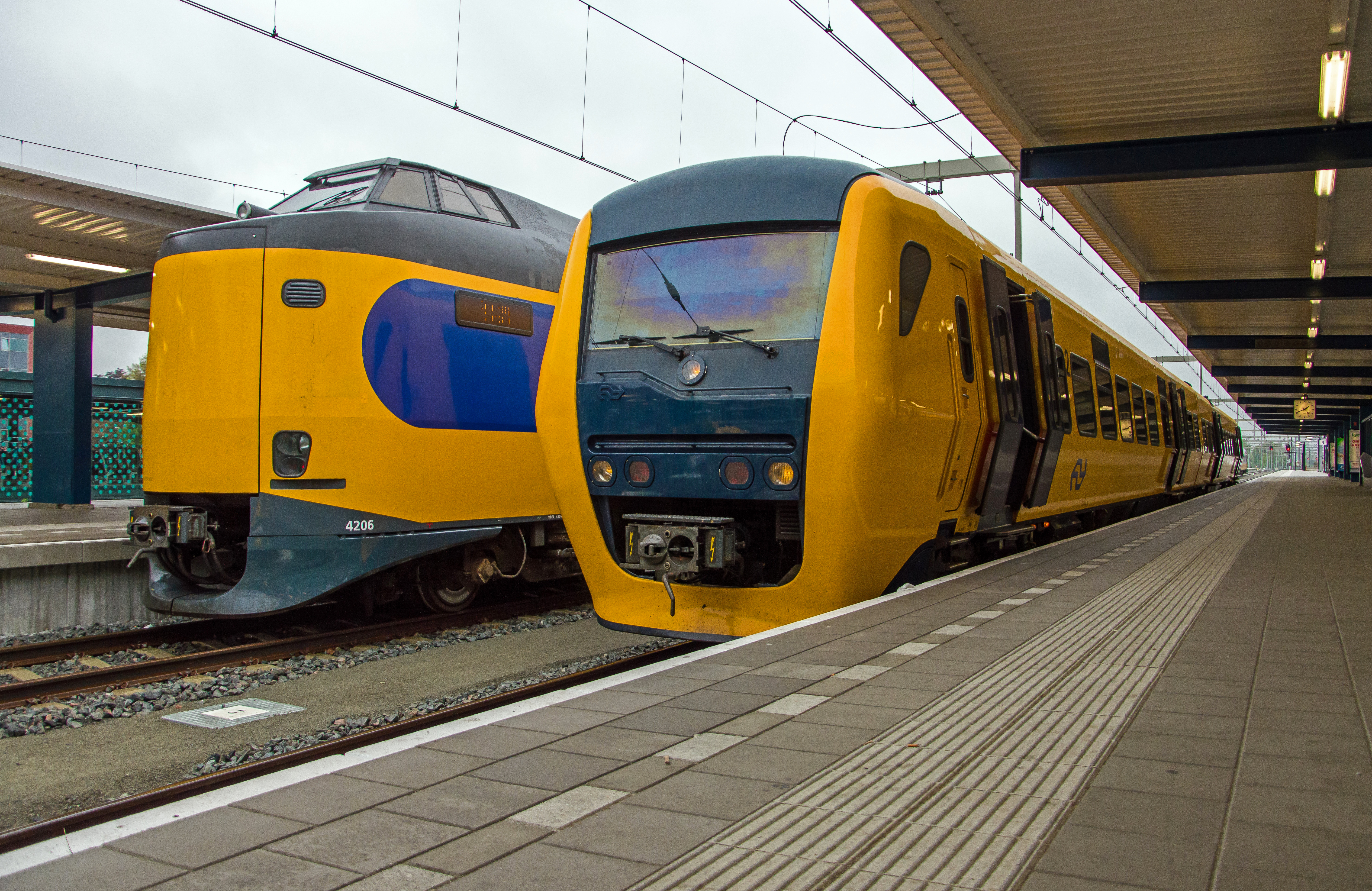
Enschede Railway Station
Thirty centimeters. That is the distance between the Dutch rails and the German rails at the eastern end of Enschede's main station - close enough to step across, far enough that no train can. The two countries' railways use different safety systems, and the official decision in May 2001 was simply to leave the gap. So Enschede is what railway people call a double terminus: a station with tracks running in from the west and tracks running in from the east, and a few decimeters of air between them that no Sprinter, no DB Regio Talent, no Intercity will ever cross. Travelers heading to Munster have to get off, walk a short distance to platform 4b, and board a different train on the other side of that small Dutch-German frontier.
1866, and a Standard Design
Enschede got its station on 1 July 1866, when the Zutphen-Glanerbeek railway reached the eastern edge of the Netherlands. The first building was a standard Staatsspoor third-class design - the same template used at Meppel, Zuidbroek, and at Hengelo until 1899. There was nothing remarkable about it architecturally. What was remarkable was where it ended. From Enschede the line ran on across the border to Germany, into Westphalia, threading the textile towns of Twente into the wider European rail network at the very moment Dutch industrial growth was accelerating. The station made Enschede possible as an industrial city. Trains brought cotton in; trains took cloth out.
Schelling's Postwar Hall
The current station building dates from 1950, designed by the Dutch architect H.G.J. Schelling, who lived from 1888 to 1978 and gave a number of Dutch cities the modernist station halls that defined postwar rail travel. Schelling worked the brief unusually: he designed Enschede as both a through station and a terminus, hedging the building's future. That hedge mattered. The German Deutsche Bahn cut its through service from Gronau to Enschede in 1981, and the station became a Dutch dead end. Twenty years passed before German trains came back.
The Border That Comes Back
On 18 November 2001, DB Regio reopened service to Gronau and onward to Munster and Dortmund. The German trains came in on a newly built platform 5, set apart on the north side, connected to the rest of the station only by a level crossing. When the station was rebuilt in 2013, the German services were folded back into the main complex on a split platform - 4a for the Sprinters, 4b for the trains to Germany. But the tracks themselves still do not connect. Train safety systems do not match. The two networks pull right up to each other and stop. To stand on that platform is to stand at one of the small, persistent seams of European integration - a place where the customs union is total, the labor mobility is total, and yet the steel rails refuse to touch.
Bus Lines and a City Beyond
Out front, the station square spills into Enschede's bus network, where the red Twents livery marks routes that fan out across the eastern Overijssel. Line 1 runs to the University of Twente through Boswinkel; line 2 goes to Roombeek, the neighborhood that the 2000 fireworks disaster reshaped and architects rebuilt; line 8 loops out to Hengelo and back through the city center. Long-distance buses head to Oldenzaal and Haaksbergen and through the Achterhoek to Winterswijk. The station, in other words, is more than a railway endpoint. It is the seam where the Dutch railway meets the German railway, where the city meets the region, and where the urban grid meets the green Twente countryside that begins just a few kilometers out.
From the Air
Located at 52.22 degrees north, 6.89 degrees east, in the city center of Enschede, about 5 minutes from the German border. From cruising altitude, the station is identifiable as a clear east-west rail line cutting through central Enschede, with the city's grid radiating around it. The nearest airport is Munster Osnabruck (EDDG), 60 km east. Enschede Airport Twente (EHTW) lies 8 km north. Schiphol (EHAM) is about 175 km west via the A1 and rail corridor. The station is a key stop on the Amsterdam-Berlin rail axis via Hengelo. Oceanic climate, frequent low stratus in winter months.