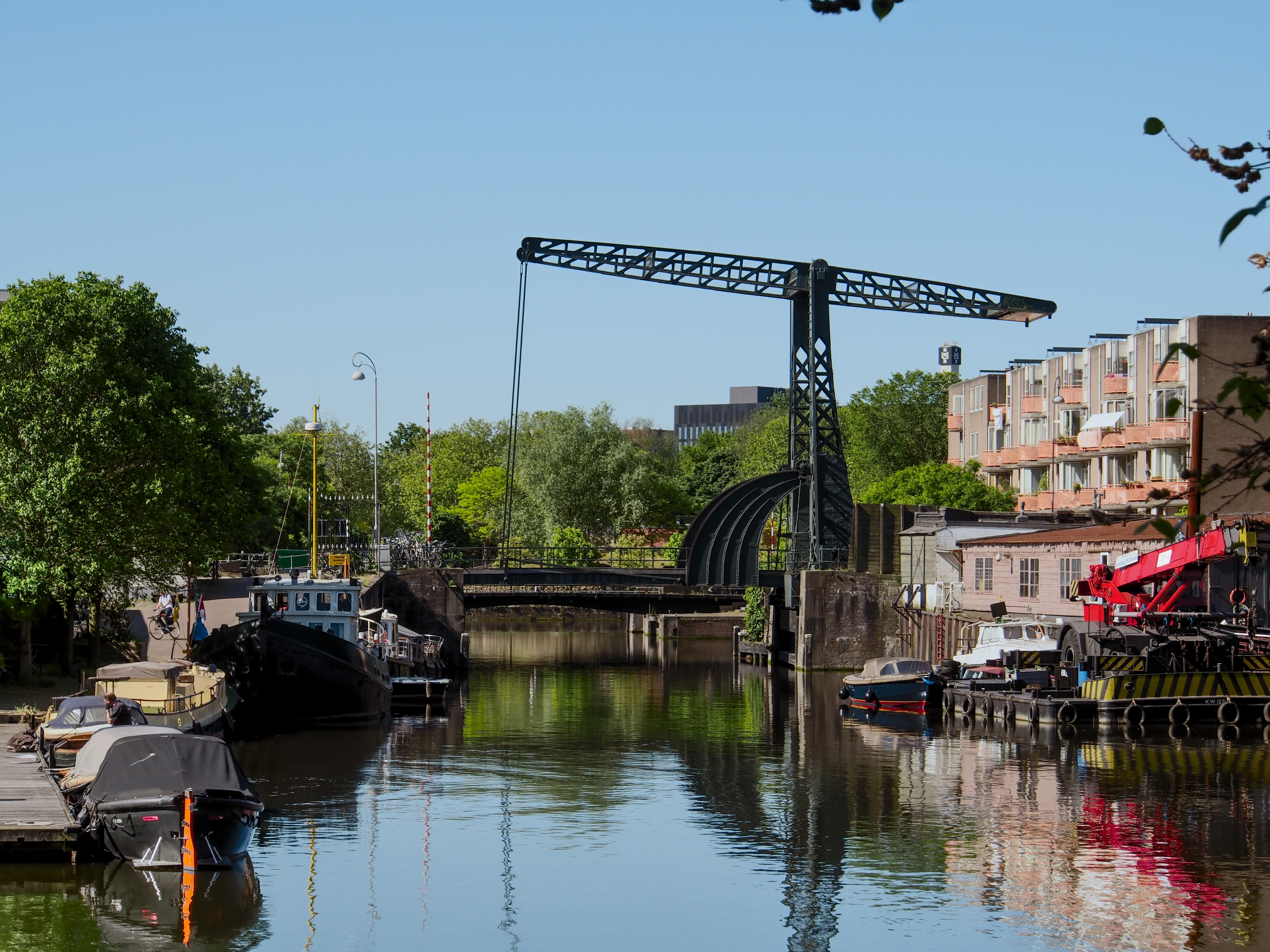
Entrepotdoksluis
Bridge no. 80 in the Amsterdam municipal registry is not the kind of structure that ends up on postcards. It is 13.44 meters wide, 3.02 meters of clearance, riveted steel painted dark, with decorative ironwork on the railings that looks almost too pretty for what is, fundamentally, a piece of nineteenth-century mechanical engineering. It sits at the Hoogte Kadijk, where it has tilted up and down for passing boats since 1903. Most pedestrians cross it without noticing. The hint that something is special is in the railings: ornate cast iron where most working bridges have plain bars. The Entrepotdoksluis bridge is the kind of monument that hides in plain sight in a city full of more obvious ones.
A Lock With a Purpose
The lock under the bridge predates the bridge by more than half a century. The current Entrepotdoksluis lock opened in 1840, connecting the Entrepotdok to the Nieuwe Vaart. The name gives it away: an entrepot is a warehouse where imported goods sit, untaxed, until their owners pay the customs duties. The Entrepotdok itself was an inland port built in 1827 along the eastern edge of central Amsterdam, a strip of warehouses where coffee, spices, sugar, and tobacco waited in bonded storage. To move that cargo in and out, you needed a lock that could keep ship-traffic water levels stable. The first bridge across the lock was a double wooden drawbridge, the kind you still see in old photographs of Dutch port towns. By the turn of the twentieth century, it was wearing out.
The Engineer's First Try
Around 1902 the municipality decided to replace the wood with iron and steel. The first tender went out in September of that year, calling for sixteen cubic meters of granite. The bridge was built in 1903 by Werkspoor, an Amsterdam engineering firm based on the Oostenburg island just to the north. The designer was Arend de Graaf of the Public Works Department, and bridge 80 represents what Smit van Wichert called "his first generation of drawbridges." That is a polite way of saying De Graaf had not yet figured out how to make them beautiful. Most of his early designs were eventually scrapped because they looked, in the words of one historian, "somewhat crude." Bridge 80 survived. The decorative ironwork in the balustrades is the giveaway that someone in 1903 was already trying to make the working machine into something more.
How a Bascule Bridge Thinks
The mechanism is a quadrant balance - a bascule, French for see-saw - with a counterweight on the short side and a long deck on the other. Pull on the lifting cables, the counterweight drops, the deck rises. On bridge 80 the moving parts are closed inside the iron housing rather than left exposed, which is unusual for De Graaf's later work; he opened them up in subsequent designs. The frame and the balance are riveted steel with half-timbering, the deck still partially wooden. In 1911 the controls were electrified, with a drive supplied by Gebr. Figee of Haarlem. Some repair work happened in 1936. Otherwise the bridge has done its job, day after day, for more than a hundred and twenty years. Recent control changes mean the bridge now requires lubrication only once a quarter, down from ten times a month - a 1903 machine getting more efficient in the twenty-first century.
The District Around It
The neighborhood has changed almost completely. The Entrepotdok warehouses no longer hold coffee and tobacco; they were converted to apartments in the 1980s in one of the better-loved adaptive reuse projects in central Amsterdam. The Plantage district just to the south, once a botanical-garden suburb for wealthy Amsterdammers, is now leafy and quietly fashionable, full of cafes, the zoo, and the resistance museum. Bridge 80 became a national rijksmonument in 2001, which means no one can quietly demolish it the way nineteenth-century infrastructure gets demolished. Stand on it in late afternoon when the light is low, look down the Nieuwe Vaart toward the IJ, and the whole shape of how Amsterdam fed itself for centuries - water, locks, warehouses, customs - is still right there underfoot.
From the Air
Bridge 80 sits at 52.368 N, 4.919 E on Amsterdam's eastern canal ring, along the Hoogte Kadijk between the Entrepotdok warehouses and the Nieuwe Vaart. From the air, look for the long parallel line of Entrepotdok warehouses and the lock structure breaking the water below the kadijk. Nearest airport: Amsterdam Schiphol (EHAM), 14 km southwest. Best viewed at 1,500-3,000 feet in clear conditions.