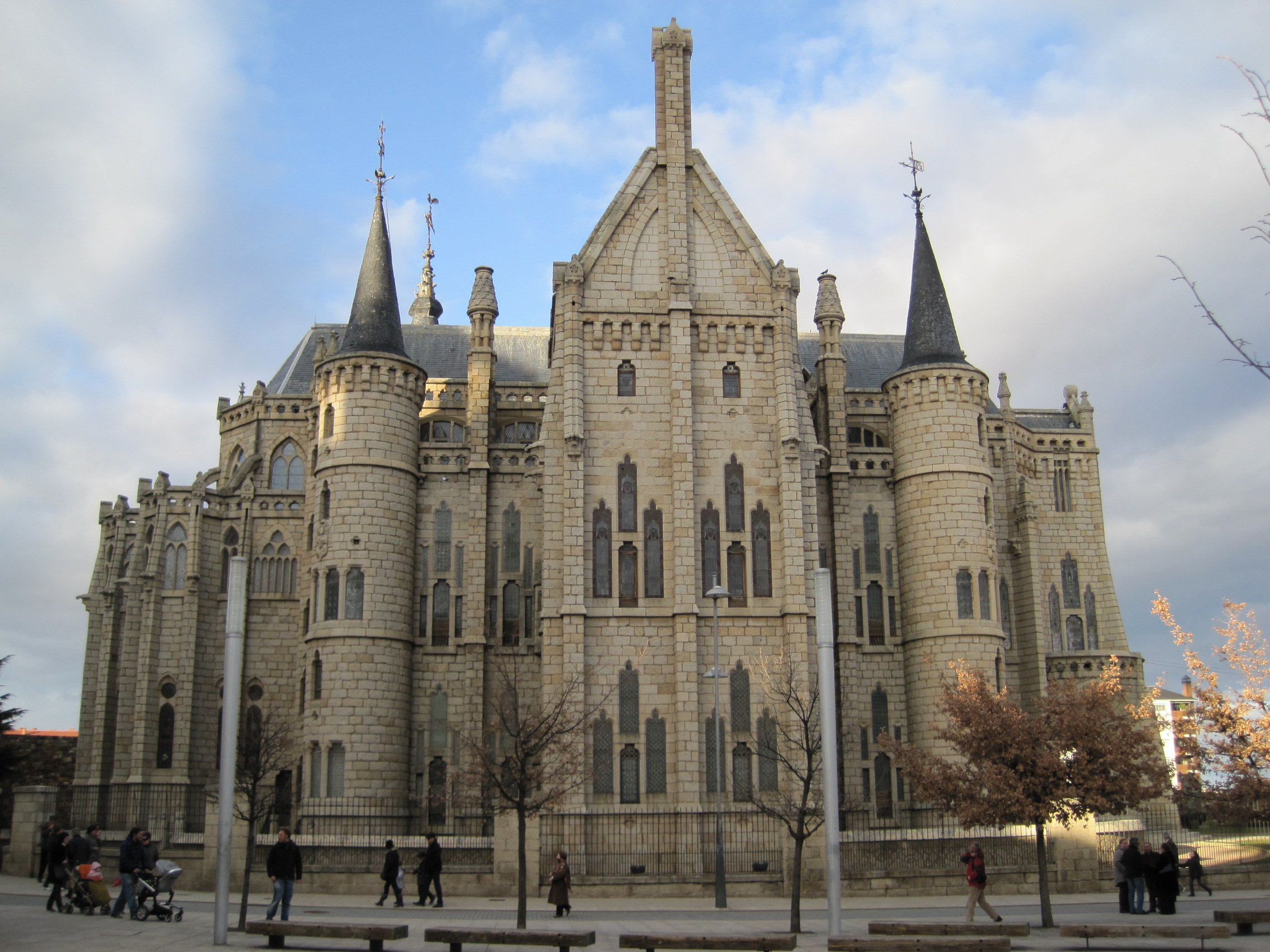
Episcopal Palace, Astorga
Antoni Gaudi designed the Episcopal Palace of Astorga from photographs. He was busy in Barcelona, deep into the construction of the Palau Guell, and could not travel to this small city in Leon province to study the terrain in person. So he asked his friend, Bishop Juan Bautista Grau y Vallespinos, to send pictures. From those images, Gaudi conceived a building unlike anything Astorga had seen: a neo-medieval fantasy in gray granite, bristling with cylindrical towers and surrounded by a ditch, as if a castle from a Catalan folktale had materialized beside the city's medieval cathedral. It is one of only three buildings Gaudi ever designed outside Catalonia, and the story of its construction is almost as improbable as its appearance.
A Friendship and a Fire
The commission was born from personal connection. Grau and Gaudi had become friends when the bishop served as Vicar-General in the Archdiocese of Tarragona, where he had inaugurated a church featuring Gaudi's altar design. When fire destroyed the original Episcopal Palace in Astorga, Grau turned to the architect he trusted most. Gaudi sent his plans, and they were approved in February 1889. The first stone was laid in June 1889. From the start, the project was unusual: a Catalan Modernisme building rising not in Barcelona's Eixample district but in a conservative Castilian city on the Camino de Santiago, 600 kilometers from the architect's home turf. The gray granite came from El Bierzo, the mountainous region to the west, and Gaudi chose it deliberately to harmonize with the neighboring cathedral and the surrounding landscape.
A Palace of Towers and Moats
The building Gaudi designed looks like a fortified church dreamed up by someone who had studied Gothic castles and then decided the rules were optional. Four cylindrical towers anchor the corners, rising above a facade that combines pointed arches, heavy buttresses, and chimneys integrated into the side walls in ways that anticipate his later, more radical work. A ditch surrounds the structure, giving it the feel of a small fortress rather than an ecclesiastical residence. Gaudi had planned a five-meter-tall angel to crown the main facade, but it was never mounted. The entrance arches lean forward with a structural dynamism characteristic of his style, transferring loads through buttresses in a way that was technically innovative for the period. Inside, the spaces were designed for both the bishop's residential needs and the ceremonial functions of his office.
The Architect Walks Away
In 1893, Bishop Grau died. With his patron gone, Gaudi found himself answering to a diocesan council that did not share Grau's enthusiasm for the project or the architect's vision. Disagreements mounted over design decisions and costs, and Gaudi -- never one to compromise his artistic principles -- resigned. Construction halted. The palace sat unfinished for more than a decade, its towers rising above empty floors, a monument to ambition interrupted. It was not until 1907 that the architect Ricardo Garcia Guereta took over, completing the building by 1915 in a style that respected Gaudi's design without replicating his genius. The result is a palace that speaks in two architectural voices -- Gaudi's in the bones and Garcia Guereta's in the skin.
From Falange Headquarters to Museum
The palace's later history reflects the upheavals of 20th-century Spain. During the Spanish Civil War, the building served as the local headquarters of the Falange, Franco's political movement, its neo-medieval grandeur repurposed for authoritarian politics. After the war, it stood underused until 1956, when a Catalan restorer named Julia Castelltort began adapting it as a bishop's residence. The building eventually found a more fitting purpose: Bishop Marcelo Gonzalez Martin championed its conversion into the Museo de los Caminos, a museum of religious art dedicated to the Way of Santiago. Today, pilgrims walking the Camino Frances pass through Astorga and encounter Gaudi's gray granite towers beside the cathedral -- a juxtaposition of medieval tradition and modern creativity that captures the layered history of the route itself.
From the Air
Located at 42.46N, 6.06W in the city of Astorga, Leon province, northwestern Spain. The palace stands adjacent to Astorga Cathedral on a hill visible from moderate altitude. The neo-medieval towers and gray granite give it a distinctive silhouette. Nearest major airport: LELN (Leon Airport, ~45 km east). Astorga sits along the Camino de Santiago pilgrimage route, visible as a small walled city on the edge of the meseta before the terrain drops westward into El Bierzo.