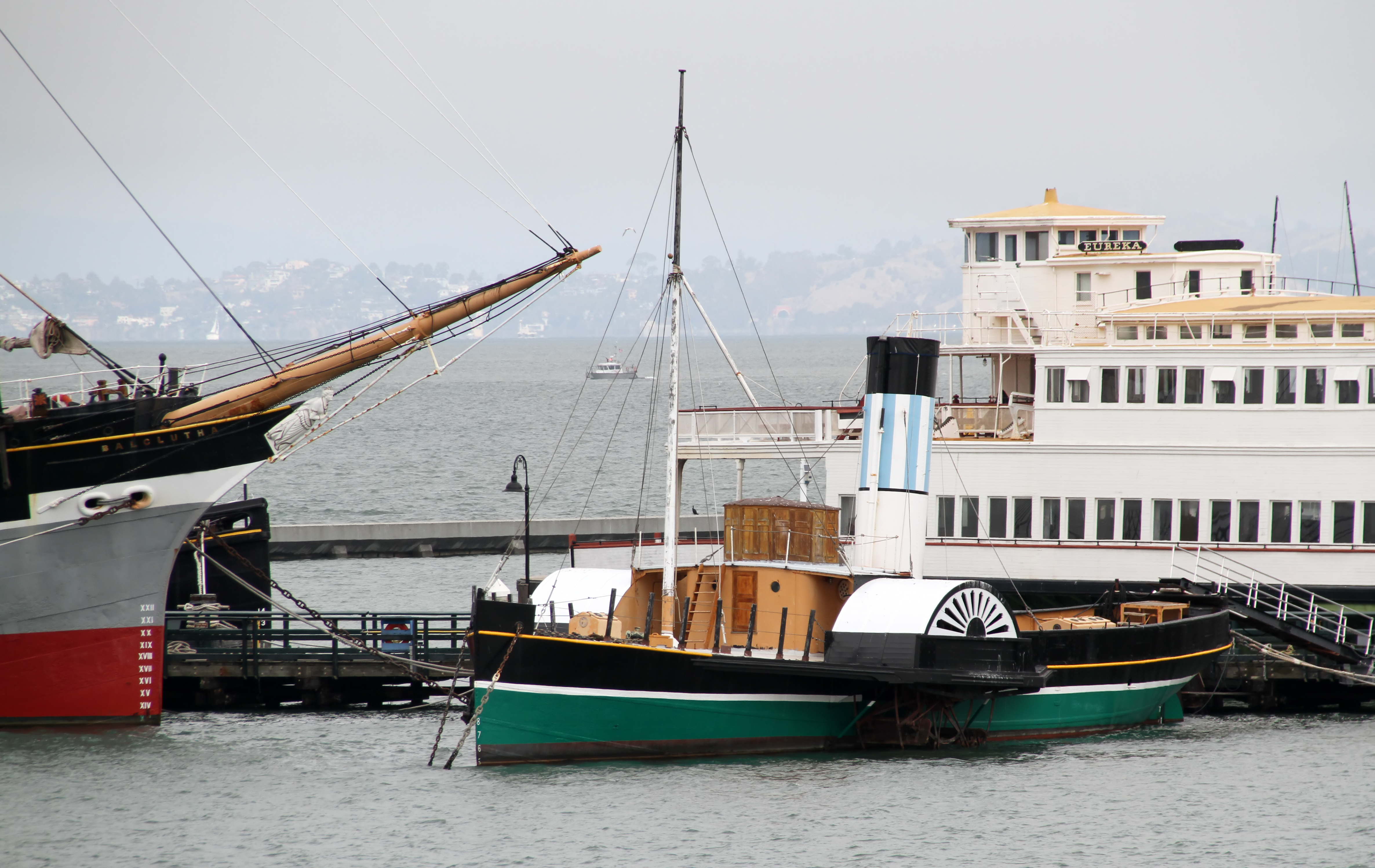
Eppleton Hall
The acquisition of Eppleton Hall reads less like museum curation and more like a heist that went sideways. When San Francisco Maritime Museum trustee Scott Newhall tried to negotiate with London's National Maritime Museum for a Victorian paddle tug called Reliant, six months of deliberations collapsed in what Newhall described as communications that were "fatuous, uncooperative or downright insulting." He then attempted to collect the Reliant by subterfuge, leading a team to the English port of Seaham while pretending to be representatives of the British museum. The police were called. The day after that failure, Newhall bought the derelict Eppleton Hall instead.
Built for Coal Country
Eppleton Hall was built in 1914 by Hepple and Company of South Shields for the Lambton and Hetton Collieries Ltd. She was designed to tow seagoing colliers -- the ships that carried coal from mine to market -- from open water to wharfside and back, primarily on the River Wear in northeastern England. Her twin paddle wheels, driven by side-lever engines of a type dating back to the earliest days of steam, gave her the maneuverability that screw-propelled tugs lacked in the tight confines of the river. The collieries merged with Joicey Collieries in 1924, and when Britain's coal industry was nationalized after World War II, the towage business was sold to France, Fenwick Tyne and Wear Ltd, which refurbished the tug and operated her at Sunderland until 1964.
The Transatlantic Acquisition
By the time Newhall found her, Eppleton Hall was in a partially scrapped condition -- derelict, but with her essential machinery intact. He purchased her from H.W. Clayton of Clayton and Davey with the intention of restoring her for the voyage to San Francisco. The restoration was ambitious: a vessel built for the sheltered waters of the River Wear would need to survive an ocean crossing. The effort succeeded, and the tug made it to California, where maritime historian Karl Kortum donated her to the National Park Service in 1979. She was berthed at Hyde Street Pier, joining the fleet of historic vessels at the San Francisco Maritime National Historical Park.
Last of Her Kind
Eppleton Hall is the only remaining intact example of a Tyne-built paddle tug, and one of just two surviving British-built paddle tugs in the world. She has been restored to resemble her post-war 1946 condition, when France Fenwick refurbished her for continued service. Because she was built in England, she is ineligible for grants reserved for U.S.-built vessels, making her maintenance a perpetual challenge. She is visible from Hyde Street Pier but is not open to the public for boarding. Her sister vessel's fate provides a sobering contrast: Reliant -- the tug that Newhall originally wanted -- was eventually sectioned by the National Maritime Museum for display in Neptune Hall, where it remained until 2005 before being controversially scrapped as a cost-cutting measure.
A Pier Full of Ghosts
Moored at Hyde Street Pier alongside the Eureka, the Balclutha, and other historic vessels, Eppleton Hall occupies a particular niche in San Francisco's maritime collection. She represents not the grand passenger liners or clipper ships that most people associate with the age of sail and steam, but the workhorses -- the tugs that made commercial shipping possible by hauling loaded coal ships through tidal rivers barely wide enough for them. Her paddle wheels, her side-lever engines, her low profile designed for river work rather than open ocean -- everything about her speaks to a vanished industrial landscape of collieries, wharves, and river pilots. That she ended up in San Francisco at all, after a failed negotiation, a foiled subterfuge, and a last-minute purchase of a derelict hull, only makes her preservation more improbable.
From the Air
Eppleton Hall is moored at Hyde Street Pier at 37.8094N, 122.4219W in San Francisco's Fisherman's Wharf area. The pier and its collection of historic ships are visible from the air as vessels clustered at the western end of the waterfront. Best viewed from 1,500-2,500 feet AGL. Nearby airports: KSFO (San Francisco International, 11nm S), KOAK (Oakland International, 8nm E).