Erasmus MC
There is one piece of the original hospital left. It is called the Coolsingelpoort - the Coolsingel Gate - and it stands almost alone now on the Lijnbaan, an iron-gated remnant of the eighty-two-meter facade that used to occupy the corner of Van Oldenbarneveltstraat and the Coolsingel. The rest of the Coolsingelziekenhuis - completed in 1851, designed by city architect Willem Nicolaas Rose, where Dr. Jan Bastiaan Molewater taught medical students from 1828 - was destroyed by the Luftwaffe on May 14, 1940, in the bombing that erased the heart of Rotterdam. Modern Erasmus MC is the descendant of that vanished hospital. It is now the largest university medical center in the Netherlands and one of the highest-ranked clinical institutions in the world.
Three Buildings, One Hospital
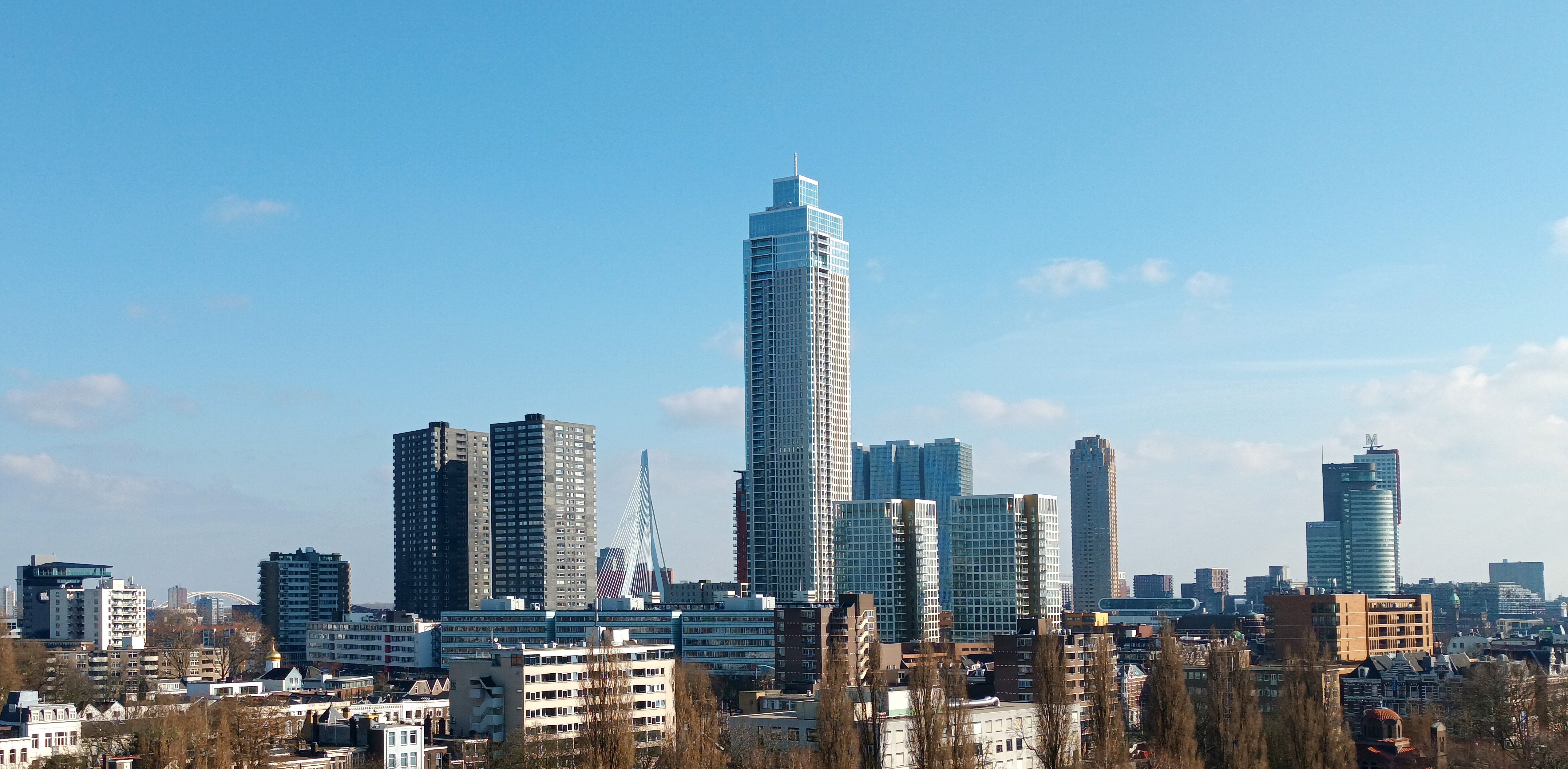
Today the complex sits on the Wytemaweg next to the Museumpark in central Rotterdam, comprising three connected institutions. The main Erasmus MC building handles general clinical work and houses the faculty of medicine. The Sophia Children's Hospital - linked to the main building by a raised glass walkway - specializes in pediatric medicine and trauma. The Erasmus MC Cancer Institute, the former Daniel den Hoed Clinic, handles oncology. The hospital runs neurosurgery, cardiothoracic surgery, neonatal and pediatric intensive care, pediatric oncology, a Level I trauma center with its own helicopter, and the Department of Viroscience that would become globally important in 2020. Times Higher Education ranks Erasmus MC the top European institution in clinical medicine and twentieth in the world.
From Coolsingel to Dijkzigt
After the 1940 bombing, Rotterdam's main hospital spent two decades in temporary arrangements before the new Dijkzigt Hospital opened in 1961 on the present site - named after Villa Dijkzigt on the Land van Hoboken estate, which the shipowning Van Hoboken family sold to the city in 1924. In 1965 the Dutch government designated Rotterdam as one of seven major medical training centers, and in 1966 the new Medical Faculty Rotterdam opened with 160 students. The Dijkzigt Hospital became its teaching hospital. In 1970 it merged with the Sophia Children's Hospital to form the Academisch Ziekenhuis Rotterdam. In 1973 the whole operation became part of Erasmus University. In 1993 the Daniel den Hoed cancer clinic joined - named for the founder of Dutch radiotherapy. On June 1, 2002, all four institutions formally merged into the current Erasmus MC.
The Tower and the Glass Wing
What now sits on the Wytemaweg is one of the largest hospital construction projects in Dutch history. Erasmus MC broke ground on a major rebuild in May 2009. The eastern half opened in 2013; the western half came online in 2018, with a new main entrance directly above Dijkzigt metro station. The old Dijkzigt Hospital - the 1961 building that had served the city for half a century - was demolished afterward to make room for further work. The new complex was sized to handle 525,000 patient visits a year. Inside it are some of the most ambitious clinical operations in Europe: forensic molecular biology collaborating with the Dutch National Forensic Institute, the long-running Generation R study tracking thousands of Rotterdam children from birth, and the ERGO study following elderly residents of Ommoord for decades to map how diseases unfold across a lifetime.
Viroscience
When SARS-CoV-2 began circulating in early 2020, Erasmus MC's Department of Viroscience was already among the world's leading virology labs. It was designated by the Dutch government as one of two national expertise laboratories running corona tests, partnered with the National Institute for Public Health and the Environment (RIVM) in Bilthoven. The hospital became the National Coordination Center for Patient Spreading, the agency that decided where intensive care patients went when local ICUs ran out of beds. In collaboration with Utrecht University, Erasmus MC researchers developed one of the first human monoclonal antibodies shown to block SARS-CoV-2 infection. None of this was accidental. The hospital had been preparing for exactly this kind of event since the SARS outbreak of 2003 and the H5N1 scares of the following decade.
September 28, 2023
On the afternoon of September 28, 2023, a 32-year-old medical student drove to a residential building in the Delfshaven neighborhood, where he killed a 39-year-old woman and fatally wounded her 14-year-old daughter, then set fire to the apartment. He then went to a classroom at Erasmus MC, where he shot and killed a 43-year-old lecturer and general practitioner, before being arrested. The hospital that had survived the Luftwaffe, that had grown up around the rubble of its predecessor and built itself into one of the world's most respected medical institutions, was now the scene of a multiple homicide. The lecturer killed had taught medical students. The family killed lived in a neighborhood the hospital had served for generations. Erasmus MC mourned its dead in public ceremonies, then went back to caring for the city that gathered around it.
From the Air
Erasmus MC sits at approximately 51.91°N, 4.47°E in central Rotterdam, on the Wytemaweg next to the Museumpark and just north of the Maas river. From the air the complex reads as a cluster of glass-and-steel high-rise medical buildings southwest of the Coolsingel and east of the Erasmusbrug suspension bridge - the white pylon of the bridge is the easiest landmark from altitude. Closest airport is Rotterdam The Hague (EHRD), about 6 km north; Schiphol (EHAM) is roughly 55 km north-northeast. Cruising altitude 2,000-4,000 feet works well; expect EHRD CTR boundaries and high heliport activity around the hospital itself - the trauma helicopter operates on the roof, and the hospital's helipad is one of the busiest in the Netherlands. The Erasmus MC tower is one of the taller structures in the southern half of Rotterdam's skyline.