Erasmus University Rotterdam
On November 8, 1913, in a city that had grown rich on shipping and trade, a group of Rotterdam merchants put their money behind something universities of the time mostly refused to teach: commerce. The result was the Nederlandsche Handels-Hoogeschool - the Netherlands School of Commerce - and it was, in its founding moment, both an upstart and a statement. The country's older universities at Leiden and Groningen taught law, theology, medicine, classics. They did not teach business. The Rotterdam business community decided that if the universities would not train its sons in the discipline of trade, the city would build its own. The school that opened that November would, sixty years later, change its name to honor Rotterdam's most famous native son: Desiderius Erasmus.
The Man on the Letterhead
Desiderius Erasmus Roterodamus - the Latin name he adopted - was born in Rotterdam, probably in October 1466, the illegitimate son of a priest. He became the most widely read humanist scholar in Renaissance Europe, the editor of the first Greek New Testament published in print, the satirist of In Praise of Folly, the correspondent of nearly every important mind of his age. He died in Basel in 1536 and his works were both celebrated and condemned across the Reformation, sometimes by the same people. When Rotterdam's school of commerce and its medical faculty finally merged in 1973 to form a full university, naming it after Erasmus was a particular kind of claim: this place is for free inquiry across all the disciplines, not just trade and not just medicine. It also made Erasmus University Rotterdam the first university in the Netherlands ever named after a person.
From Commerce to Economics to Tinbergen
The Netherlands School of Commerce was upgraded to full higher education status in 1937 and renamed the Netherlands School of Economics - the NEH. The change reflected what was happening intellectually: a Rotterdam economist named Jan Tinbergen was building one of the first quantitative models of a national economy, treating macroeconomic forecasting as a problem solvable with statistics and differential equations. Tinbergen would, in 1969, share the very first Nobel Memorial Prize in Economic Sciences ever awarded - the inaugural laureate, ever, of his entire field. He and his colleague Henri Theil founded the Econometric Institute, which is still in operation. The Tinbergen Institute, jointly run with the University of Amsterdam and the VU University, became one of the world's top graduate schools in economics and finance. Rotterdam's commercial origins had paid off in mathematical rigor.
The Modern Rankings
Erasmus University now ranks among the world's elite institutions for what it was founded to teach. Times Higher Education ranked the university first in the Netherlands, seventh in Europe, and twenty-eighth in the world for Economics and Business in 2020. The Rotterdam School of Management routinely appears in the Financial Times European top ten, and its CEMS Master's in International Management was ranked third in the world in 2022. RSM holds the triple accreditation - AMBA, EQUIS, AACSB - achieved by only about a hundred business schools globally. The Erasmus School of Economics ranked ninth in Europe and fiftieth in the world for economics and econometrics by QS in 2018. The university has campuses at five locations - four in Rotterdam, one in The Hague - and the medical center attached to it is one of the largest in Europe.
Generation R and the Long Studies
Some of the most important work happens slowly, over decades. The Generation R study, run out of Erasmus MC and Erasmus University since 2002, has followed thousands of children born in Rotterdam from before birth into adulthood, mapping how environment and genetics interact to shape human development. The companion study, ERGO (Erasmus Rotterdam Gezondheid Onderzoek), has tracked elderly residents of the Ommoord neighborhood for decades, producing some of the most cited longitudinal data in the world on how diseases unfold across a lifetime. Together they constitute one of the great natural experiments in modern epidemiology - patient, methodical, the opposite of viral. The work would be impossible without a university willing to fund research that pays off in twenty years rather than two.
Protests on Woudestein
Like most European universities, EUR has spent the recent past being argued with - by climate activists demanding the university sever financial ties with fossil fuel companies, by students staging tent encampments in support of Palestinian causes, by faculty debating where free expression ends and harm begins. Campus occupations in 2022 and 2023 were broken up by riot police, controversially. In May and June 2025, pro-Palestinian students set up a tent encampment on Woudestein, the main campus near Rotterdam-Kralingen, which lasted until threatened police intervention. The same fall, the Executive Board condemned a planned demonstration against a professor who had made anti-Palestinian social media posts, citing safety while saying the university offers space for differences of opinion. The arguments are not new. Erasmus himself spent much of his life arguing about how much religious opinion a society could tolerate before tearing itself apart - and how much it must, in order to remain a society at all.
From the Air
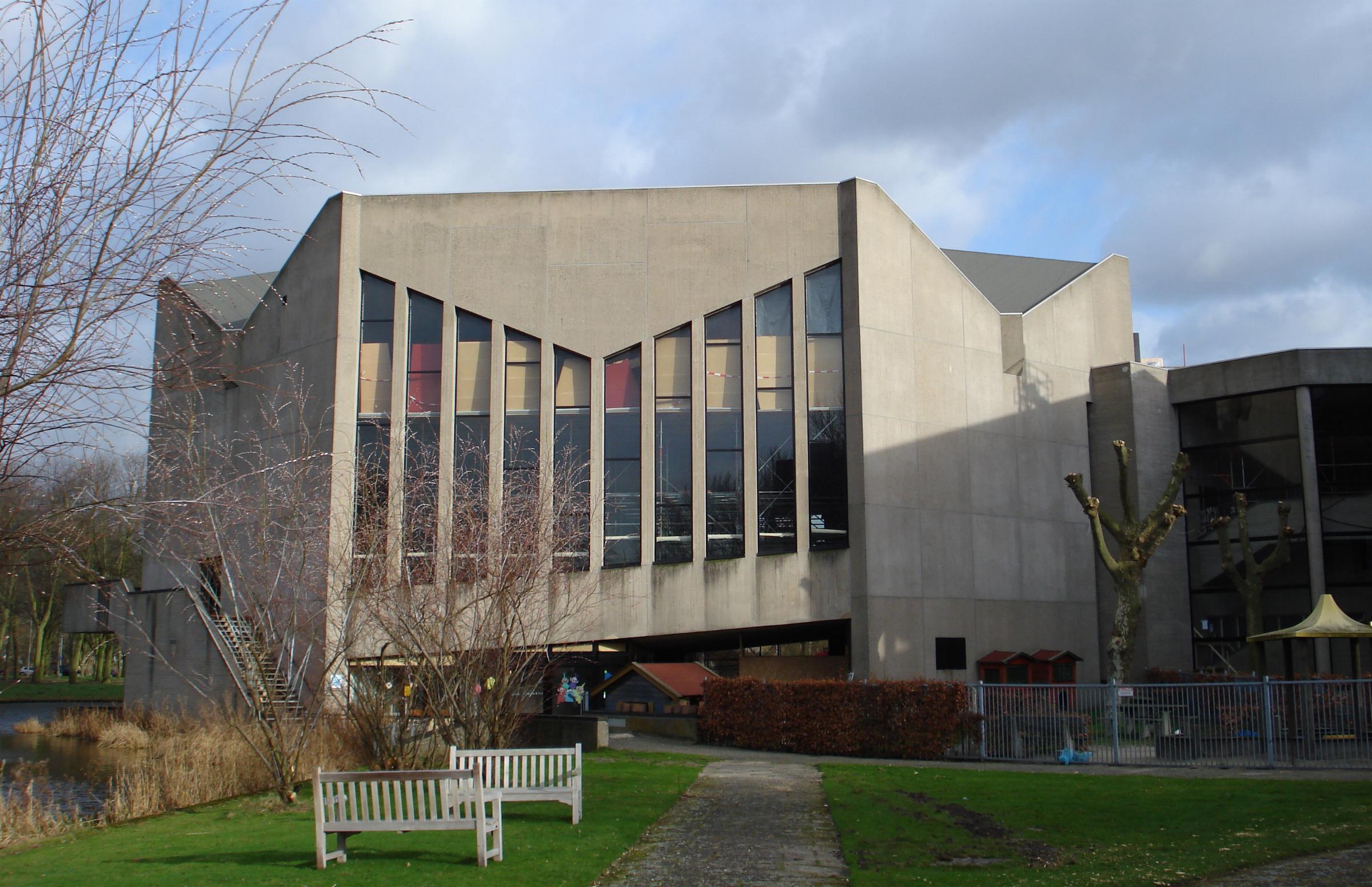
The main Woudestein campus sits at approximately 51.92°N, 4.52°E in eastern Rotterdam, near the Kralingen district and just south of the Kralingse Plas lake. The Hoboken campus housing Erasmus MC is about 4 km west at 51.91°N, 4.47°E, with separate campuses for EUC near downtown, ECE near Delfshaven, and the International Institute of Social Studies in The Hague. Closest airport is Rotterdam The Hague (EHRD), about 8 km northwest of Woudestein; Schiphol (EHAM) is roughly 55 km north. From the air the main campus is recognizable as a cluster of modernist academic buildings around an artificial lake, with the distinctive Erasmus Pavilion and the new education building visible from altitude. Cruise at 3,000-5,000 feet for the best survey of all five campuses; Kralingse Plas to the north is an unmistakable navigation landmark.