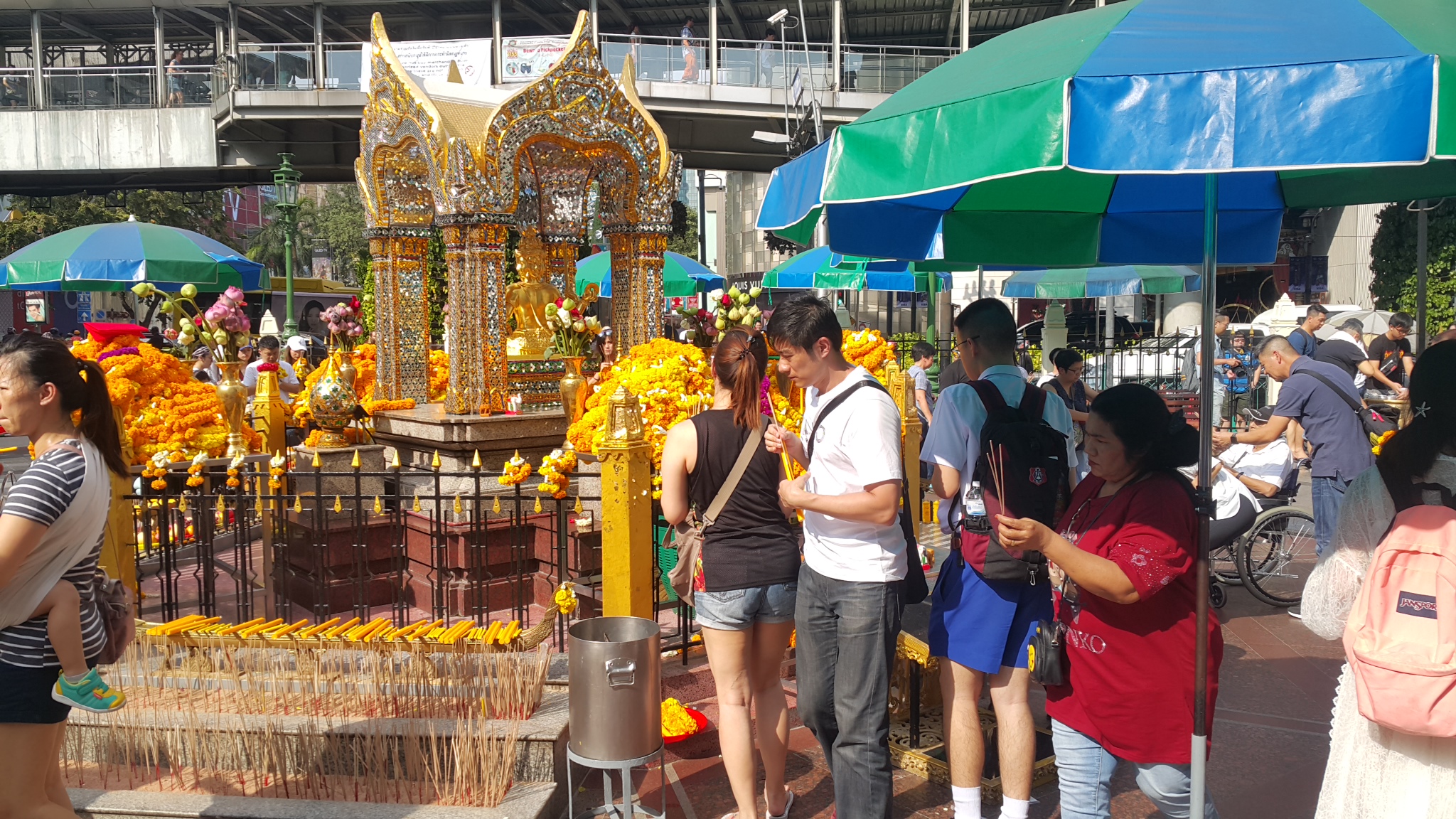
Erawan Shrine
The construction crew had every reason to worry. Workers were getting injured. Costs kept climbing. A shipload of Italian marble bound for the hotel had been lost at sea. Worst of all, someone pointed out that the Ratchaprasong intersection where the government-owned Erawan Hotel was rising had once been used to display condemned criminals. An astrologer was consulted. His diagnosis was precise: the foundation had been laid on the wrong date, generating bad karma that would continue until it was counteracted. His prescription was equally specific -- build a shrine to Brahma.
Where Hinduism Meets Buddhism Meets Animism
The Brahma statue was designed by Thailand's Fine Arts Department and enshrined on 9 November 1956. The hotel's construction proceeded without further incident -- a fact that believers cite as proof of the shrine's power. But what makes the Erawan Shrine remarkable is not the statue itself; it is the layered religious practice that surrounds it. The four-faced figure is Phra Phrom, the Thai representation of Brahma, the Hindu god of creation. Yet the worshippers who crowd the shrine daily are overwhelmingly Buddhist, and their veneration draws on Thai animist traditions of guardian spirits rather than Hindu theology. This syncretism is characteristically Thai -- boundaries between religions treated not as walls but as permeable membranes. When prayers are answered, worshippers hire traditional Thai dance troupes to perform at the shrine, their movements weaving gracefully between the incense smoke and the roar of traffic on Ratchadamri Road.
Destruction and Devotion
In the early hours of 21 March 2006, a man named Thanakorn Pakdeepol climbed onto the statue's base and smashed the hollow figure of Brahma with a large hammer. He shattered the four-faced head, the torso, the eight arms and their weapons. Bystanders beat him to death on the spot. The violence of the response -- an act of protective fury for a religious object -- shocked even devout believers. Thanakorn's father, Sayant Pakdeepol, told The Nation newspaper that his son had suffered from psychiatric illness, and condemned the killing as a betrayal of the very values the shrine represented. "Doing something like this is not the act of people with good beliefs, of those with real faith in Brahma," he said. "Murder is an immoral act and people with morality would not have done what they did." The statue was restored by May 2006, the Fine Arts Department sculpting a new Phra Phrom to replace the one destroyed.
The Bombing at Rush Hour
On 17 August 2015, at 6:55 in the evening, a pipe bomb packed with three kilograms of TNT detonated in the shrine grounds. Twenty people died. One hundred and twenty-five were injured. The blast ripped through the evening crowd of worshippers and tourists, scattering offerings and shattering the calm of answered prayers. Analysts at IHS Jane's suggested the attack was linked to Thailand's deportation of Uyghur suspects to China, a decision that had angered the Turkish ultra-nationalist Grey Wolves organization. The statue itself sustained only minor damage and was repaired within two days. The government reopened the shrine almost immediately, drawing criticism from those who felt the speed prioritized tourism over mourning. The dead -- Thai nationals, tourists from China, Hong Kong, Malaysia, Singapore, Indonesia -- had come to the shrine seeking blessings. They found the opposite.
Sacred Ground on Commercial Soil
The original Erawan Hotel was demolished in 1987 and replaced by the Grand Hyatt Erawan Bangkok, but the shrine remained -- too powerful to move, too beloved to question. It sits today at one of the busiest intersections in Bangkok, overlooked by the elevated walkway of the BTS Skytrain's Chit Lom Station and surrounded by shopping malls: Gaysorn, CentralWorld, Amarin Plaza. Five other Hindu shrines dot the Ratchaprasong area, dedicated to Lakshmi, Trimurti, Ganesha, Indra, and Narayana. Since March 2020, incense and candles are no longer permitted at the shrine, banned for health and environmental reasons. But the flowers remain, heaped in garlands around the four-faced statue. So do the dancers, hired by those whose prayers were answered, performing to an audience of gods and commuters alike.
From the Air
Located at 13.744N, 100.540E in Bangkok's Pathum Wan district, at the Ratchaprasong intersection. The shrine itself is small and not visible from altitude, but the surrounding cluster of high-rise hotels and shopping malls (CentralWorld, Grand Hyatt Erawan) serves as a landmark. Best identified at 2,000-3,000 feet by the intersection's distinctive cross pattern amid dense commercial development. Nearest airports: Don Mueang (VTBD) approximately 14 nm north; Suvarnabhumi (VTBS) approximately 16 nm east-southeast.