Eridu
Before Babylon, before Ur, before the very concept of kingship had a name, there was Eridu. The Sumerian King List -- humanity's oldest known record of political succession -- names it as the place where kingship first descended from heaven. Founded in the 6th millennium BC on a virgin sand dune near the mouth of the Euphrates, Eridu grew around a single idea: that the god Enki, lord of fresh water and wisdom, lived beneath this spot in the Abzu, the subterranean aquifer from which all life flowed. For more than four thousand years, worshippers built temple upon temple here, eighteen layers stacking up like geological strata of devotion. Today the site is a collection of low mounds called Tell Abu Shahrain in the desert of Dhi Qar Governorate, about 90 miles inland from the Persian Gulf that once lapped nearby. The rivers shifted. The city did not follow.
The God Beneath the Water
Enki was not a thundering sky deity or a war god. He was the god of the sweet underground waters, of wisdom, of craft and magic. The Sumerians believed he lived in the Abzu -- the word itself breaking down to ab (water) and zu (far) -- a vast freshwater aquifer beneath the earth from which rivers, marshes, and life itself emerged. His temple at Eridu, called the E-Abzu, was the architectural expression of this belief. Excavators uncovered eighteen superimposed mudbrick temples on the site, the earliest nothing more than a small square room with a niche, the later ones expanding into the tripartite form that would define Mesopotamian sacred architecture for millennia. Each new ruler who came to power rebuilt the temple atop the ruins of the last, an act of piety and political legitimacy. Ur-Nammu of the Third Dynasty of Ur eventually constructed a ziggurat over all of them around 2100 BC, a stepped platform that was never finished.
Layers of Sand and Time
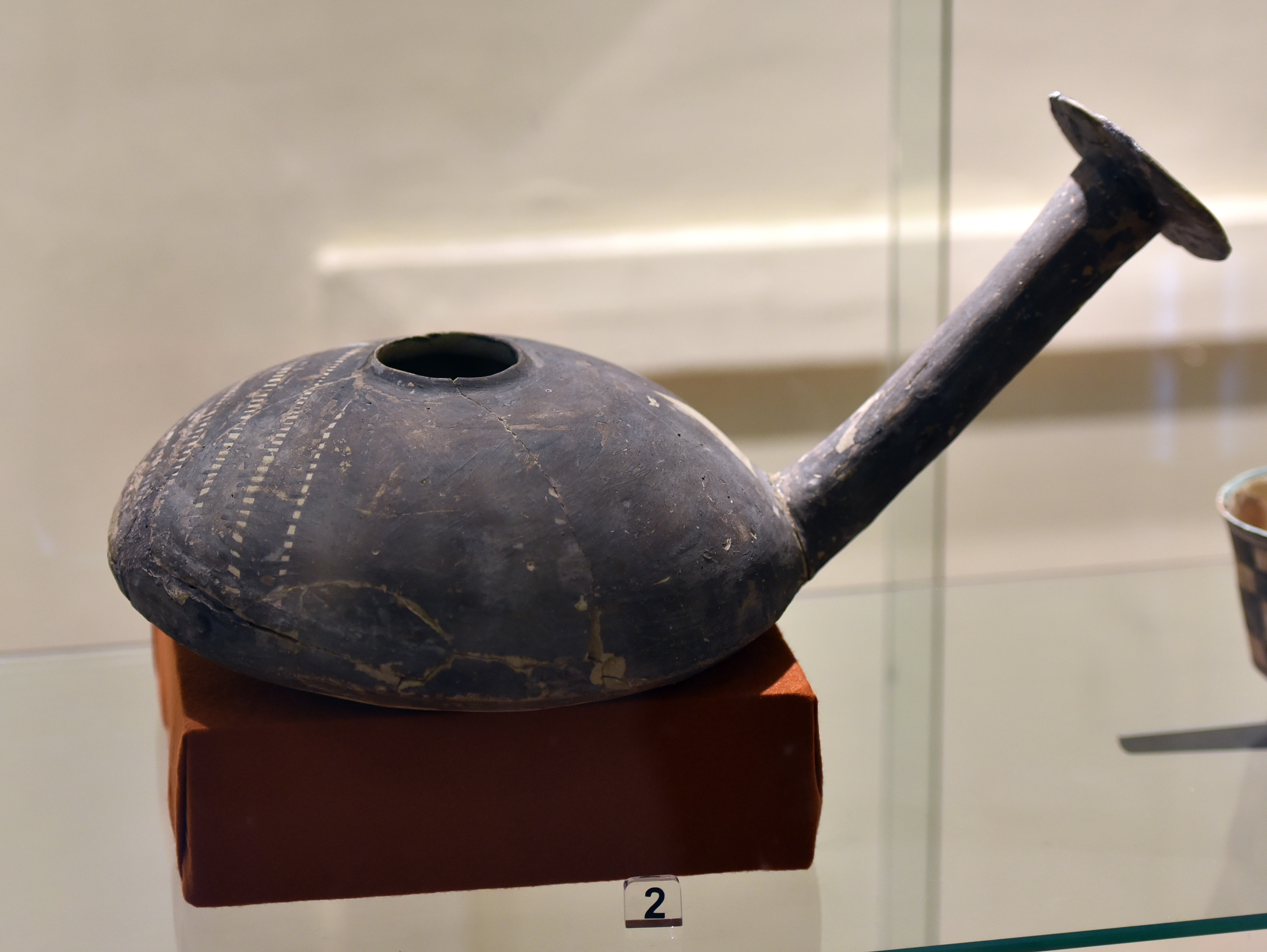
Archaeologists first visited Tell Abu Shahrain in 1855, when John George Taylor, the British Vice-consul at Basra, found inscribed bricks that identified the site as ancient Eridu. Serious excavation came in waves: R. Campbell Thompson in 1918, H. R. Hall in 1919, and most substantially Fuad Safar and Seton Lloyd between 1946 and 1949. What they found was staggering in its depth. The site contains eight distinct mounds. Mound 1, Abu Shahrain itself, rises 25 meters and holds the Enki Temple, the Ur III ziggurat, and a cemetery of roughly 1,000 graves from the Ubaid period -- mudbrick boxes oriented to the southeast. Among the artifacts were a terracotta boat model with a socket for a mast, decorative cones topped with copper, and a lump of cobalt-blue glass dating to the 21st century BC or earlier, possibly the oldest manufactured glass object in the world. In 2019, a joint Italian, French, and Iraqi team resumed excavation, focusing on the Ubaid cemetery and residential areas.
Where Civilization Learned to Write Itself Down
Eridu's importance was not just religious. The Sumerian King List places it as the first of five antediluvian cities where kingship existed before a great flood, naming Alulim and Alalngar as its earliest rulers. The culture hero Adapa, depicted as a sage and vizier to King Alulim, was said to have brought civilization to the city. When the goddess Inanna needed the me -- the divine gifts of civilization that included everything from kingship to brewing -- she traveled from Uruk to Eridu to receive them from Enki. Even Eridu's star had a name: the bright southern star Canopus was called MUL.NUNKI by the Babylonians, meaning "star of the city of Eridu." Six thousand years ago, the precession of Earth's axis meant Canopus could first be seen rising above the southern horizon only from Eridu, the southernmost city of Mesopotamia. From Ur, just to the north, the same sight came sixty years later.
A City That Outlived Its River
Eridu endured far longer than most ancient cities. Royal inscriptions from the Third Dynasty of Ur, the Isin-Larsa period, Hammurabi's Old Babylonian empire, the Kassite dynasty, and even the Neo-Assyrian and Neo-Babylonian periods all reference construction, maintenance, or rituals at Eridu's temple. Nebuchadnezzar II left inscribed bricks here. Sargon II granted the city special economic status. But the Euphrates eventually shifted its course, and continuous irrigation increased the salt content of the soil until agriculture became untenable. By 600 BC, the city was abandoned. When the Sumerians lost a city, they wrote laments -- a literary genre unique to Mesopotamian civilization. The Lament for Eridu mourns the departure of the gods from their temples, the silence where prayers once echoed. Today the mounds of Tell Abu Shahrain rise from flat desert, 90 miles from the Gulf that once lay nearby, holding beneath their surface the compressed history of humanity's first attempt at urban life.
From the Air
Located at 30.82N, 46.00E in the desert of Dhi Qar Governorate, southern Iraq. From altitude, Tell Abu Shahrain appears as a cluster of low mounds rising from flat, arid terrain approximately 20 km south-southwest of the ruins of Ur (Tell al-Muqayyar). The Hammar Marshes are visible to the east. No nearby airports serve the immediate area; the closest is ORMM (Basra International Airport), roughly 130 km to the southeast. ORNI (Nasiriyah Airport) lies approximately 80 km to the north. The site is remote, accessible primarily by unpaved roads. The Euphrates River corridor to the northwest provides a visual navigation reference.