Erin-ji
"For a peaceful meditation, we need not go to the mountains and streams; when thoughts are quieted down, fire itself is cool and refreshing." These were the last words of Kaisen Joki, head priest of Erin-ji, spoken as Oda Nobunaga's soldiers set the temple ablaze in 1582. The monks refused to surrender a fugitive sheltering within their walls, and every one of them burned alive. That act of defiance defines the spirit of this Rinzai Zen temple in Koshu, Yamanashi -- a place that has been founded, destroyed, rebuilt, burned again, and restored across more than six centuries, each time emerging with its serenity intact.
A Garden Before Kyoto
Before the famous moss gardens of Saihoji, before the dragon clouds of Tenryuji, there was Erin-ji. The Zen master Muso Soseki designed the temple's garden in the 1380s, when he was 56 years old, and the landscape he shaped here on the slopes of Yamanashi became the prototype for his later masterworks in Kyoto. The garden covers approximately 2,270 square meters behind the main hall, arranging large stones, a tranquil pond, a small stream, and a gentle waterfall against the living mountain backdrop -- a technique called shakkei, or borrowed landscape, that makes the garden feel as though it extends into the peaks beyond. Designated a National Place of Scenic Beauty in 1994, the garden remains one of the purest surviving examples of medieval Zen landscape design.
The Tiger of Kai's Resting Place
Erin-ji is inseparable from the Takeda clan, the warrior dynasty that ruled Kai Province for generations. Takeda Shingen -- the legendary daimyo known as the Tiger of Kai -- revived the temple in 1541 after it had fallen to ruin during the Onin War. He installed Kaisen Joki as head priest in 1564 and made Erin-ji the clan's bodaiji, or family temple. Today, Shingen's grave stands among the temple grounds, a quiet stone marker for a man whose military campaigns reshaped the politics of Sengoku-era Japan. The temple was originally founded in 1380 by Nikaido Sadafuji, the shugo (military governor) of Kai Province, who invited Muso Soseki from Kamakura to build a hermitage. The fame of Muso Soseki attracted such prestige that Shogun Ashikaga Yoshimitsu named Erin-ji among the Kanto Jissetsu, the ten most important Zen temples in eastern Japan.
Burned Twice, Standing Still
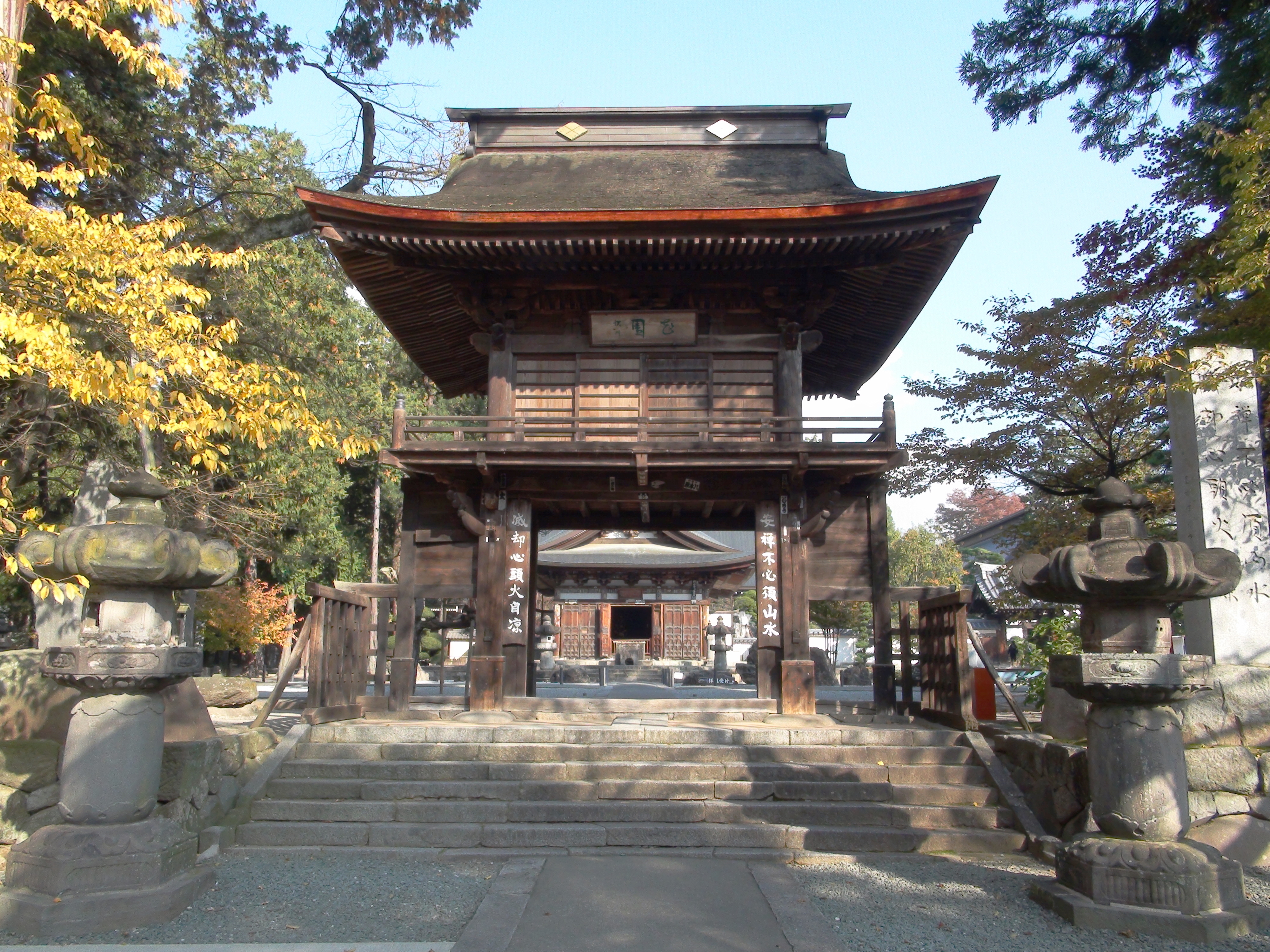
The temple's first destruction came in 1582, when Oda Nobunaga and Tokugawa Ieyasu invaded Kai Province and crushed the Takeda. Erin-ji was accused of sheltering Rokkaku Yoshisuke, a rival of the Oda, and the temple was set ablaze with its monks inside. But destruction carried the seeds of renewal. Once Tokugawa Ieyasu consolidated power over the province, he ordered Erin-ji rebuilt. By 1672, memorial services for Takeda Shingen were once again held on the grounds. The temple honored its Takeda connection through the entire Edo period and beyond the Meiji Restoration. Then, in 1905, fire struck again, consuming most of the Edo-period structures. What survived that second blaze was the temple's oldest treasure: a wooden gate with four pillars and a cypress-shingle roof, built in 1606, designated an Important Cultural Property of Japan in 1907.
Blades and Devotion
Among Erin-ji's designated Important Cultural Properties are two Japanese swords that trace the temple's role as a place of memorial and patronage. A tachi -- a long, curved sword -- was forged in 1705, measuring 79.5 centimeters, and donated by the powerful daimyo Yanagisawa Yoshiyasu during the 133rd memorial service for Takeda Shingen. Alongside it rests a tanto, a short blade just 27.4 centimeters long, dating from 1367 during the Nanbokucho period. Both swords were designated Important Cultural Properties in 1915. They are not weapons displayed for spectacle; they are offerings, physical expressions of loyalty to a warrior lord who died centuries before the steel was folded. In a temple shaped by fire and war, these blades stand as quiet testaments to the enduring bond between the Takeda name and the monks who keep their memory.
From the Air
Erin-ji sits at 35.73°N, 138.71°E in the Koshu Basin of Yamanashi Prefecture, nestled in the mountainous interior of central Honshu. The Kofu Basin is ringed by peaks of the Southern Alps and Chichibu Mountains, making it visually dramatic from altitude. Approach from the east following the Chuo Main Line rail corridor. The nearest significant airport is Matsumoto (RJAF), approximately 90 km to the northwest. Shizuoka Airport (RJNS) lies about 108 km to the south. At 3,000-5,000 feet AGL, the green temple compound is visible against the surrounding hillside. Clear days offer views of Mount Fuji to the southeast.