Erligang Culture
Somewhere beneath the traffic and apartment towers of modern Zhengzhou, a Bronze Age city sleeps. Discovered in 1951 at a site called Erligang, the remains date from approximately 1600 to 1400 BC and represent one of the earliest urban civilizations ever found in China. The ancient city's walls ran for seven kilometers around its perimeter -- rammed earth, 20 meters wide at the base, rising to an estimated 8 meters high. Outside those walls, workshops produced the bronze vessels that define the era. Inside, a society was organizing itself into something that looks unmistakably like a state.
A City You Cannot Excavate
The fundamental irony of Erligang archaeology is that the most important site sits directly underneath a modern metropolis. Zhengzhou, a city of millions, was built on top of the ancient city, and excavation of the primary site is largely impossible. What archaeologists have pieced together comes from construction projects that accidentally expose ancient layers, from the areas just outside the old walls, and from satellite Erligang sites scattered across central China. The city itself was roughly rectangular, enclosed by massive rammed-earth fortifications built using techniques that trace back to the earlier Neolithic Longshan culture. Large workshops stood outside the walls -- facilities for working bone, firing pottery, and casting bronze vessels. These were not cottage industries but organized production centers, suggesting a centralized authority directing specialized labor.
Bronze Roads to the Yangtze
The Erligang culture was not confined to Zhengzhou. At its peak, it expanded rapidly from its Yellow River heartland southward to the Yangtze River. The largest excavated Erligang site is not Zhengzhou at all but Panlongcheng, located on the Yangtze in modern Hubei province, discovered in 1954 and excavated in the 1970s. Why would a Yellow River civilization establish a major outpost 500 kilometers to the south? The answer lies in chemistry. Zhengzhou lacked local access to the copper and tin needed for bronze production. Analysis of bronze artifacts from Panlongcheng revealed that their mineral composition matched copper deposits at Tonglushan in nearby Hubei -- evidence that Panlongcheng functioned as a resource colony, securing the metals that fueled Erligang's bronze workshops. The culture had built a supply chain spanning half a continent.
The First Great Bronze Casters
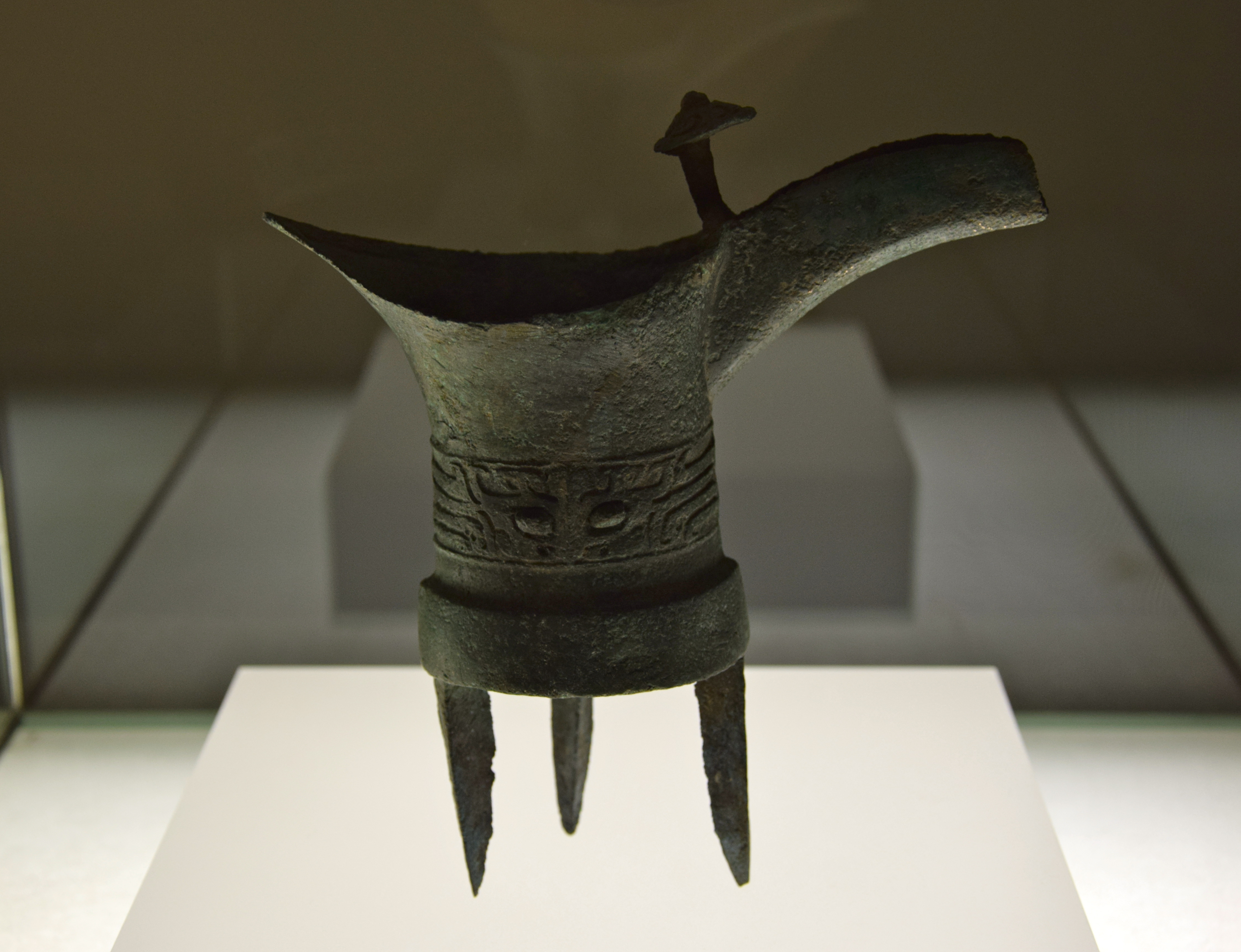
Erligang bronzes evolved from the earlier Erlitou culture, centered about 85 kilometers west of Zhengzhou, but they represent a dramatic leap in scale and standardization. Erlitou had produced bronze vessels, but sparingly and in varied styles. At Erligang, bronze casting became widespread, and the vessels took on a remarkable uniformity -- evidence of established production methods and shared aesthetic conventions across a broad geographic area. The signature vessel was the ding, a heavy cauldron used in ritual and political ceremonies that would remain central to Chinese culture for millennia. These were not decorative objects. They were instruments of power, used in the rituals that legitimized authority.
The Dynasty Question
Many Chinese archaeologists believe that the Erligang culture represents the early Shang dynasty -- that Zhengzhou was one of several Shang capitals mentioned in ancient historical texts. The identification is tantalizing but unproven. Unlike the later Shang site at Yinxu near Anyang, where oracle bone inscriptions provide written records that can be matched to traditional accounts, no writing has been found at Erligang sites. The gap between the archaeological evidence and the traditional histories, written roughly a thousand years after the Erligang period, remains unbridged. What is beyond dispute is that someone built a walled city with a seven-kilometer perimeter, organized large-scale bronze production, and extended their influence from the Yellow River to the Yangtze. Whether they called themselves Shang is a question the earth has not yet answered.
From the Air
Located at 34.75°N, 113.68°E within modern Zhengzhou. The archaeological site lies beneath the urban core of the city and is not visible from the air, but the flat alluvial plain of the Yellow River valley -- the geographic setting that made this civilization possible -- is clearly apparent from altitude. Zhengzhou Xinzheng International Airport (ICAO: ZHCC) is 37 km to the southeast.