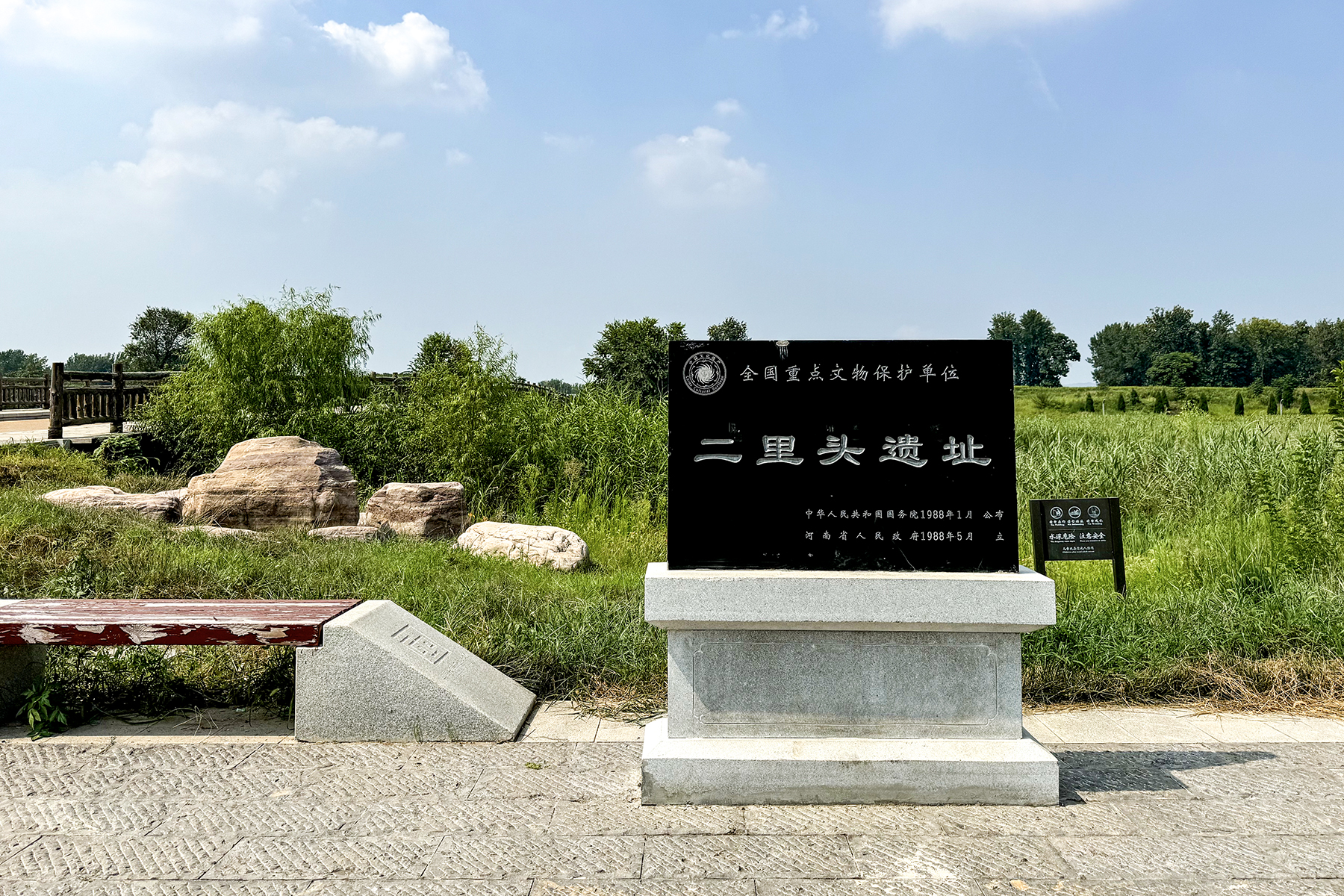
Erlitou
When archaeologist Xu Xusheng walked across the wheat fields near Yanshi in 1959, he was looking for the first capital of the Shang dynasty. What he found instead was something older and more enigmatic. Beneath the soil of the Yiluo Basin lay the remains of a city that had thrived centuries before the Shang came to power -- a settlement with palace complexes, bronze foundries, jade workshops, and a road grid that divided it into functional districts. Erlitou, as the site came to be known, has spent the past six decades challenging everything scholars thought they knew about the origins of Chinese civilization.
A City Between Rivers
Erlitou sits on the floodplain between the Yi River and the Luo River, both tributaries of the Yellow River, in what is now Yanshi District of Luoyang. At its peak around 1600 BC, the settlement covered approximately 300 hectares and may have housed upward of 24,000 people. Four major roads divided the city into a grid, with a walled palatial compound at the center surrounded by specialized workshops for bronze casting, turquoise working, and bone tool production. The site shows occupation stretching from the late Yangshao culture through the Longshan period and into the Erligang culture, but its most significant layers date to the early Bronze Age -- roughly 1750 to 1530 BC by recent radiocarbon estimates.
Palaces in the Mud
Eleven palace foundations have been identified across the site's four main phases, each built on massive platforms of rammed earth. Palace 1, the largest, covered an enormous footprint during Phase III, when the city reached its zenith. The palatial compound was enclosed by a wall two meters thick, and the buildings within were arranged along axes that would become standard in later Chinese imperial architecture. What makes these palaces remarkable is not their size alone but their implications: they represent centralized political authority expressed through monumental construction, a pattern that would define Chinese statecraft for the next three and a half millennia.
Workshops of the First Bronze Masters
South of the palatial compound, archaeologists uncovered a bronze foundry that was clearly under elite control. The workshop produced ritual vessels using the piece-mold casting technique -- a method unique to China that involved assembling ceramic molds around a clay core, pouring in molten bronze, and then breaking away the mold to reveal the finished vessel. More than 200 bronze artifacts have been recovered from the site, including jue goblets, ding cauldrons, weapons, bells, and ornamental plaques inlaid with hundreds of tiny turquoise pieces. The earliest bronze dagger-axes in China were found here. Since there are no copper deposits in the Luoyang Plain, the metal was transported from the Zhongtiao Mountains in southern Shanxi, some 200 kilometers to the north -- evidence of long-distance resource networks under centralized coordination.
The Ghost of the Xia
Whether Erlitou was the capital of the Xia dynasty remains Chinese archaeology's most contested question. Ancient texts such as the Bamboo Annals and the Records of the Grand Historian describe the Xia as the first Chinese dynasty, but these were written a thousand or more years after the Xia supposedly existed. No inscriptions or written records have been found at Erlitou itself. Symbols scratched onto pottery offer tantalizing hints of proto-writing but fall short of proof. The Xia-Shang-Zhou Chronology Project assigned all four phases of Erlitou to the Xia period, but scholars outside China generally consider the identification unproven. The city that emerged from the soil of the Yiluo Basin is, for now, a civilization without a name it can call its own.
From the Air
Located at 34.70°N, 112.70°E in the Yiluo Basin of Yanshi District, Luoyang, Henan Province. The site sits on flat agricultural land between the Yi and Luo Rivers. The Erlitou Site Museum of the Xia Capital, a large copper-clad modern building opened in 2019, is adjacent to the archaeological site and visible from low altitude. Nearest airport is Luoyang Beijiao Airport (ZHLY/LYA), about 20 km west. Zhengzhou Xinzheng International (ZHCC/CGO) is approximately 130 km east. Altitude recommendation: 2,000-4,000 feet AGL. The river confluence area and museum building serve as visual landmarks.