Erlitou Culture
Somewhere in the muddy soil of the Yellow River valley, between the years 1900 and 1500 BC, the first state-level society in China took shape. Its people built palaces with rammed-earth walls two meters thick. They invented a technique for casting ritual bronze vessels that would define Chinese metalwork for millennia. They may have used wheeled wagons centuries before any other culture in China. And they left behind no written records -- which means that the most fundamental question about the Erlitou culture, whether it was the legendary Xia dynasty described in ancient texts, remains unanswered.
Discovery in the Yiluo Basin
In 1959, archaeologist Xu Xusheng led a survey team into the Yiluo Basin near Yanshi, Henan Province, and found what he initially believed to be Bo, the first capital of the Shang dynasty. He was wrong about the dynasty, but right about the significance. The site, named Erlitou after the nearby village, turned out to be the largest settlement of an entire archaeological culture that stretched across Henan and Shanxi, eventually reaching into Shaanxi and Hubei. Most archaeologists now consider it the first state-level society in China -- a place where centralized political authority, monumental architecture, and controlled production of prestige goods first came together.
Four Phases of a Vanished City
The site grew through four distinct phases. During Phase I, it was a regional center of about 100 hectares with a population in the low thousands. Urbanization began in Phase II, when the settlement expanded to support roughly 11,000 people. A palatial complex emerged, demarcated by four roads, with a bronze foundry established nearby under elite control. Vehicle tracks found near the palace represent the earliest evidence of wheeled wagons in China. By Phase III, the city reached its peak -- perhaps 24,000 inhabitants living around palaces enclosed by massive rammed-earth walls. Then came Phase IV, when the population declined to around 20,000. Production of bronze and elite goods eventually ceased, the palaces were abandoned, and Erlitou shrank to a village. No evidence of destruction by fire or war has been found. The city simply faded.
The Bronze Revolution
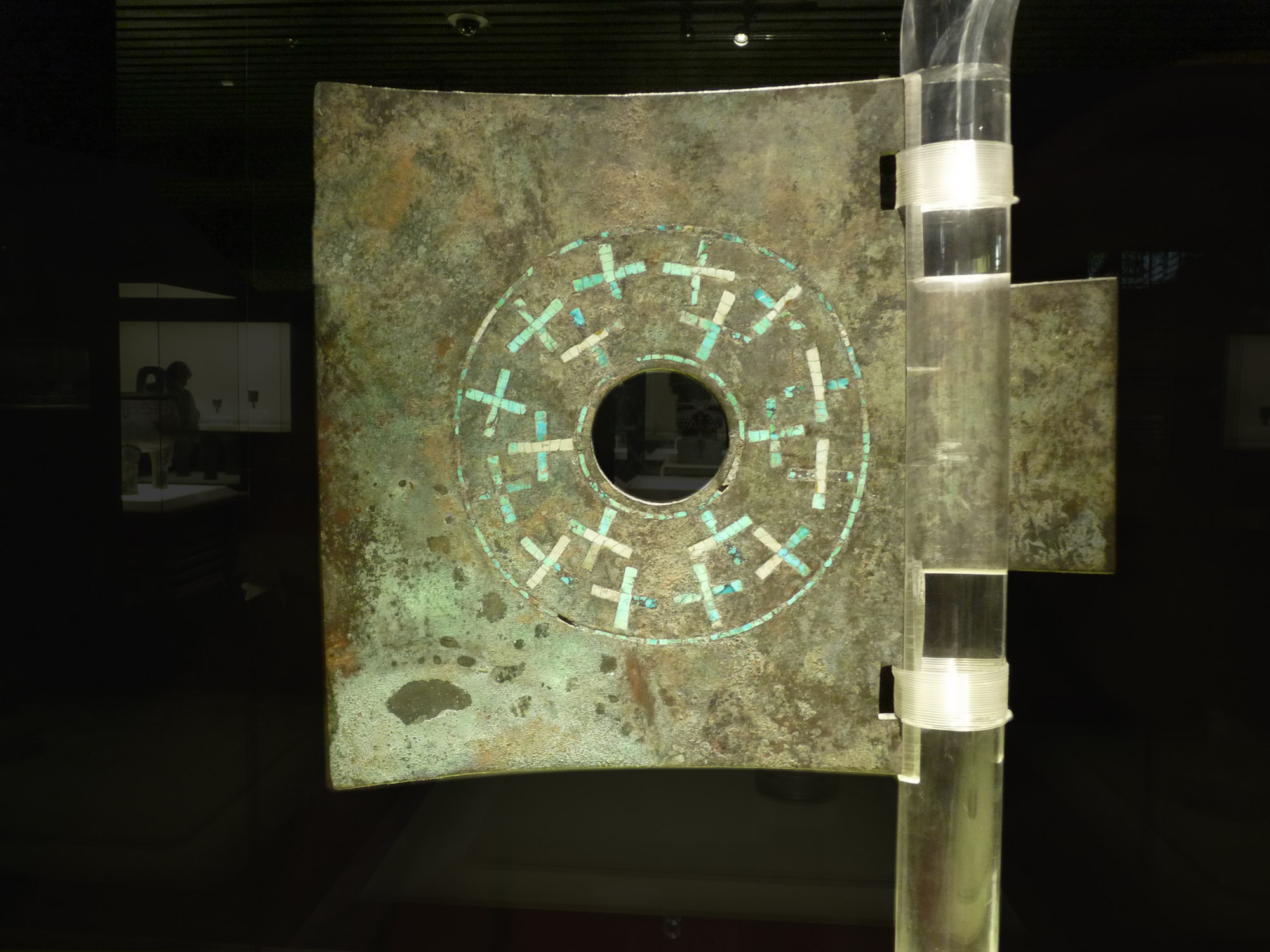
Erlitou's most lasting contribution was its bronze technology. While earlier cultures like the Qijia had worked with bronze, Erlitou's output was incomparably more sophisticated and diverse. The culture pioneered the section-mold casting process that would become the hallmark of Chinese bronze production for the next thousand years. Artisans produced tools, musical bells, weapons, and ritual vessels including the earliest known ding -- the three-legged cauldrons that became symbols of political legitimacy. Animal-faced plaques inlaid with turquoise are among the most striking surviving objects. Since there are no copper resources in the Luoyang Plain, the Erlitou people likely acquired their ore from the Zhongtiao Mountains of southern Shanxi, the same region from which they probably obtained salt.
The Xia Question
The Erlitou culture occupies the same territory and timeframe that ancient Chinese texts assign to the Xia dynasty, and Chinese archaeologists have generally embraced the identification. The Xia-Shang-Zhou Chronology Project classified all four phases of Erlitou as Xia. But the identification rests on circumstantial evidence. No written records have been found at Erlitou -- symbols on ceramic pieces suggest possible connections to early Chinese characters, but nothing that constitutes proof. Outside China, scholars tend to be more cautious, noting that the absence of contemporary written evidence makes the link unprovable. Archaeological evidence of a massive outburst flood at Jishi Gorge around 1920 BC, shortly before Erlitou's rise, has been proposed as the historical basis for the great flood myth associated with the Xia founder Yu, but this too remains speculative.
From the Air
The Erlitou site is located at 34.70°N, 112.70°E in the Yiluo Basin near Yanshi, Henan Province. The site sits on the plain between the Yi River and the Luo River, both tributaries of the Yellow River. Nearest major airport is Luoyang Beijiao Airport (ZHLY/LYA), approximately 20 km west. Zhengzhou Xinzheng International (ZHCC/CGO) is about 130 km east. The terrain is flat agricultural land along the river plain. Altitude recommendation: 3,000-5,000 feet AGL. The Erlitou Site Museum of the Xia Capital, opened in 2019, is visible as a large modern structure near the archaeological site.