Ernest Harmon Air Force Base
On March 3, 1960, Elvis Presley stepped off an airplane in Stephenville, Newfoundland. He was returning from his army posting in Germany, refueling at Ernest Harmon Air Force Base on the way to New Jersey. Apart from a handful of concerts in 1957, it was the only time he set foot in Canada. That Elvis ended up in this remote corner of western Newfoundland at all tells you something about the strange reach of Ernest Harmon AFB, an American military installation that spent a quarter century functioning as a pocket of United States territory on Canadian soil, complete with its own schools, radio station, and movie theater showing a different film every night.
A Buffer Against the Unthinkable
In 1940, with the Luftwaffe hammering Britain and U-boats prowling the Atlantic, American military planners confronted an alarming scenario: Nazi Germany could establish a beachhead on Newfoundland and the nearby French islands of Saint Pierre and Miquelon, then stage attacks against North America's industrial heartland. The Destroyers for Bases Agreement with the United Kingdom traded fifty aging destroyers for 99-year leases on military sites across British territories in the Western Hemisphere. Newfoundland became the primary focus. The US established Fort Pepperrell in St. John's and a naval base at Argentia on the Avalon Peninsula, but the west coast and the strategic Strait of Belle Isle remained exposed. In April 1941, Congress approved a 99-year lease on 8,159 acres at the head of Bay St. George, near the coastal hamlet of Stephenville. Construction began on a deepwater port and airfield beside a village that had no paved streets, no sidewalks, and no water system.
From Hamlet to Crossroads
Originally called Stephenville Air Base, the facility quickly became one of the largest US military airfields outside the continental United States, capable of handling the biggest cargo aircraft in the world. It served as a critical refueling stop for aircraft crossing the Atlantic throughout the war, and the Newfoundland Base Command transferred control to the North Atlantic Wing of Air Transport Command on September 1, 1943. On June 23, 1948, the base was renamed for Captain Ernest Emery Harmon, a US Army Air Corps pilot killed in an air crash in 1933. When Newfoundland joined Canadian Confederation on March 31, 1949, the base's legal status grew even more unusual: an American enclave operating under the Uniform Code of Military Justice inside Canada's newest province. The village of Stephenville, meanwhile, grew from several hundred people in 1941 into a modern town of over 5,000 by the mid-1950s, then doubled again before the base finally closed.
Nuclear Tankers Over the Long Range
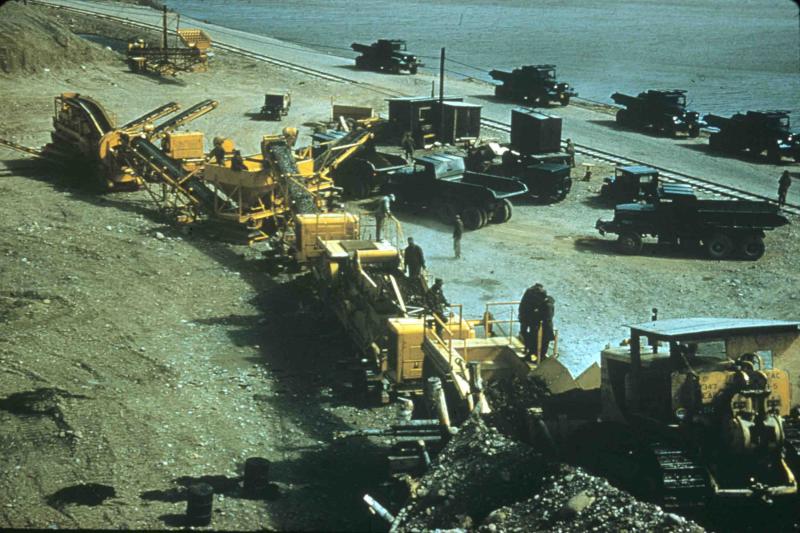
The Cold War transformed the base from transit point to frontline facility. In April 1957, Strategic Air Command assumed control and stationed KC-97 Stratofreighter tankers on alert, ready to meet and refuel nuclear-armed B-52 Stratofortress bombers in the skies over western Newfoundland. The base also supported Pinetree Line radar stations and three Aerospace Defense Command units. The 1950s expansion was enormous: the 347th Engineer Aviation Battalion and over 2,500 contractor personnel completed 62 construction projects. They extended runways, built fighter hangars, dredged Port Harmon into a harbor 8,000 feet long, 200 feet wide, and 35 feet deep, and constructed four petroleum tanks with a capacity of 25,000 tons of aviation fuel. The harbor facilities had to be demolished to give aircraft clearance. At its Cold War peak, thousands of servicemen and their families lived in a self-contained community ringed by the Long Range Mountains.
A Movie Every Night, Elvis on Occasion
Geographic isolation shaped everything. In the 1940s and 1950s, western Newfoundland's only ground link to the outside world was the narrow-gauge Newfoundland Railway, a slow train connecting to coastal ferries at North Sydney, Nova Scotia. So the base built its own world. By the mid-1950s, Harmon offered hobby shops for leathercraft, ceramics, lapidary, and amateur radio. A fishing lodge at Camp 33, leased from the Bowater Pulp and Paper Company, provided eight cabins and a 40-man bunkhouse. The gymnasium seated 500. The base chapel accommodated 1,500 worshippers weekly. The library lent a thousand books a month. The Base Theater was the most popular facility of all, running a new movie every night except Sundays and Mondays, with four shows daily and a Saturday matinee. Among the celebrities who visited during the Cold War years were Marilyn Monroe, Frank Sinatra, and Bob Hope. The base also ran its own schools, growing from 28 children and 3 teachers in 1948 to over 1,500 students and nearly 70 teachers by the time it closed.
Buried Machinery and Borrowed Buildings
Ernest Harmon AFB closed in 1966. The property reverted to Canada under the original lease terms, then transferred to the Government of Newfoundland and Labrador, which created the Harmon Corporation to manage the transition. The airfield became Stephenville International Airport. One seven-story barracks now houses residences for the College of the North Atlantic and serves as a hotel during summer tourist season; the other became the Stephenville Manor apartment complex. The 11-mile bypass road that engineers carved through the wilderness became the Hansen Memorial Highway. And somewhere near Noels Pond, buried under 30 acres of former salvage yard, lie the bulldozers and graders that built it all, interred in 1959 when they wore out, dug up in 1986 after newspaper articles drew curiosity seekers with metal detectors, then reburied when the machinery proved worthless. The equipment had arrived on Liberty ships from Florida with the 347th Engineers in 1953. It remains in Newfoundland's soil, as permanent a legacy as anything the base left behind.
From the Air
Located at 48.54°N, 58.55°W on the western coast of Newfoundland, at the head of Bay St. George. The former base is now Stephenville International Airport (ICAO: CYJT) with three runways clearly visible from altitude. The Long Range Mountains rise to the east and north. Port Harmon and the Bay St. George coastline are prominent visual references. The Hansen Memorial Highway bypass road is visible running south of the base along the former rail line. Best viewed from 3,000-8,000 ft AGL. Nearest alternate is Deer Lake Airport (CYDF), approximately 90 km northeast.