Eruption of Mount Vesuvius in 79 AD
Emperor Nero was performing in a Naples theater in 64 AD when an earthquake shook the building. According to Suetonius, he kept singing until he finished his song; Tacitus records that the theater collapsed shortly after it was evacuated. Fifteen years later, when four days of minor tremors preceded the most catastrophic volcanic eruption in Roman history, the people living around Mount Vesuvius paid little attention. As Pliny the Younger later wrote, the tremors "were not particularly alarming because they are frequent in Campania." Around 1:00 p.m. on a day in autumn of 79 AD, Vesuvius exploded. The eruption destroyed the Roman towns of Pompeii and Herculaneum, killed untold thousands, and gave its name to the Vesuvian type of volcanic eruption -- the kind that sends columns of hot gas and ash into the stratosphere.
A Column Like a Stone Pine
Pliny the Younger was seventeen years old and staying at Misenum, 29 kilometers across the Bay of Naples, when he saw the eruption begin. He described an extraordinarily dense cloud rising rapidly above the mountain, its shape resembling a stone pine tree -- a trunk of gas and debris topped by a spreading canopy. The first Plinian phase projected a column of volcanic material into the stratosphere, where it lasted 18 to 20 hours and spread pumice and ash southward toward Pompeii. Herculaneum, upwind, was initially spared the fallout. But the reprieve was temporary. When the column's energy could no longer support its mass, it collapsed, sending pyroclastic density currents racing down the mountain's slopes at hundreds of kilometers per hour. The eruption was primarily phreatomagmatic -- driven by seawater seeping into deep faults and flashing to steam on contact with magma.
The Last Hours of Two Cities
Pompeii and Herculaneum died differently. Pompeii, to the southeast, was pummeled first by hours of pumice and ash fallout that collapsed roofs and choked streets. White pumice fragments up to 3 centimeters across fell for several hours, heating roof tiles to 120 degrees Celsius -- the last window in which escape was possible. Then came a second, heavier fall of grey pumice that lasted 18 hours. Early on the second morning, two massive pyroclastic surges struck the city at temperatures between 180 and 300 degrees Celsius. Anyone still sheltering inside buildings was killed instantly by thermal shock. Herculaneum, closer to the crater but shielded from the initial ashfall by wind direction, was obliterated by the pyroclastic surges and buried under 23 meters of volcanic material. In the arched vaults along the waterfront -- probably boathouses -- victims were found packed at a density of three per square meter, all killed by the first surge.
The Admiral Who Sailed Toward the Fire
Pliny the Elder, the younger Pliny's uncle, commanded the Roman fleet at Misenum. When he saw the eruption cloud, he ordered the fleet galleys launched -- not to flee, but to evacuate the coastal population. A woman named Rectina, living near the foot of the volcano, had sent a messenger pleading that her party could only escape by sea. The elder Pliny sailed his light ship directly toward the eruption. He reached shore but could not return; the winds that had carried him south now blew against him. He spent the night at a friend's villa near the coast. By the next morning, sulfurous gases and ash were filling the air. Pliny the Elder collapsed and died, likely from respiratory failure caused by the toxic atmosphere. His nephew later wrote to Tacitus that his uncle's weak lungs could not withstand the poisonous cloud. His body was found the next day, intact and without visible injury.
Frozen in the Moment of Death
By 2003, approximately 1,044 casts had been made from body impressions in the ash at Pompeii, with scattered bones of another 100 individuals. At Herculaneum, the remains of about 332 people have been recovered, 300 of them in the waterfront vaults discovered in 1980. The contorted postures of the Pompeii casts -- figures crouching, shielding their faces, clutching children -- were not the result of prolonged agony. They were caused by cadaveric spasm, an instantaneous muscular contraction triggered by heat shock. The temperatures were so extreme that organs and blood vaporized. One victim's brain may have been vitrified -- turned to glass -- by the heat, though this remains debated. Among the named dead are the Herodian princess Drusilla and her son Agrippa, the senator Pomponianus, and the poet Caesius Bassus. The total death toll has never been established. Only 85 meters of Herculaneum's coastline have been excavated; more victims almost certainly remain.
A Date Still in Dispute
For centuries, the eruption was dated to August 24, 79 AD, based on a 1508 printed edition of Pliny the Younger's letters to Tacitus. But the original date may have been corrupted through fourteen centuries of manuscript copying. Since the late 18th century, archaeologists have found evidence pointing to autumn: remnants of pomegranates, victims in heavy clothing, and storage vessels full of wine suggesting a post-harvest date. A 2007 wind study showed the eruption's southeasterly debris pattern is consistent with autumn conditions and inconsistent with August, when prevailing winds blow westward. In 2018, a charcoal inscription was uncovered reading "the 16th day before the calends of November" -- October 17. A 2022 collaborative study narrowed the date to between October 24 and November 1. The debate continues, but the mountain itself is indifferent to calendars. Vesuvius has erupted dozens of times since 79 AD, most recently in 1944, and today three million people live within its potential blast radius.
From the Air
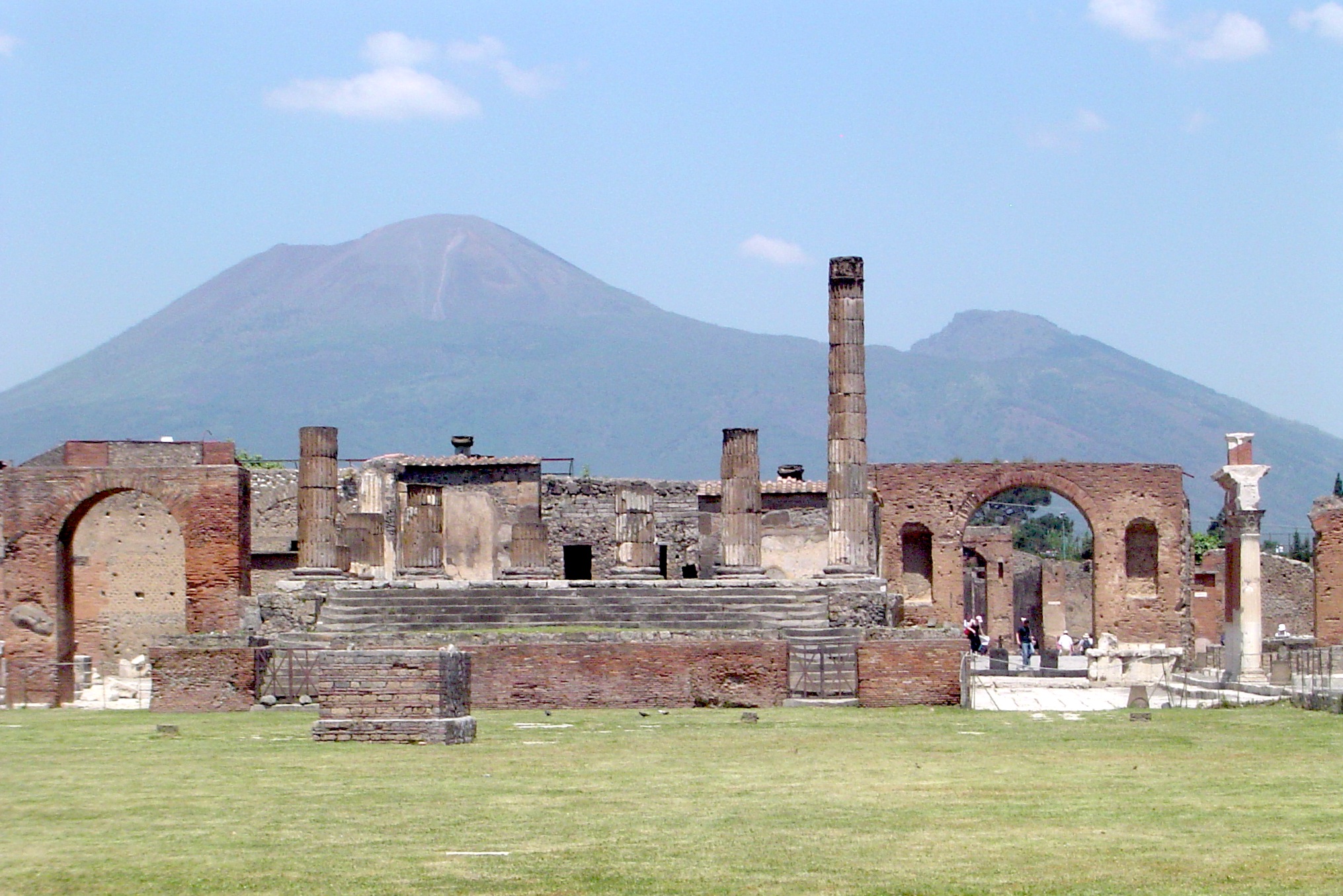
Located at 40.82°N, 14.44°E on the Bay of Naples. Mount Vesuvius (1,281 m) dominates the landscape southeast of Naples, with the excavated ruins of Pompeii visible at its southern base and Herculaneum to the west. Nearest major airport is Naples International (LIRN). Best viewed from 6,000-10,000 feet to see Vesuvius, the ruins of both cities, and the Bay of Naples in a single panorama.