Escondida
The name means "hidden," and for millions of years the deposit obliged. Buried beneath a barren cap of leached rock up to 300 meters thick, the Escondida copper orebody lay concealed in the Atacama Desert, waiting under one of the most inhospitable landscapes on the planet. When geologists finally pierced that cap and found what lay beneath — a porphyry copper deposit stretching 18 kilometers north to south — they uncovered what would become the single most productive copper mine on Earth. Since 1996, Escondida has led Chile's copper output every year, in some years more than doubling the production of its nearest rival.
Anatomy of a Giant
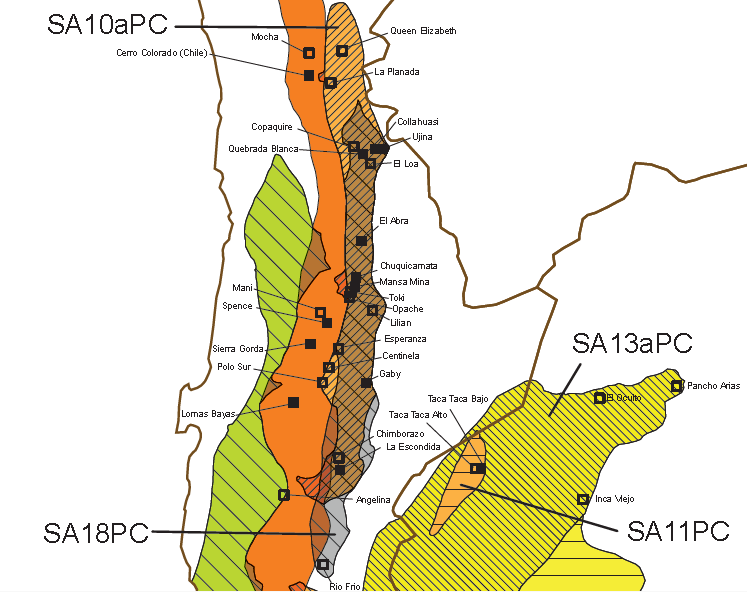
Escondida belongs to a cluster of porphyry copper deposits along the West Fissure fault system, a 600-kilometer geological scar that accounts for most of Chile's major copper wealth. The deposit's structure reads like a textbook in deep time. Below the barren, leached cap sits a thick zone of high-grade secondary minerals — chalcocite and covellite — formed by groundwater slowly enriching the copper content over millions of years. Deeper still lies the unaltered primary mineralization: chalcopyrite, bornite, and pyrite, the original copper-bearing rock that the Earth's own chemistry upgraded through patient supergene processes. As of 2019, the known resource stands at a staggering 21.7 billion tonnes of ore at 0.54 percent copper, a figure that continues to grow as exploration pushes outward.
The Machine That Feeds a Nation
Scale at Escondida defies easy comprehension. In 2006, the mine moved 338.6 million tonnes of material — 928,000 tonnes per day, enough to fill a freight train stretching from the pit to the coast and back. Sulfide ore, which holds 77 percent of recoverable copper, is crushed, milled, and separated through froth flotation, recovering roughly 86 percent of the metal. The concentrate is then piped downhill to the port at Coloso, where it is dewatered and shipped worldwide. Oxide ore gets a different treatment: crushed and acid-leached in enormous heaps, then refined through solvent extraction and electrowinning. Even the lowest-grade sulfide ore is put to work, heaped and bioleached using microorganisms that oxidize the rock and release copper into solution. The mine's current capacity sits at around 1.4 million tonnes of copper per year. Two worker camps, San Lorenzo and 2000, sustain 7,000 people daily in a place where nothing grows without human effort.
Water in the Desert
Copper mining demands water, and the Atacama is the driest desert on Earth. For two decades, from 1998 to 2019, Escondida drew freshwater from a well field in the Monturaqui area, 78 kilometers east of the mine, tapping the Monturaqui-Negrillar-Tilopozo Aquifer at rates up to 1,400 liters per second. The environmental cost became a legal reckoning. In 2024, Chile's First Environmental Court of Antofagasta ordered the mining company to pay more than US$8 million in compensation for aquifer damage — a ruling that echoed through the broader debate over mining and scarce water in the Atacama. Today, Escondida has shifted entirely to desalinated seawater, pumped uphill from a plant near Caleta Coloso on the Pacific coast. The transition represents both an engineering feat and an acknowledgment that underground water in the Atacama cannot sustain industrial extraction forever.
Copper, Power, and the Desert Sun
Mining at this scale consumes enormous quantities of electricity. BHP, the mine's operator, purchases 3 terawatt-hours per year to run Escondida and the nearby Spence mine. In 2019, BHP cancelled its coal contracts and committed to powering both operations entirely with renewable energy — a decision made practical by the Atacama's extraordinary solar resource, where irradiance exceeds 3 kilowatt-hours per square meter per year. The mine and its ancillary industries contribute an estimated 2.5 percent of Chile's GDP, a remarkable share for a single industrial operation. That economic gravity gives Escondida outsized influence on national policy, labor relations, and the perpetual tension between extraction and environmental protection that defines Chile's mining heartland.
A Visible Scar from Above
From the air, Escondida is unmistakable. The open pit gouges into the desert surface at 3,100 meters elevation, surrounded by the geometric terracing of waste dumps and the pale rectangles of leach pads. The neighboring Zaldivar mine is visible to the north. No vegetation softens the view — just rock, dust, and the engineered landscape of extraction stretching across the Atacama plateau. The copper concentrate pipeline traces an invisible line downhill to the coast, where Coloso's port facilities mark the point where Atacama copper meets the global supply chain. For a deposit whose name means "hidden," Escondida has become one of the most visible marks that human industry has left on the South American landscape.
From the Air
Escondida sits at 24.27°S, 69.07°W at 3,100 meters (10,170 feet) elevation in the Atacama Desert of northern Chile. From cruising altitude, the open pit and surrounding waste dumps are clearly visible against the barren desert surface. The neighboring Zaldivar mine lies to the north. The nearest significant airport is Cerro Moreno (SCFA) at Antofagasta, approximately 170 km to the northwest on the coast. The Atacama's extreme aridity generally provides excellent visibility, though dust can reduce contrast at lower altitudes. The copper concentrate pipeline runs downhill to the port at Caleta Coloso near Antofagasta.