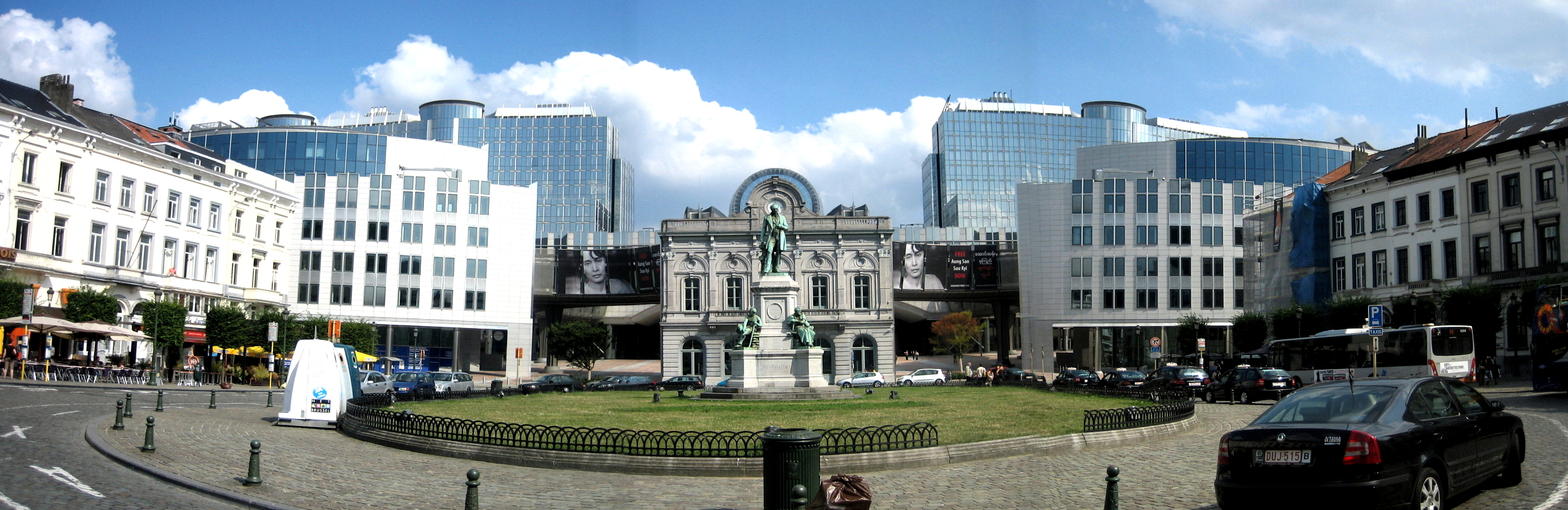
Espace Léopold
Locals call it the Caprice des Dieux, the 'Whim of the Gods,' after a French soft cheese with the same elongated oval shape. The nickname is affectionate and irreverent at once, which is fitting, because the building under the glass dome is one of the most expensive parliamentary chambers ever constructed and, by law, it cannot be the parliament's actual home. The hemicycle of the European Parliament in Brussels sits at the heart of the Espace Léopold, a complex that grew out of an old brewery and a covered railway station on the edge of Leopold Park. It hosts three weeks of work a month. For the fourth week, the parliament packs up and travels 435 kilometres south to Strasbourg, because a treaty says it must.
The Building That Was Never Supposed to Be a Parliament
The original cover story was an international congress centre. In 1987 the Société Générale de Belgique and BACOB began work on what the planning documents described as a venue for conferences. Everyone in Brussels understood what was really being built. With the European Parliament's legal seat fixed in Strasbourg by intergovernmental compromise, the institution needed working space close to the Commission and the Council, both headquartered in Brussels. Construction on the hemicycle and north wing started in 1989, the south wing in 1992. The architect of the main Paul-Henri Spaak building, Michel Boucquillon, designed it as an oval, symbolising union. Its facades of woven stainless steel cloth, a material never used in architecture before, were meant to let light flow into the chamber like 'truth.' The glass dome on top, holding the President's Dining Room on the 12th floor, became the building's signature.
The Two-Seat Farce
Today roughly three-quarters of all European Parliament work happens here, in the Espace Léopold. Committees meet here. Political groups headquarter here. MEPs maintain their offices in the Altiero Spinelli building, a 372,000-square-metre slab with five towers, each up to 17 floors. Yet once a month, hundreds of lawmakers, thousands of staff, interpreters, security personnel, and several trucks of documents board trains and cars and travel to Strasbourg for a four-day plenary session. The arrangement, locked in by treaty and impossible to change without unanimous member-state agreement, has been called the most visible waste in the EU budget. France, where Strasbourg sits, has been the most consistent defender. The 'two-seat parliament' has its own Wikipedia entry, its own pressure groups demanding reform, and a routine in which every newly elected MEP discovers it and complains. Nothing changes.
Naming the Towers
When the final extensions along the Rue de Trêves were completed in 2008, parliament had to decide what to call the new buildings then known prosaically as D4 and D5. Polish MEPs, mourning the death of Pope John Paul II, pushed hard for his name, but the proposal foundered on the secular character of EU institutions. Václav Havel, Nelson Mandela, Olof Palme, Margaret Thatcher, and Jan Palach were all suggested. One sardonic MEP proposed naming both towers after the Kaczyński brothers, then leading a Polish government on famously poor terms with Brussels. In January 2008 the bureau settled on Willy Brandt, the German chancellor who knelt at the Warsaw Ghetto memorial, and József Antall, the first elected Hungarian prime minister after communism. The bridge linking them across the Esplanade was named for Konrad Adenauer. The press room was named for Anna Politkovskaya, the Russian journalist assassinated in 2006.
The Ceiling That Came Down
In August 2008, parts of the ceiling of the Strasbourg hemicycle collapsed during recess. No one was hurt. Plenaries shifted to Brussels in a hurry, and for a few weeks the Espace Léopold hosted the first full plenary sessions ever to be held outside Strasbourg. The accident felt like a sign. Then, in August 2012, three beams supporting the Brussels plenary chamber's ceiling were found cracked. The A section of the Paul-Henri Spaak Building was shuttered for what was first announced as 'at least six months,' then extended until November 2013. MEPs were furious. Mini-plenaries scheduled in Brussels were scrapped. The building that had been built specifically so the parliament could work near the Commission was suddenly unable to host the parliament at all. The diagnosis turned into a project: in 2019 the parliament opened an international competition for a full renovation of the Spaak building. In July 2022 a consortium led by JDS Architects, Coldefy, Carlo Ratti Associati, NL Architects, and Ensamble Studio won with a proposal estimated at around 500 million euros, later refined to approximately 455 million euros. The Caprice des Dieux, it turns out, will be rebuilt.
A Statue of Europa
Outside the Spaak building stands a bronze sculpture simply called Europe, by the Belgian artist May Claerhout. It depicts Europa, the Phoenician princess of Greek myth carried off by Zeus in the form of a bull, here transformed into a figure carried by the crowd and yet part of it, holding aloft the Greek letter epsilon, the symbol of the euro. The Belgian presidency presented it to parliament on 20 December 1993. Inside the building's glass dome, a 150-square-metre ceramic mural by Aligi Sassu, called Miti del Mediterraneo, depicts the abduction of Europa and other elements of Greek myth. The building is dense with allegory: Europa carried, Europa transformed, Europa choosing. Fifteen thousand visitors pass through the public areas each day. They take selfies under the dome, file through the visitor centre in the Brandt building with its mock hemicycle where you can simulate the work of an MEP, and wonder, like most who come here, why all of it has to happen here three weeks out of four and somewhere else the fourth.
From the Air
Located at 50.8386 N, 4.3753 E in Brussels' European Quarter, between Leopold Park and Place du Luxembourg. Recommended viewing altitude 2,500-4,000 feet for a good view of the distinctive elongated glass dome of the Paul-Henri Spaak building. Visual landmarks include the five-tower Spinelli complex to the west and the curved Berlaymont (Commission) several blocks north. Nearest major airport: Brussels Airport (EBBR), 11 km northeast. Brussels TMA airspace restrictions apply.