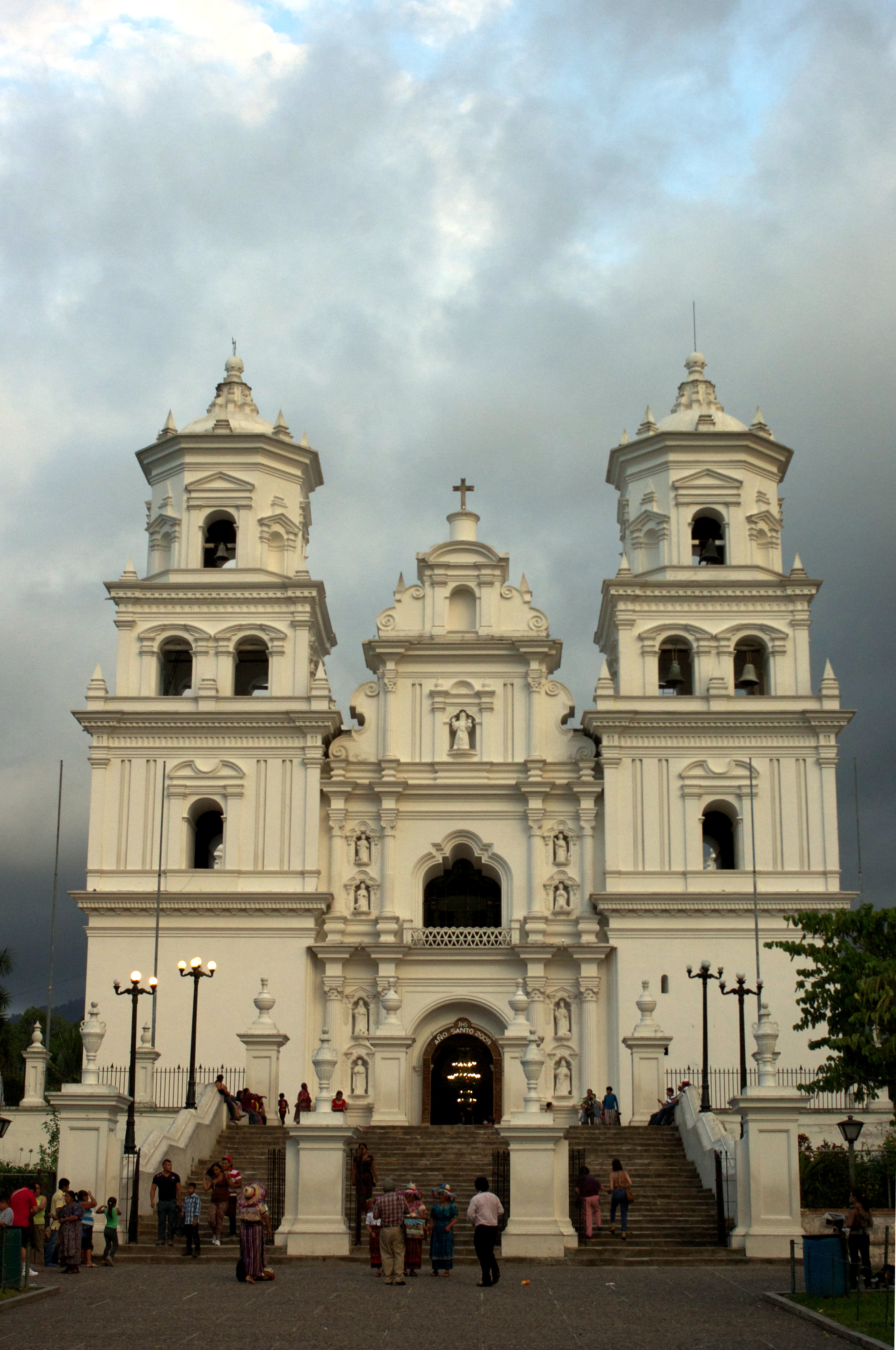
Esquipulas
In 1594, the villagers of a remote Guatemalan town asked a Portuguese sculptor named Quirio Catano to carve them a crucifix. They had one stipulation: the Christ must have a dark complexion, matching the skin of the indigenous and mestizo people who would pray before it. Catano delivered the sculpture on October 4 of that year, and it arrived in the village the following March. More than four centuries later, between four and five million people travel to Esquipulas annually to kneel before that same figure -- the Black Christ -- in a basilica that Pope John Paul II declared "the spiritual center of Central America." The Nahuatl name for this place, Isquitzuchil, means "where flowers abound." What abounds here now is faith.
Roots in the Valley
Long before the basilica drew pilgrims from across the continent, the valley of Esquipulas was home to the Ch'orti' Maya, descendants of the great civilization centered at nearby Copan. Another group, the Payaqui, also settled here -- their priest Topiltzin Axcitl founded the Kingdom of Payaqui in a lineage reaching back, by some accounts, to 1000 BC. Spanish forces arrived in 1525 under the command of Pedro de Alvarado's captains, conquering the province of Chiquimula and imposing Catholicism on the indigenous population. Between 1550 and 1560, Juan Perez Dardon formally founded the town of Yzquipulas, laying out a main street running from the Iglesia de Santiago to the town aqueduct. By the early 1700s, the community numbered 198 people in its baptismal registry. Settlers kept coming, drawn by the extraordinary fertility of the surrounding valleys.
The Dark Christ
The sculpture that transformed Esquipulas from a colonial outpost into a continental shrine was an act of devotion made tangible in balsam wood. When the Black Christ arrived in 1595, it was installed in a small hermitage outside town, and almost immediately the inhabitants began calling it miraculous. By 1650, pilgrims were arriving from as far as El Salvador and Comayagua. The growing crowds demanded a proper church: construction of the Santiago Church began in 1680 and finished in 1682, when the sculpture was moved inside. But even that building proved insufficient. In 1740, Bishop Pedro Pardo de Figueroa -- grateful for what he believed was a miraculous healing -- commissioned architect Felipe Jose de Porres to build a basilica grand enough for the ever-swelling pilgrimages. Pardo de Figueroa died in 1751, still supervising construction, and was buried on the grounds. The basilica was completed in 1758 and inaugurated on January 4, 1759.
Faith and Holy Earth
Pope Pius XII established a special prelature for the Black Christ in 1956, and in 1959, Benedictine monks from the Abbey of San Jose in Louisiana arrived to care for the sanctuary -- a responsibility the order still holds. Pope John XXIII elevated the church to the rank of Minor Basilica in 1961, the only basilica so designated in all of Central America. Esquipulas is also famous for its Tierra Santa tablets -- small cakes of clay pressed from local deposits that pilgrims purchase during church festivals. Known by a constellation of regional names -- akipula, cipula, askipula, kipula -- these tablets are believed by many to have curative properties. Pilgrims eat the clay or rub it on their bodies, a practice that echoes similar traditions at the sister shrine of El Santuario de Chimayo in New Mexico, with which Esquipulas shares a deep spiritual connection.
Peace and Coffee
Esquipulas shaped not only the spiritual life of Central America but its political destiny. During the mid-1980s, the town hosted the Esquipulas Peace Accords, a landmark diplomatic effort that helped end the civil wars tearing through the region. Pope John Paul II visited in 1996 for the 400th anniversary of the shrine, and Mother Teresa of Calcutta also made the pilgrimage. Beyond its religious significance, the town sustains a strong agricultural economy. Coffee farms in the surrounding hills -- including Finca Cloud and Cascajal -- have won national and international competitions for producing some of Guatemala's finest coffee. The combination of fertile volcanic soil, elevation, and consistent rainfall creates ideal growing conditions, and the coffee trade provides an economic counterweight to the town's dependence on religious tourism.
A Living Pilgrimage
Walking through Esquipulas today, the twin plazas tell the town's story. Parque de la Basilica anchors the south end of the main street, where the white facade of the basilica rises above everything. To the north, Parque Centroamerica sits beside the older Santiago Church. Between them, the streets fill with vendors selling candles, rosaries, and Tierra Santa tablets. The Stone of the Compadres -- two enormous boulders balanced impossibly atop each other, weighing an estimated 50 tons and blackened by centuries of ritual candle smoke -- draws visitors to the outskirts. A local legend says two friends were turned to stone for betraying their sacred bond. Nearby, the Mine Caves along the Rio Chacalapa still attract indigenous pilgrims who burn copal incense and leave offerings in the darkness. Esquipulas registered on UNESCO's tentative World Heritage list in 2002, recognition of a place where Maya heritage, colonial architecture, and living Catholic devotion have intertwined for half a millennium.
From the Air
Located at 14.62N, 89.20W in the department of Chiquimula, eastern Guatemala, near the Honduras border. The town sits in a valley at moderate elevation surrounded by hills. Nearest major airport is La Aurora International Airport (MGGT) in Guatemala City, approximately 220 km to the west. Regional strips may exist closer but lack commercial service. Approach from the east reveals the distinctive white basilica as the dominant structure in town. Fly at 2,000-4,000 feet AGL for best view of the valley setting and the basilica complex. The Trifinio Biosphere Reserve lies nearby at the convergence of the Guatemala, Honduras, and El Salvador borders.