Essen Minster
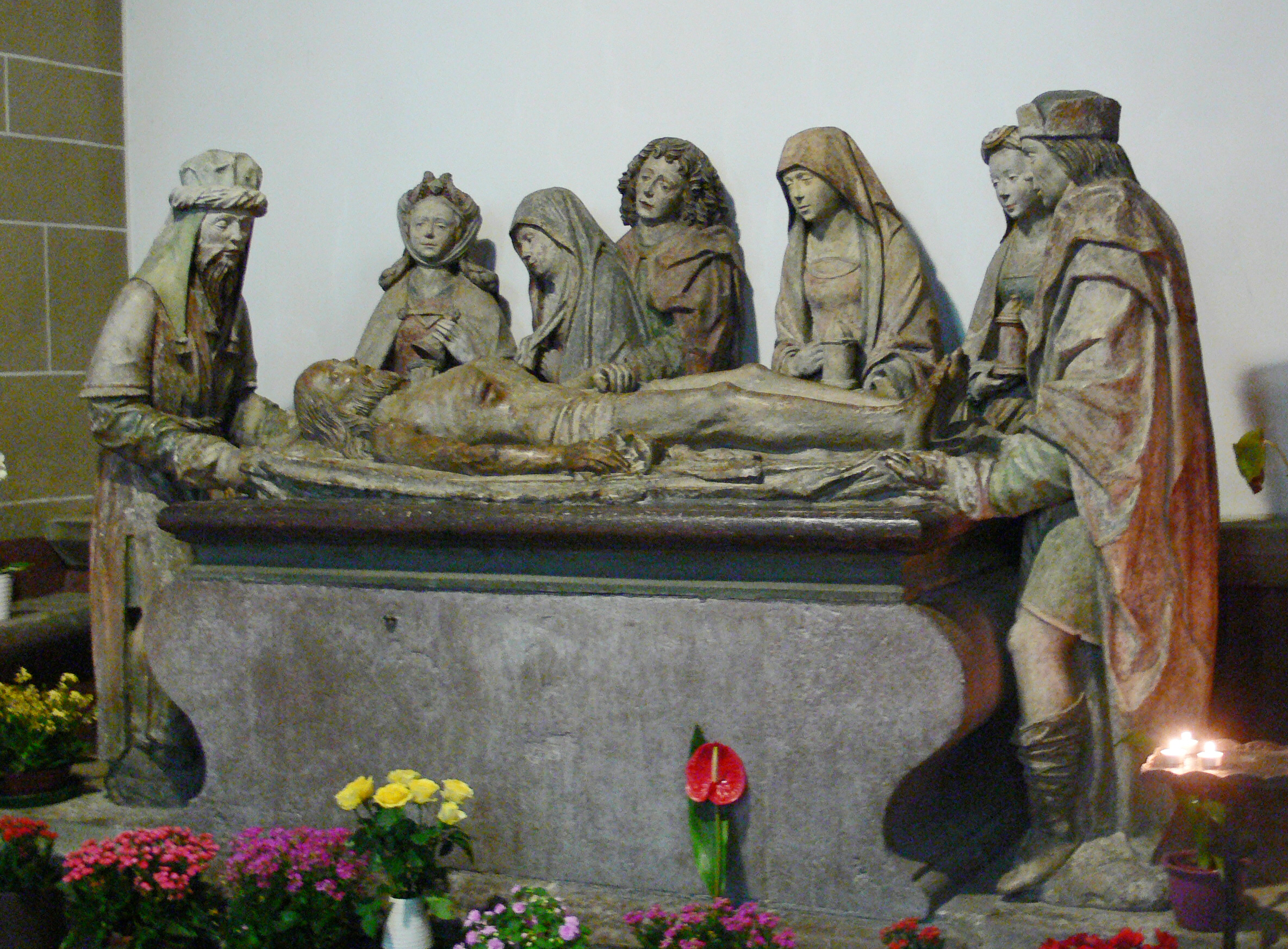
For nearly a thousand years the most powerful person in Essen was a woman. Not a duchess or a queen, but the Abbess of Essen, who from the ninth century until the Napoleonic mediatization of 1803 ruled both a community of aristocratic canonesses and a small imperial principality that grew up around them. Their church is still standing in the middle of the modern city. It is called Essen Minster, or - since the diocese was created in 1958 - Essen Cathedral. Its octagonal westwork has been watching over the Burgplatz since the eleventh century. Inside, in a chapel beside the choir, sits the oldest fully sculptured figure of the Virgin Mary in the world.
The Abbess and Her Estate
Bishop Altfrid of Hildesheim founded the abbey around 845 on an estate called Asnide, which became Essen. The community he established was unusual. The women were not Benedictine nuns under the strict rule of poverty and enclosure; they were secular canonesses governed by the milder Institutio sanctimonialium, issued at Aachen in 816. They held private property. They could leave to marry. At the community's height in the tenth century, under the Abbess Mathilde, there were about seventy of them. By the sixteenth century there were three. Their church was effectively private - the people of Essen were only admitted for the high feast days. For the rest of the year the parish ducked next door into St Johann Baptist, the smaller church attached to the westwork by a short atrium. The Reformation made almost no dent in any of this. The burgers of Essen mostly went Protestant; the canonesses stayed Catholic; everyone kept their building.
Theophanu's Westwork
The minster you see today is the third church on this site. The first, built between 845 and 870, burned in 946. The second was a great Ottonian basilica raised under Abbesses Mathilde and then Theophanu - the latter likely commissioning the extraordinary westwork that still anchors the building's west end. From outside it looks like an almost square central tower crowned by an octagonal belfry with a pyramidal cap, flanked by two smaller octagonal staircase towers. Inside, the west choir takes the form of half a hexagon, modeled on the west choir of Aachen Cathedral - Charlemagne's own foundation - and like Aachen it uses the octagon as a belfry. The Last Judgement was once painted across its half-cupola, showing Christ appearing to the kneeling Theophanu, whose Greek name actually means divine apparition. The crypt below, consecrated on 9 September 1051, still holds the bones of saints in its altars.
Gothic Independence
In 1275 the Ottonian church burned down. Only the westwork and the crypt survived. When the rebuild began under the abbesses Berta von Arnsberg and Beatrix von Holte, the choice of style was a political statement. The Archbishop of Cologne was busy raising his enormous new cathedral down the river and pressing claims to authority over Essen. The Essen canonesses refused to copy him. Instead of a soaring basilica they chose the hall church - nave and aisles at the same height, a more Westphalian form, plainly different from anything in Cologne. Master Martin, a builder from Burgundy and Champagne who knew the design idiom of Trier and Cologne, drew up the plan but quit in 1305 after disputes with Beatrix von Holte. His unnamed successor finished the work and the church was consecrated, probably on 8 July 1316. The minster still celebrates 8 July as its anniversary.
March 1943
On the night of 5 and 6 March 1943, 442 Royal Air Force aircraft flew over Essen and dropped 137,000 incendiary bombs and 1,100 high explosives on the central city in under an hour. The Krupp works were the target. The minster caught fire and suffered heavy damage, though the oldest parts of the building - the Ottonian westwork and the crypt - came through better than the rest. After the city's occupation the new council, under the communist mayor Heinz Renner, voted unanimously at its first meeting to rebuild. Work began in 1951. The nave was usable again by 1952; the full church by 1958, just in time to become the seat of the new Diocese of Essen. The damage allowed the archaeologist Walter Zimmermann to excavate beneath the floor and recover, for the first time, the foundation walls of the earlier churches that had stood on the same plot.
Two Pieces of Gold
Step inside today and your eye will be pulled to two objects above all others. In the center of the westwork stands a seven-armed bronze candelabrum, 2.26 meters tall, 1.88 meters across, cast in 46 individual pieces under Abbess Mathilde between 973 and 1011. It symbolizes the Trinity, the four corners of the earth, and Christ as the light of the world who will lead believers home at the Last Judgement. In the northern side chapel, displayed since 1959, sits the Golden Madonna - 74 centimeters of gilded poplar, the oldest fully sculptural figure of Mary in Western art, made under Mathilde around the year 980 and restored once again in 2004. She was placed here by an abbess who was related to the Ottonian dynasty, and for a thousand years she has been carried in processions, hidden during wars, and brought back to the same chapel. The minster around her has been built three times. She has not moved.
From the Air
Essen Minster stands at 51.456 degrees north, 7.014 degrees east, on the Burgplatz in the dead center of the old town, immediately north of the Hauptbahnhof and the A40 motorway. From the air the distinctive marker is the squat, almost-square central tower of the westwork with its octagonal belfry, attached to a slender flèche over the crossing - very different from the soaring twin spires of Cologne 60 km to the southwest. The smaller church of St. Johann Baptist is bonded to the minster on the west side via a short atrium. Düsseldorf International (EDDL) is about 30 km southwest; Dortmund (EDLW) about 30 km east. Recommended viewing altitude 2,500 to 4,000 feet for a clear read of the westwork-and-nave silhouette.