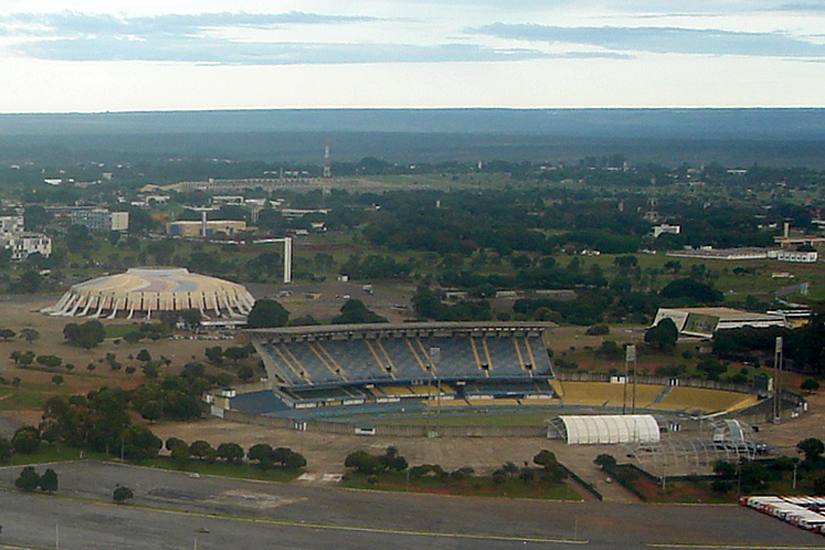
Estadio Nacional Mane Garrincha
Brasilia spent $900 million on a stadium that hosted seven matches during the 2014 World Cup and has struggled to find regular tenants since. Against its original budget of $300 million, the final cost made the Mane Garrincha the third-most expensive football stadium in the world after Wembley and Tottenham Hotspur Stadium. Critics called it a white elephant. Defenders pointed out that the capacity of 69,910 makes it one of the largest stadiums in Brazil, which matters when you are hosting a World Cup. Both sides had a point. What neither could argue with was the name on the door, which honors one of the strangest and most beloved figures in Brazilian football history.
The Crooked-Legged Angel
Manuel Francisco dos Santos, known to everyone as Mane Garrincha, was born in 1933 with a spine twisted by scoliosis, a left leg bent outward, a right leg six centimeters shorter and bent inward, and childhood polio on top of all that. His nickname came from the garrincha, a little wren-like bird common to the Brazilian interior. By every medical expectation, he should never have played professional sport. He won two World Cups for Brazil, in 1958 and 1962, and on a Brazilian team stocked with Pele he was often the best player on the field. His ball control with those mismatched legs seemed to violate physics. Defenders could not predict which direction a Garrincha cut would go because his own body seemed to be improvising in real time. He died in 1983 at age 49, destroyed by alcoholism, and Brazilians have been building things to honor him ever since. The stadium is one of them.
From 1974 to 2013
The original Mane Garrincha opened in 1974 with a capacity of 45,200 people, named then for Governor Helio Prates da Silveira. In the 1980s the stadium was renamed for Garrincha, and it stood as Brasilia's main football venue for three more decades without major distinction. In 2010, with Brasilia confirmed as one of twelve host cities for the 2014 World Cup, the decision was made to demolish and rebuild. Two failed demolition attempts with explosives led the consortium of Andrade Gutierrez and Track Engineering to switch to mechanical demolition. Construction dragged through delays, cost overruns, and corruption investigations. The inauguration on May 18, 2013, with President Dilma Rousseff attending, featured a Brasiliense Candangao final in which Brasiliense beat Brasilia 3-0. The new capacity was 69,910. All the seats were red.
Seven World Cup Matches
During the 2014 World Cup, the Mane Garrincha hosted seven matches, including the third-place playoff. Switzerland beat Ecuador 2-1 on June 15 with Haris Seferovic scoring the latest game-winning goal in group-stage history. Colombia beat the Ivory Coast 2-1 and qualified for its first knockout stage in 24 years. Brazil thrashed Cameroon 4-1 with two Neymar goals. Portugal and Ghana drew 2-2 after Cristiano Ronaldo scored to become the first Portuguese player to score at three consecutive World Cups; had Ghana won, they would have eliminated the United States. Argentina beat Belgium 1-0 on a Gonzalo Higuain goal in the eighth minute to reach their first semifinal in 24 years. France beat Nigeria 2-0 to reach the quarterfinal. And on July 12, Brazil lost 3-0 to the Netherlands in the third-place match, ending a tournament in which Brazil allowed more goals than in any World Cup in its history. Seven matches at roughly $130 million per match in construction cost.
Stadium Without a Team
The problem for the Mane Garrincha after 2014 has been the same problem that faced the Arena da Amazonia in Manaus, the Arena das Dunas in Natal, the Arena Pantanal in Cuiaba: a stadium built to FIFA's specifications in a city without a major football club to fill it. Brasilia has no team in Brazil's top division, the Brasileirao. The local sides play in lower divisions and draw crowds in the thousands rather than the tens of thousands. Mixto from Mato Grosso has the record for most state titles and is the only Mato Grosso club to have played in the Brasileirao, and that was in 1976 and 1986. For Brasilia, the stadium has remained primarily an event venue. Beyonce sang here on the Mrs. Carter Show Tour in 2013. Bruno Mars played two nights in October 2024. Guns N' Roses, Aerosmith, Iron Maiden, Linkin Park, all have passed through. The 2016 Olympics brought ten football matches back. The 2021 Copa America hosted the opening match between Brazil and Venezuela. In 2019, the stadium passed to private administration under Arena BSB company, and a naming-rights deal with Banco de Brasilia rebranded it Arena BRB Mane Garrincha.
The Final Concert That Was Not
On March 2, 1996, the band Mamonas Assassinas played their final concert at the Mane Garrincha. Later that night after the show, the quintet from Guarulhos boarded a Learjet at Brasilia International Airport bound for Sao Paulo. The plane crashed into the Serra da Cantareira near Sao Paulo's Guarulhos airport, killing everyone on board. The band had been preparing to leave for Portugal the next day. In June 1988, Legiao Urbana, the Brasiliense rock band whose members had grown up in the city, played the stadium and the show ended in chaos when fans threw homemade bombs toward the stage. Hundreds of young people were hospitalized, and recordings of the band's records were publicly burned by angry parents. Legiao Urbana never performed in their hometown again. The stadium holds these memories along with the football ones: a building designed for crowds, collecting the weight of what happens when crowds gather.
From the Air
The Arena BRB Mane Garrincha sits at 15.78 S, 47.90 W in Brasilia's Ayrton Senna Sports Complex, along the Monumental Axis. Cruise at 3,500 to 5,000 feet to take in the stadium's distinctive circular roof ring alongside other Oscar Niemeyer landmarks of the capital. Brasilia International Airport (SBBR) is 11 km southeast of the stadium. The city sits at 1,100 meters elevation on the central Brazilian plateau.