Estate Rust Op Twist
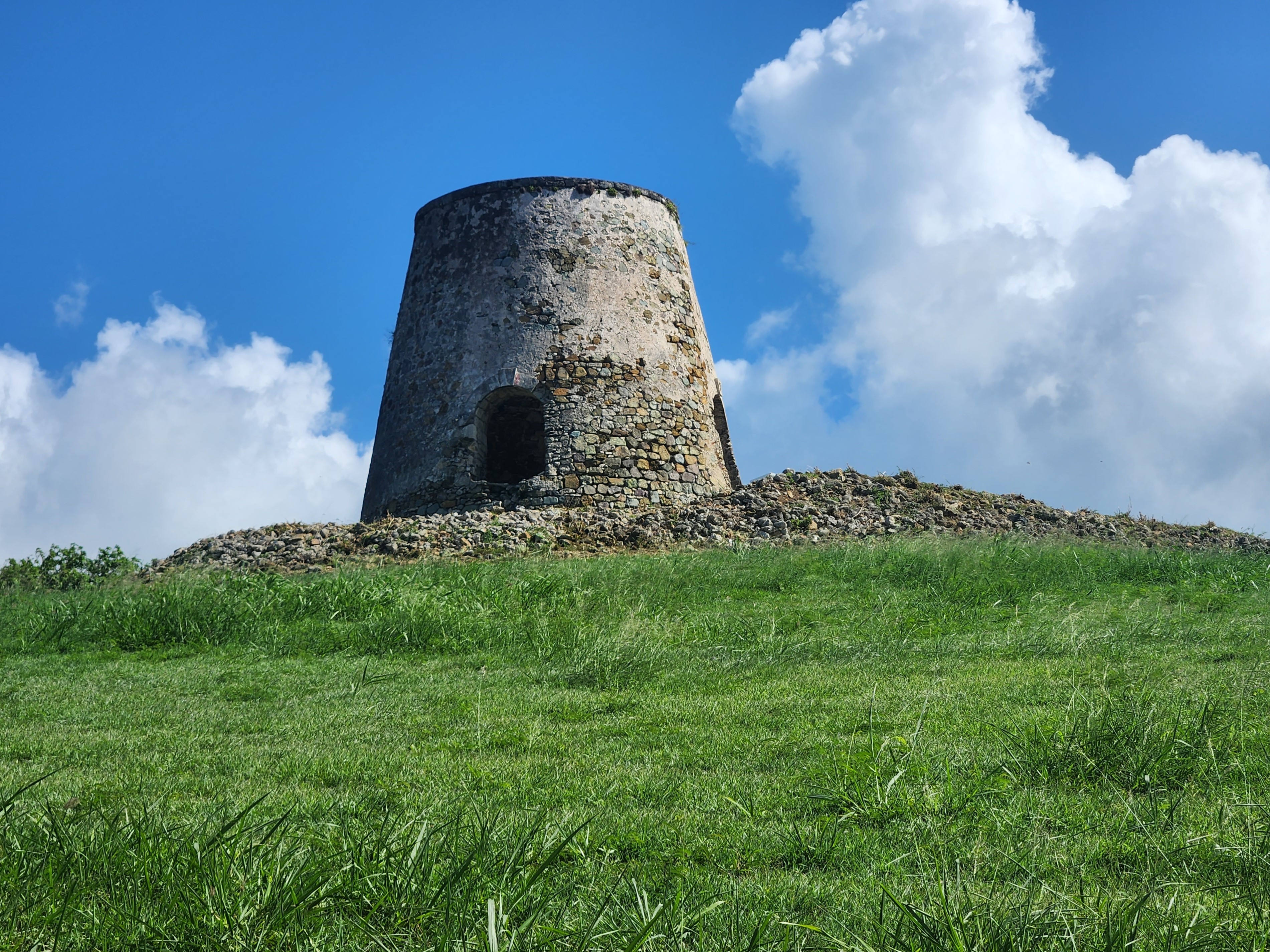
The name is almost too perfect. Rust-Op-Twist -- Dutch for "Rest After Struggle, Toil, or Strife" -- was what Danish colonists called their sugar plantation in a valley ringed by five hills on the north side of St. Croix. For the plantation owners who cycled through bankruptcies and debt crises across 130 years of sugar production, the name might have felt aspirational. For the hundreds of enslaved people whose labor actually produced the sugar, ground the cane, and built the stone walls that still stand, it reads more like a cruel irony. Today, the estate's windmill tower, animal mill, and a remarkably preserved Scottish-built steam engine sit quietly near Christiansted, monuments to an industry that shaped -- and scarred -- every inch of these islands.
A Valley Between Five Hills
In the 1730s, the Danish West India-Guinea Company surveyed St. Croix and carved it into nine districts. Northside Quarter B remained largely unsettled until 1751, when Nicolai Tuit and Company purchased seven plantations there, including the 200-acre estates numbered 5 and 6. They sat uncultivated for years -- pure land speculation -- until the Danish government threatened confiscation in 1755. Johann Balthazar Uytendaal, living 40 miles away on St. Thomas, took ownership in 1757 and never moved to the island. He ran the plantation through a foreman and began expanding his enslaved workforce: 16 people in 1759, 30 by 1765, 87 by 1769 -- the largest number in the quarter. By 1773, 158 enslaved people worked Uytendaal's land. An animal mill appeared on the property, its circular stone wall roughly four feet high and three feet wide, still traceable today about 100 yards east of the warehouse that now houses the steam engine.
Debt, Sugar, and Human Lives
The Uytendaals borrowed heavily from Dutch lending firms to expand operations and acquire more enslaved workers -- a common practice among St. Croix planters in the 1760s. When those Dutch firms went bankrupt in the late 1700s, the cascading financial collapse dragged down the planters they had financed. By 1793, the Uytendaal debt had ballooned to 203,142 Dutch florins, and a court order forced the family to surrender their estates and 125 enslaved people to a trust. Ownership passed through Hans Winding and William Woods, who in 1800 held 420 acres with 156 enslaved workers, then to Nicolai Jurgenson, and then to Count Adam Moltke. Moltke held the estate until 1849 -- one year after the governor of St. Croix emancipated the enslaved population. The timing was not coincidental: the sugar economy and slavery were so deeply intertwined that the end of one meant the collapse of the other.
The Glasgow Engine
In 1850, with the estate on the auction block, an agent ordered a steam engine and cane mill from the McOnie and Mirrlees Company in Glasgow, Scotland. The Historic American Engineering Record later called it a "classic example of the foundry or cast-iron age of engine-building." Its flywheel measures 10 feet in diameter, built with wrought-iron spokes and a cast-iron hub. The engine delivered roughly 20 horsepower -- enough to crush about 5 tons of cane per hour through three rollers turning at roughly two revolutions per minute. Sugar exports climbed from 42,336 net pounds in 1850 to 144,861 pounds by 1855. But drought struck in 1856, hurricanes battered the island, and production never recovered its peak. The engine still sits on its original stone base, missing only a few valve components and a bearing cap -- an industrial artifact preserved by the very decline that made it obsolete.
Fireburn and the End of Sugar
By the 1870s, the St. Croix sugar industry was dying. Julius Arendrup took ownership in 1874 and watched production collapse to just 15,405 pounds by 1877. Then came October 1878 and the Fireburn -- a labor revolt in which formerly enslaved workers set plantations ablaze across St. Croix. The Arendrup family fled into the hillside bushes as flames consumed their residence and works. The steam machinery survived; little else did. Arendrup went bankrupt. Sugar production limped on until 1881, when the estate produced its last four hogsheads from 29 acres. A group of Danish businessmen purchased Rust-Op-Twist and nine other failing estates to experiment with alternative crops. The results are lost to history. By 1948, the property passed into private hands, and the University of Texas Marine Science Institute eventually leased the old plantation buildings for laboratories and warehouses.
What the Stones Remember
Three types of mill stand within a few hundred yards of each other at Rust-Op-Twist: the circular stone wall of the animal mill, the windmill tower likely built with loan money from 1769, and the Glasgow steam engine from 1850. Together they trace the full arc of Caribbean sugar technology -- and the human cost behind each upgrade. The former slave quarters and overseer's residence have been restored as contemporary housing. The factory ruins, rebuilt in modern times, retain stone archways that once framed the sugar-works room with its coppers and clarifiers. The estate sits on the National Register of Historic Places, a designation that preserves its physical structures but cannot fully convey what happened within them. Rust-Op-Twist's name promised rest after struggle. For most of the people who lived and labored here, that rest came only with emancipation -- or never came at all.
From the Air
Estate Rust-Op-Twist sits on the north side of St. Croix near Christiansted (17.78N, 64.79W). From 2,000-3,000 feet AGL, the estate's valley setting ringed by hills is visible, with the windmill tower and plantation structures identifiable along the coastal lowlands. Nearest airport: Henry E. Rohlsen Airport (TISX/STX) approximately 8 miles south. The Christiansted waterfront and harbor are visible landmarks to the east. The estate is inland from the north shore, set back from Salt River Bay.