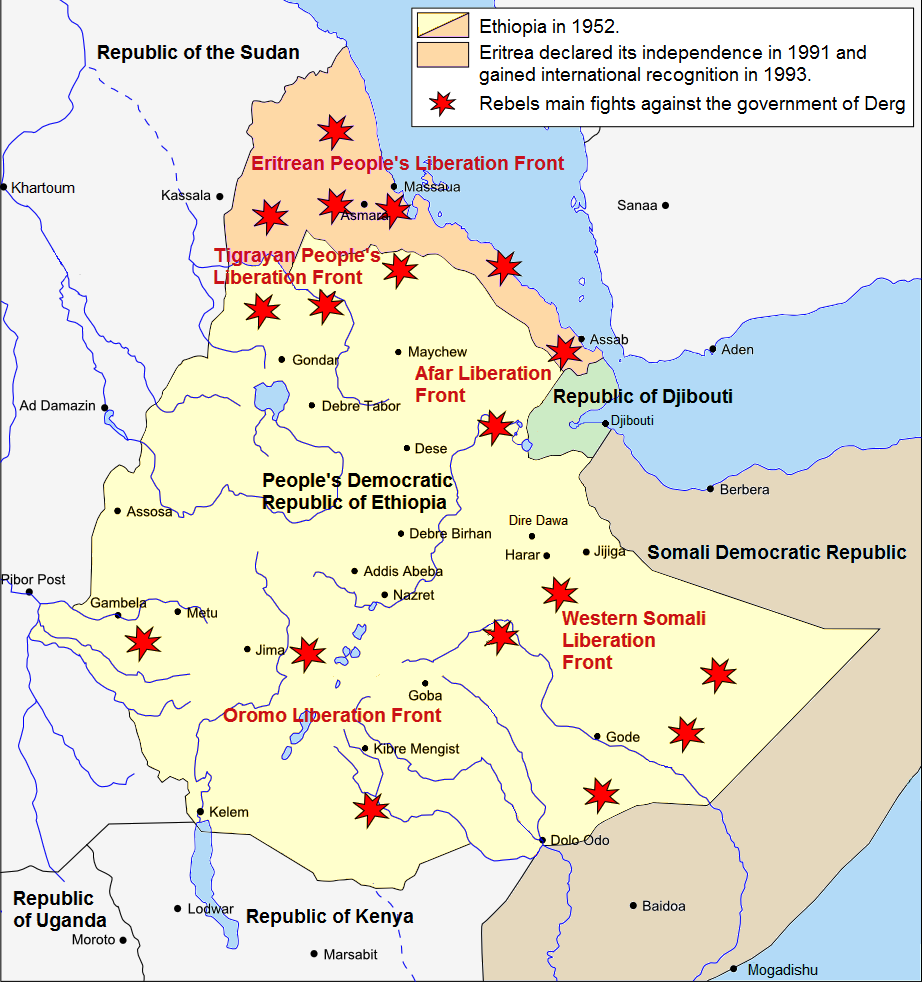
Ethiopian Civil War
On 12 September 1974, a committee of military officers calling themselves the Derg deposed Emperor Haile Selassie, ending a dynasty that claimed descent from King Solomon. What replaced it was not liberation but a new kind of tyranny. Over the next seventeen years, Ethiopia would endure a Marxist-Leninist military junta, a campaign of state terror that killed tens of thousands, a famine that starved a million people, and civil wars on multiple fronts simultaneously. By the time the Derg fell in May 1991, at least 1.4 million Ethiopians were dead. Hundreds of thousands more had fled the country, creating a global diaspora for the first time in Ethiopia's long history. The scars of what happened between those two dates remain etched into the landscape and the memory of the Horn of Africa.
The Unraveling of an Empire
The Ethiopian Empire was already fracturing before the Derg seized power. By the 1960s, stagnating economic development, widespread human rights abuses, and an aging emperor's grip on an increasingly restless population had created pressure from every direction. A radicalized student movement demanded land reform and democratization. The military, recruited from educated Ethiopians and repeatedly deployed to suppress protests and regional revolts in Ogaden, Bale, and Eritrea, grew politically aware and increasingly resentful. Eritrean separatists had been fighting since 1961. When the Derg overthrew Haile Selassie, they inherited these conflicts and added new ones. The junta nationalized industries, seized royal assets, and attempted to impose socialism on a deeply traditional society. Under their rule, the military officer corps remained dominated by the Amhara ethnic group, with over 80 percent of generals and 65 percent of colonels drawn from their ranks, perpetuating patterns of ethnic dominance that dated back centuries.
The Red Terror
The Derg never fully consolidated power, and the vacuum they created invited challengers from every political direction. Conservative monarchists, rival Marxist-Leninists, ethnic liberation fronts: the opposition was as fractured as it was determined. In 1976, the regime launched the Qey Shibir, the Red Terror, a campaign of violent political repression targeting the Ethiopian People's Revolutionary Party and later the All-Ethiopia Socialist Movement. When Mengistu Haile Mariam became chairman of the Derg on 3 February 1977, the violence intensified. Summary executions, assassinations, torture, imprisonment without trial: these became tools of governance. Families were charged fees to collect the bodies of their executed relatives. Estimates of the Red Terror's victims range from 30,000 to 750,000, and the majority are believed to have been civilians with no connection to the opposition. Rather than crushing resistance, the terror's indiscriminate brutality drove more Ethiopians toward the rebel groups it was meant to destroy. Many of those killed remain unaccounted for, their families still waiting for answers decades later.
War on Every Front
The Derg fought simultaneously on fronts that stretched from Eritrea in the north to the Ogaden in the southeast. In 1977, Somalia invaded to support the Western Somali Liberation Front, delivering a devastating blow. A massive Soviet and Cuban military intervention, transferring two billion dollars in equipment and deploying 17,000 Cuban troops, drove back the Somali forces but could not end the other insurgencies. In Eritrea, 60,000 to 70,000 Ethiopian troops struggled against the Eritrean People's Liberation Front. In Tigray, the regime bombed towns and villages with napalm and cluster munitions. Massive infantry sweeps through the countryside killed civilians indiscriminately. The Tigray People's Liberation Front controlled most of the countryside, confining government forces to major towns and highways. Meanwhile, the Derg's land reforms, though addressing genuine feudal injustice, were so badly managed that agricultural production collapsed. When the 1983-1985 drought struck, the result was catastrophic famine. Between 400,000 and 590,000 people died of starvation. Ten million were affected.
The Reckoning
The end, when it came, was swift. Soviet support dried up in the late 1980s. The Battle of Shire in February 1989 marked a decisive rebel victory. By May 1991, the Ethiopian People's Revolutionary Democratic Front, a coalition of ethnic rebel groups, was advancing on Addis Ababa. Mengistu fled to Zimbabwe on 21 May, where he still resides. A week later, the EPRDF entered the capital. The Workers' Party of Ethiopia was disbanded. Nearly all remaining senior Derg officials were arrested. In December 2006, after years of legal proceedings, 72 Derg officials were found guilty of genocide, with 25, including Mengistu, tried in absentia. The civil war's toll extended far beyond the battlefield. Forest cover in Wollo Province had fallen to 2.2 percent by 1980, and in Tigray to just 0.5 percent. Soil erosion threatened to reduce grain production by 120,000 tons annually. Ethiopia adopted a federal democratic system after the war, an attempt to represent the many ethnic groups whose grievances had fueled seventeen years of bloodshed. But the human cost, 1.4 million dead, cannot be captured in political structures alone.
From the Air
Centered on Addis Ababa at 9.0N, 40.0E, though the conflict spanned the entire country from Eritrea in the north to the Ogaden in the southeast. The Red Terror Martyrs' Memorial Museum in Addis Ababa (near HAAB, Bole International Airport) documents the era. From altitude, the Ethiopian highlands' severe deforestation, a consequence of the war years, is visible in the stripped terrain of Wollo and Tigray provinces to the north. The Rift Valley floor to the east and the highland plateaus to the west defined the geography of the conflict.