Eugene O'Neill National Historic Site
Eugene O'Neill had lived in more than thirty-five places before he found the one he would call his "final home and harbor." The son of an actor, born in a Broadway hotel room, raised on the road, O'Neill spent decades moving -- from boarding schools to a tuberculosis sanatorium, from a dive bar in lower Manhattan to a château in France. He drank enormously, married three times, and wrote plays that redefined American theater. Then, in 1937, he used his Nobel Prize money to build a house on a hillside above Danville, California, in the San Ramon Valley. He named it Tao House, after the Chinese philosophy of "the way." For seven years, in a study lined with books and silence, he wrote the plays that would cement his reputation as the greatest dramatist America has produced.
Prize Money and Pine Trees
O'Neill won the Nobel Prize for Literature in 1936, the first and still only American playwright so honored. He was too ill to attend the ceremony in Stockholm -- a tremor in his hands, later diagnosed as a cerebellar cortical atrophy, was already making it difficult to write. The prize money, roughly forty thousand dollars, went toward building Tao House in the rolling hills east of San Francisco Bay. The Monterey Colonial-style home, with its white stucco walls and dark wood beams, was designed to be a retreat. O'Neill and his third wife, the actress Carlotta Monterey, planted pine, almond, and redwood trees on the property. Carlotta laid out the garden in a zigzag pattern -- Chinese tradition held that evil spirits could only travel in straight lines, and the zigzag would turn them away. Whether the spirits cooperated is unclear, but the isolation worked. O'Neill wrote steadily here, even as his tremor worsened and the words on his manuscript pages grew larger and more ragged.
Four Plays in Seven Years
The work O'Neill produced at Tao House between 1937 and 1944 represents the summit of American drama. The Iceman Cometh, a four-hour marathon set in a skid-row saloon, dissects the lies people tell themselves to survive. Long Day's Journey Into Night -- which O'Neill sealed in a safe with instructions that it not be published until twenty-five years after his death -- is an autobiographical reckoning with his family's addictions, delusions, and desperate love. Hughie, a one-act dialogue between a small-time gambler and a night clerk, achieves in forty minutes what most playwrights cannot manage in three hours. A Moon for the Misbegotten closes the cycle with a story of forgiveness set on a Connecticut farm. These four plays share a quality that sets them apart from O'Neill's earlier, more experimental work: a willingness to sit with pain without flinching, to let characters talk until the truth falls out of them. The Danville hills gave O'Neill the quiet he needed to listen that closely.
Saved from the Wrecking Ball
O'Neill and Carlotta left Tao House in 1944, and the property changed hands. By the early 1970s, it faced demolition. Several women stepped in. Darlene Blair and Lois Sizoo founded the Eugene O'Neill Foundation to raise money to purchase the house, which had been designated a National Historic Landmark in 1971. Their fundraising efforts included benefit performances of O'Neill's one-act Hughie starring Jason Robards, an actor whose career was inseparable from O'Neill's work -- Robards had originated the role of Jamie Tyrone in the Broadway premiere of Long Day's Journey Into Night in 1956. In 1975, Congressman George Miller and Senator Alan Cranston introduced companion bills to have the site recognized as a National Historic Site. President Gerald Ford signed the legislation in October 1976, and by June 1980, Tao House had been transferred to the National Park Service. The Foundation still maintains an archive at the site, including photographs, playbills, manuscripts, and O'Neill's original phonograph record collection.
A Place You Cannot Simply Drive To
Visiting Tao House requires a small act of intention. The National Park Service does not publish the site's address, though it is widely known to sit near Kuss Road in Danville. A locked gate blocks the private road. The property occupies thirteen acres accessible only by a free shuttle that runs twice daily from downtown Danville -- at 10 a.m. and noon, Wednesday through Sunday, with an additional 2 p.m. departure on Saturdays. Private vehicles are not allowed. The inconvenience is the point, or at least it rhymes with O'Neill's original purpose: Tao House was built to be hard to reach. O'Neill wanted separation from the world that consumed him, a buffer of hills and oaks between his study and the noise. Trails from Las Trampas Regional Wilderness also lead to the site, and visitors occasionally arrive on horseback or on foot, approaching the house the way the landscape suggests you should -- slowly, with effort, leaving the freeway behind.
The Study Where the Silence Worked
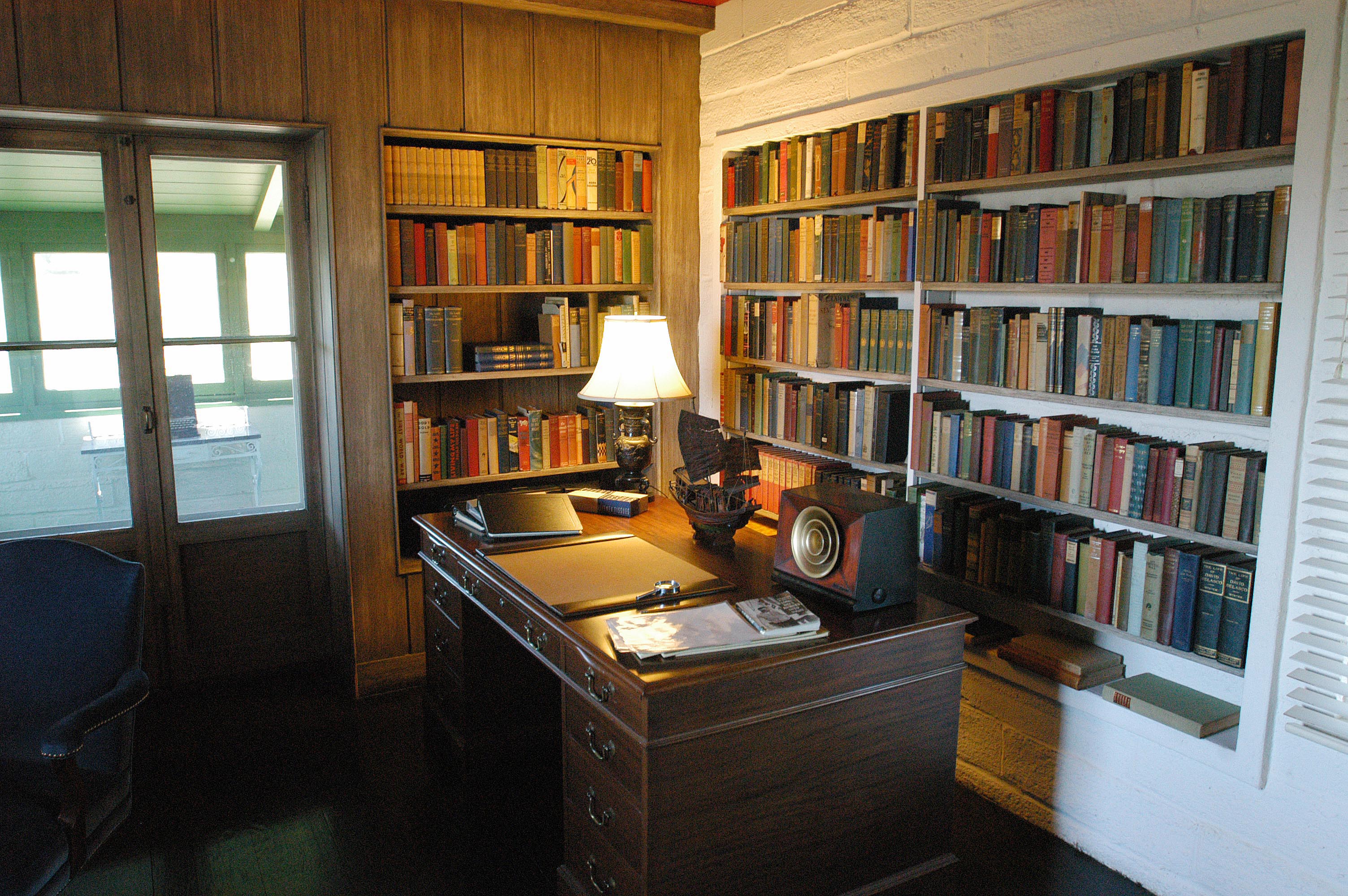
O'Neill's study at Tao House has been preserved much as he left it. The room faces the hills, not the valley -- he wrote looking east, away from the bay and the cities, toward the dry grass ridgeline of the Diablo Range. The desk where his trembling hand traced the words of Long Day's Journey Into Night is still there. So is the sense of enclosure. O'Neill was a large man who craved small rooms, and the study has the proportions of a ship's cabin, which suits a playwright who went to sea as a young man and never entirely left the ocean behind. Productions of O'Neill's plays are still staged in the adjacent barn, performed for audiences who have made the shuttle trip up the hill. There is something fitting about seeing O'Neill in a barn rather than a Broadway theater -- his greatest plays strip away theatrical grandeur to expose raw family dynamics, the kind of reckoning that happens not on a stage but in a kitchen, a bedroom, a study with the door closed.
From the Air
Located at 37.824N, 122.030W in the hills above Danville in the San Ramon Valley, Tao House sits on a wooded hillside east of the Las Trampas Ridge. The site is not visible from high altitude -- it blends into the oak-studded hills of Contra Costa County. Look for the San Ramon Valley running north-south between the East Bay hills and Mount Diablo. Buchanan Field Airport (KCCR) in Concord is approximately 8 nm to the north-northwest. Livermore Municipal Airport (KLVK) is about 15 nm to the southeast. Best viewed below 3,000 feet in clear conditions, though the house itself is small and screened by trees.