Euphrasian Basilica
Bishop Euphrasius had a problem. The old basilica in Porec was falling apart, and he needed something extraordinary to replace it. So in 553, he did what ambitious bishops of the late Roman world did: he imported marble from the Sea of Marmara, summoned mosaic masters from Constantinople, and built a church so remarkable that it would still be standing fifteen centuries later. Today the Euphrasian Basilica remains the best-preserved early-Christian church in the world, a UNESCO World Heritage Site since 1997, and the quiet pride of this small Istrian town on Croatia's Adriatic coast.
Three Churches Deep
The ground beneath the basilica holds layers of faith stretching back to the fourth century. The earliest church on this site was dedicated to Saint Maurus of Parentium, the first bishop of Porec, sometime in the second half of the 300s. Its oratory had been part of a large Roman house, and the original floor mosaic, with its early Christian fish symbol, survives in the church garden. Coins bearing the likeness of Emperor Valens, who ruled from 365 to 378, were found embedded in the same floor, anchoring the dates. That first church grew into a twin-nave basilica, which itself gave way to a fifth-century expansion. Euphrasius built atop all of it, recycling what he could, so the current church literally stands on the bones of its predecessors.
Gold Against Azure
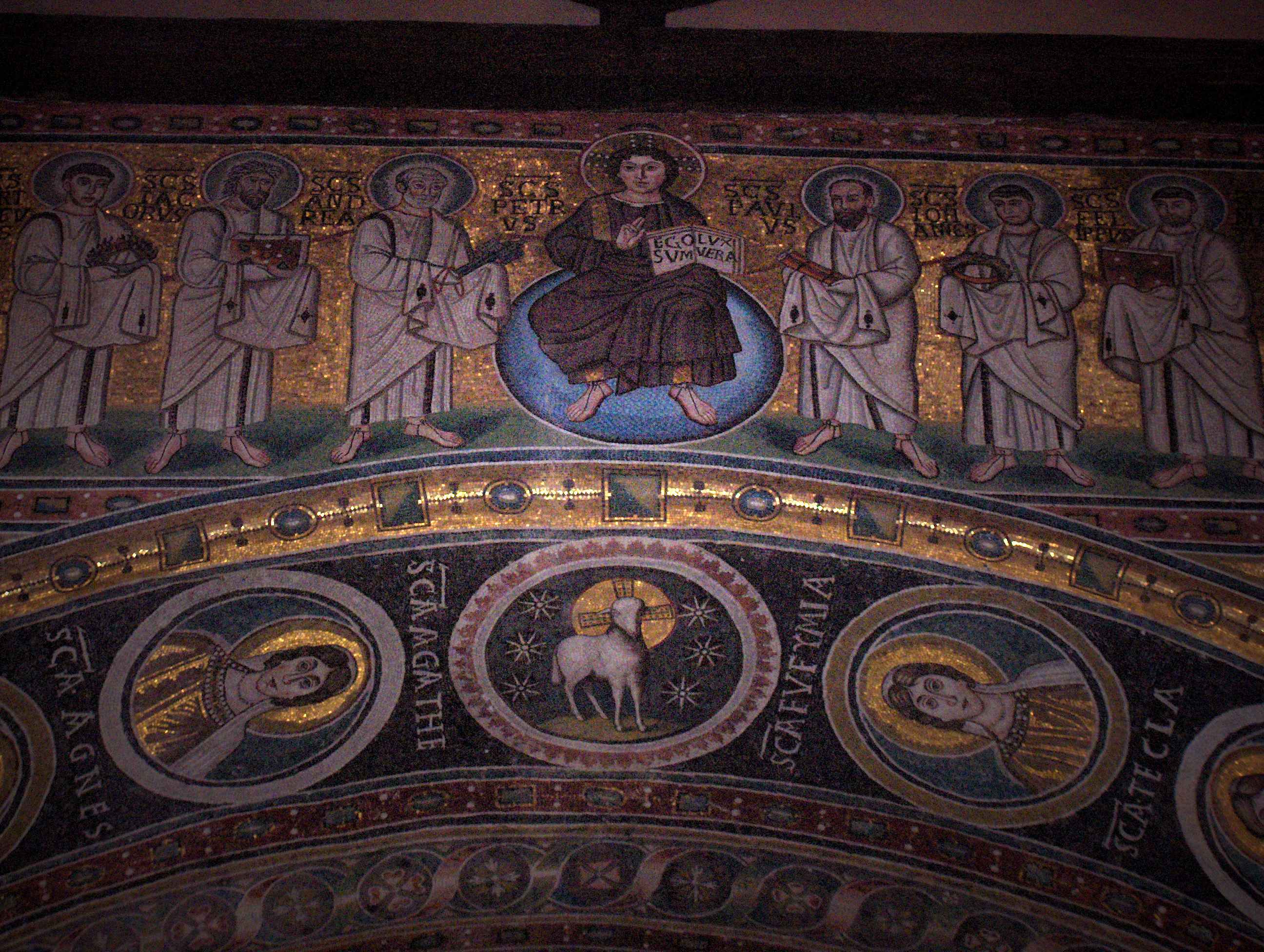
Walk through the colonnaded atrium and the mosaics stop you cold. In the apse vault, the Virgin Mary sits enthroned with the Christ Child, a wreath held above her by a disembodied hand representing God the Father. This is the only such depiction to survive in any early-Christian basilica in Western Europe. Flanking the scene are angels, Bishop Euphrasius himself holding a model of his church, and Saint Maurus. Between Euphrasius and the archdeacon Claudius stands a small boy, identified by inscription as the bishop's nephew. All the figures stand on a meadow of golden flowers. Below, Christ holds an open book inscribed with the Latin words "Ego sum lux vera" -- "I am the true light" -- while twelve female martyrs gaze from medallions on the arch beneath. Byzantine craftsmen executed the wall mosaics; local artisans handled the floors. The collaboration took roughly ten years to complete.
Where East Meets West in Stone
The basilica introduced an architectural innovation that would ripple through Western church design. Rather than closing the apse with a flat wall, as was standard practice, Euphrasius shaped it as a polygon on the exterior while retaining semicircular interior apses for the two side aisles. This made the Euphrasian Basilica the earliest triple-apsed church in Western Europe. Eighteen columns of Greek marble line the nave, their capitals carved with animals and each stamped with the monogram of Saint Euphrasius. The stucco arches between them, the Byzantine tiles on the altar rail, the octagonal baptistery dating to the fifth century -- every element reflects the meeting point of Eastern craft and Western ambition. A marble ciborium modeled after the one in Saint Mark's in Venice was added in 1277, its four supporting columns salvaged from the original sixth-century canopy.
Surviving the Centuries
Fires, earthquakes, and the slow grinding of time have altered details but never destroyed the whole. The earthquake of 1440 shattered the southern nave windows, which were rebuilt in the Gothic style -- the only major concession to a later era. A sixteenth-century bell tower now rises beside the complex, and a trefoil memorial chapel was added across the seventeenth and nineteenth centuries. The bishop's palace, built alongside the basilica in the sixth century, has lost most of its original form. But the basilica itself has held its shape with stubborn resilience, its mosaics still catching the light much as they did when Justinian ruled Constantinople. The complex today includes the sacristy, the baptistery, and the atrium with its portico of stone monuments, all contained within the old town of Porec on a narrow peninsula jutting into the Adriatic.
An Istrian Jewel from Above
From the air, Porec's old town appears as a thin finger of terracotta rooftops reaching into turquoise water. The basilica complex sits near the peninsula's spine, its bell tower the tallest structure in the medieval core. The Adriatic coastline here is a scalloped edge of harbors and pine-fringed headlands, with the green hills of Istria rising to the east. The region has belonged to Rome, Byzantium, Venice, Austria-Hungary, Italy, and Yugoslavia before becoming part of independent Croatia. Each empire left its mark, but none more vividly than the sixth-century bishop who placed Constantinople's golden mosaics on the shores of the Adriatic.
From the Air
Located at 45.23N, 13.59E on the western coast of the Istrian peninsula, Croatia. The basilica sits in the old town of Porec, visible on a narrow peninsula extending into the Adriatic. Recommended viewing altitude: 2,000-4,000 feet for the old town layout. Nearest airport: Pula Airport (LDPL), approximately 55 km south. The coastline, harbors, and terracotta rooftops of Porec are clearly distinguishable from moderate altitude.