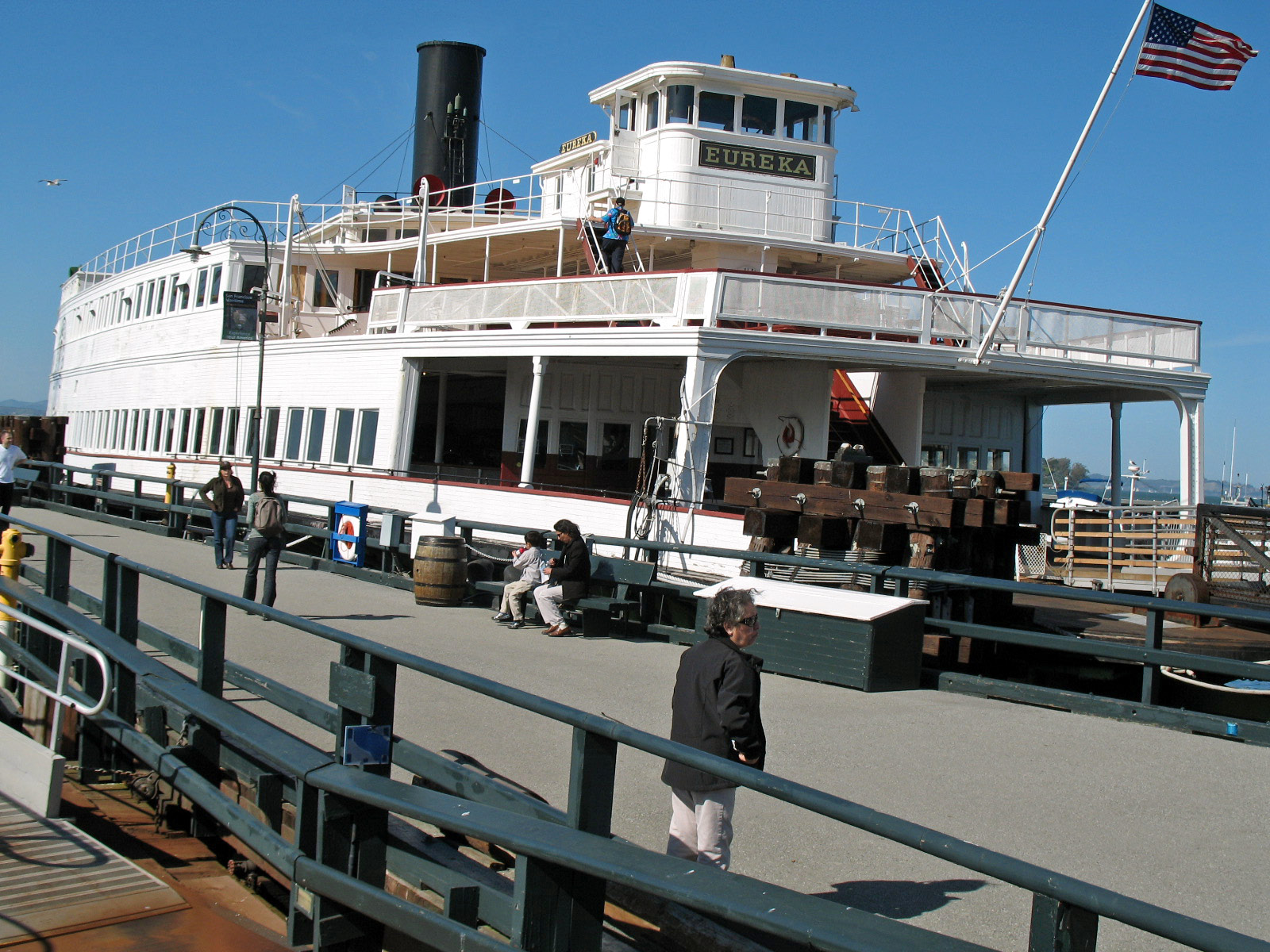
Eureka (ferryboat)
They called the rebuild "jacking up the whistle and sliding a new boat underneath." After the ferry Ukiah nearly shook herself apart hauling munition-filled railcars during World War I, the government paid for shipwrights at the Southern Pacific yard to replace everything above the waterline over two years of labor. When the refurbished vessel emerged, she was rechristened Eureka -- 299 feet long, 78 feet wide, certified to carry 2,300 passengers and 120 automobiles. She was the largest and fastest double-ended passenger ferry in the world, and she would spend the next four decades shuttling commuters across San Francisco Bay until bridges made her obsolete.
Born as the Ukiah
The San Francisco and North Pacific Railroad built the vessel at their Tiburon yard, launching her into San Francisco Bay on the evening of May 17, 1890, before a crowd of about 800 spectators, many of whom had arrived by special train from San Rafael. She was named Ukiah to mark the railroad's recent extension to that Northern California city. In 1907, the Northwestern Pacific Railroad rerouted the ferry to the Sausalito-San Francisco Ferry Building run. As automobiles appeared, the lower deck was refitted to carry vehicles -- in an era before bay bridges, driving across the water meant driving onto a ferry. Her wooden hull, round-bottomed and 277 feet long, would prove to be her most distinctive feature: Eureka remains the only large surviving American ferryboat built entirely of wood.
The Commuter Years
Between 1922 and 1941, Eureka ran the heavy commuter trips on the Sausalito route -- the 7:30 morning departure and the 5:15 evening return, each averaging 2,200 passengers. The upper deck offered seating areas, a magazine stand, and a restaurant serving full meals. For two decades, this was how thousands of Marin County residents got to work in San Francisco. The completion of the Golden Gate Bridge in 1937 doomed ferry service. Northwestern Pacific cut runs and then abandoned ferries entirely in 1941. During World War II, Eureka found new purpose transporting troops from Camp Stoneman in Pittsburg down the Sacramento River to San Francisco's embarkation piers. By the 1950s, she linked Southern Pacific's cross-country trains at Oakland with San Francisco -- until 1957, when she snapped an engine crank pin and was retired.
The Walking Beam
Eureka's most remarkable feature sits below her passenger decks. Her walking beam engine, built in 1890 by the Fulton Iron Works in San Francisco, is a technology that dates to the earliest era of steam navigation. The massive rocking beam, visible through the engine room, converts the vertical motion of pistons into the rotary motion that drives the paddle wheels. The engine was originally powered by coal-fired boilers, converted to oil in 1905. Eureka is one of only two surviving vessels equipped with a walking beam engine -- the other is the Ticonderoga, preserved on land in Vermont. Eureka is the only one still afloat. With her increased length after the World War I rebuild, she became the largest wooden passenger ferry ever built, certified to carry 3,500 people.
Preservation at Hyde Street Pier
In 1958, Eureka joined the fleet of historic ships at what would become the San Francisco Maritime National Historical Park. She was designated a National Historic Landmark and listed on the National Register of Historic Places on April 24, 1973. In 1999, a million-dollar restoration focused on her superstructure, including replacing the four massive wooden kingposts that support the paddlewheels and upper decks. In the late 1990s, she served as a filming location for the television show Nash Bridges. Today she sits at Hyde Street Pier alongside other preserved vessels, her wooden hull a reminder of the era when San Francisco Bay was crossed not by bridges but by boats -- when the rhythm of the city was set by ferry schedules and the sound of a walking beam engine rocking back and forth over dark water.
From the Air
Eureka is moored at Hyde Street Pier at 37.8097N, 122.4217W in San Francisco's Fisherman's Wharf area. The large white ferry is visible from the air alongside other historic vessels at the pier. Best viewed from 1,500-2,500 feet AGL. Nearby airports: KSFO (San Francisco International, 11nm S), KOAK (Oakland International, 8nm E). Within San Francisco Class B airspace.