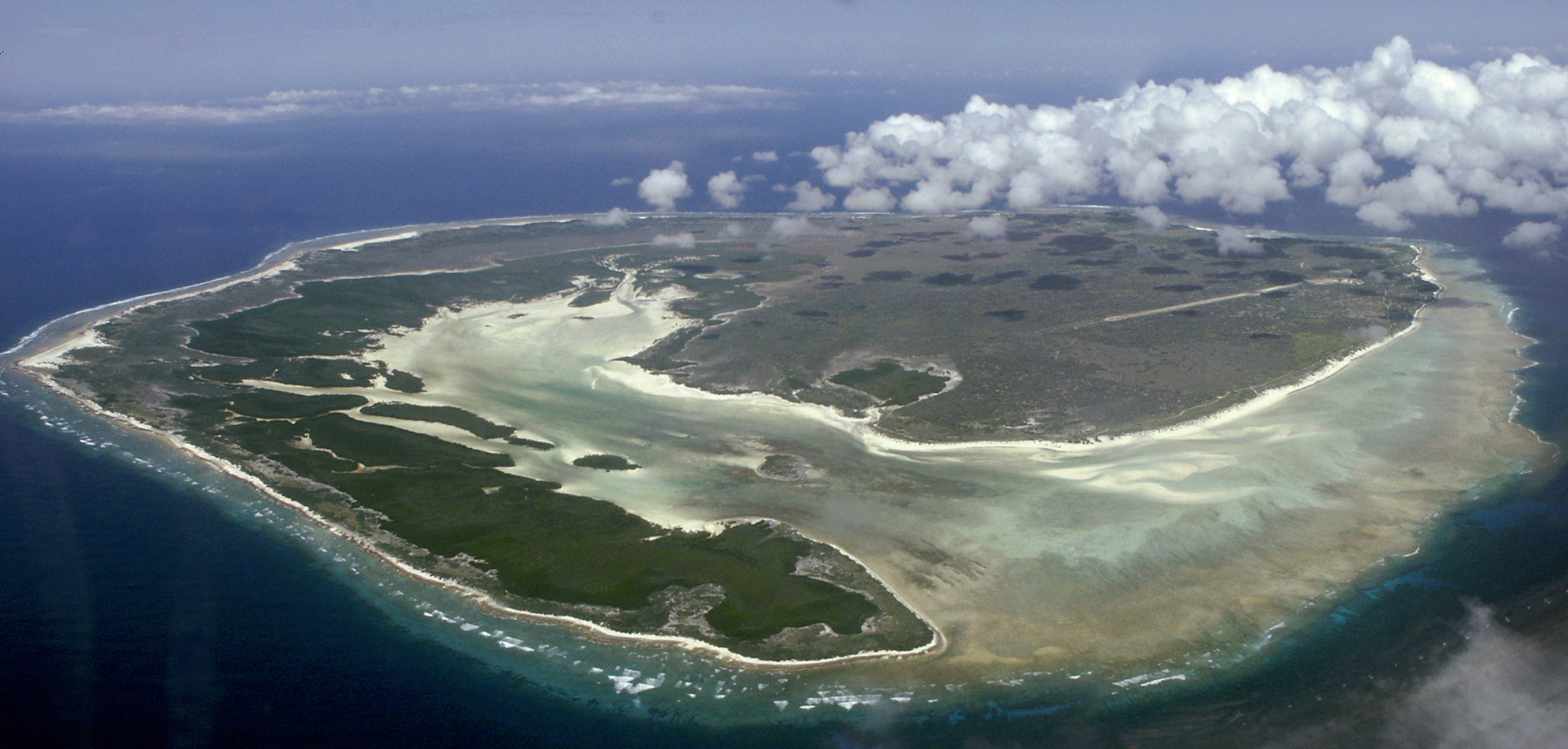
Europa Island
The island has its own species of hissing cockroach. That detail, somehow, captures Europa Island perfectly -- a place so remote, so undisturbed by human ambition, that even the insects have had time to evolve into something unique. This 28-square-kilometer atoll sits in the Mozambique Channel, roughly a third of the way between southern Madagascar and southern Mozambique. No one lives here permanently. France claims it; Madagascar disputes the claim. The only regular visitors are soldiers garrisoned from Reunion, scientists studying its extraordinary wildlife, and, every nesting season, thousands of green sea turtles hauling themselves onto the coral beaches to lay their eggs.
Named by a Passing Ship
Navigators probably sighted Europa for centuries before anyone bothered to record the encounter. The island takes its name from the British ship Europa, which visited in December 1774 -- a practical christening with no ceremony attached. Ruins and graves scattered across the island tell of several failed settlement attempts between the 1860s and the 1920s. The French Rosiers family moved here in 1860, tried to make a life of it, and eventually abandoned the effort. The remains of a sisal plantation testify to another attempt at economic extraction that the island shrugged off. France officially claimed Europa in 1897, folding it into the Scattered Islands administrative region of the French Southern and Antarctic Lands. Madagascar contests that claim, and the 2024 agreement to return the Chagos Islands to Mauritius has reignited debate about who owns these scattered specks of sovereignty in the Indian Ocean.
An Atoll at the Edge
Europa is a low-lying coral ring, six kilometers in diameter, rising no more than six meters above sea level at its highest point. A fringing reef surrounds the island, and inside it lies a mangrove lagoon of roughly nine square kilometers, open to the sea on one side. There are no ports or harbors; ships anchor offshore. The only infrastructure is a 1,500-meter airstrip, a weather station, and a military garrison. The Agulhas Current warms the surrounding waters above 30 degrees Celsius, southeast trade winds dominate the austral winter, and cyclones visit periodically. The climate oscillates between semi-arid and tropical -- wet summers, dry winters -- and the vegetation matches: dry forest, scrub, euphorbia thickets, and the mangrove swamp that fills the lagoon.
Turtle Highway, Frigatebird Colony
Europa Island is one of the largest green sea turtle nesting sites on Earth. During nesting season, females emerge from the warm Mozambique Channel to dig their nests in the coral sand -- a spectacle that drew Jacques Cousteau here in 1968 for an episode of The Undersea World of Jacques Cousteau called 'Search in the Deep.' The island's birdlife is equally remarkable. BirdLife International has designated it an Important Bird Area for its large and diverse breeding seabird populations. The great frigatebird colony -- up to 1,100 pairs -- is the second largest in the western Indian Ocean. Europa is one of only three known breeding sites for the Malagasy pond heron, alongside Aldabra and Madagascar. Tropical shearwaters, dimorphic egrets, and Caspian terns also nest here, along with an endemic subspecies of white-tailed tropicbird found nowhere else in the world.
Evolution in Isolation
Isolation is Europa's defining condition, and evolution has made the most of it. Beyond the endemic hissing cockroach and the unique tropicbird subspecies, the island supports its own subspecies of the Malagasy white-eye -- one of only three landbird species resident here. Goats introduced by settlers in the late 18th century still roam the island, the only mammalian residents apart from visiting scientists and soldiers. The nature reserve status offers formal protection, but Europa's real defense has always been its remoteness. No permanent population means no development pressure, no pollution, no light contamination. The 127,300-square-kilometer exclusive economic zone surrounding Europa and neighboring Bassas da India encompasses a vast tract of open ocean where marine life operates largely undisturbed. In a world rapidly running out of wild places, Europa Island persists as one -- not because anyone chose to preserve it, but because no one ever managed to tame it.
From the Air
Located at 22.37S, 40.36E in the Mozambique Channel, approximately one-third of the way between southern Madagascar and southern Mozambique. The island appears from altitude as a distinct low-lying atoll with a visible lagoon and coral reef ring, 6 km in diameter. A 1,500-meter unpaved airstrip is present but restricted to military and scientific use. The nearest significant airports are in Mozambique (Maputo, FQMA) and Madagascar (Toliara, FMST), both hundreds of kilometers away. The island's exclusive economic zone is contiguous with nearby Bassas da India atoll to the north.