European Air Transport Command
On any given morning at Eindhoven Airbase, an unremarkable office building issues orders that move airplanes belonging to seven different countries. A French Airbus A400M might be tasked to fly Belgian medical supplies; a German C-130 might haul Dutch paratroopers; a Spanish tanker might refuel Italian fighters mid-mission. None of this happens through phone calls between national headquarters. It is coordinated, day after day, by a small multinational staff that took a generation to build - because pooling military airlift across European borders is the kind of thing nations resist until they cannot afford not to.
The Slow Path to Pooling
The idea started, as so many European-defence ideas do, between Paris and Berlin. In 1999, France and Germany launched a joint political-military initiative to prepare the way for a European Air Transport Command. That same year the European Council in Helsinki spoke of "collective goals for rapid capability" - diplomatic language for the fact that Europe could not lift its own troops to a crisis without American help. A 2000 study by the European Air Group recommended building from the inside out: first share information, then coordinate, then command. In 2001 the Airlift Coordination Cell appeared; in its first year, savings already exceeded the cell's running costs. In 2003 it became the European Airlift Centre. But political will never matched its formal mandate, and by 2006 France and Germany decided a real command was needed - one with authority, not just a clipboard.
Standing Up in Eindhoven
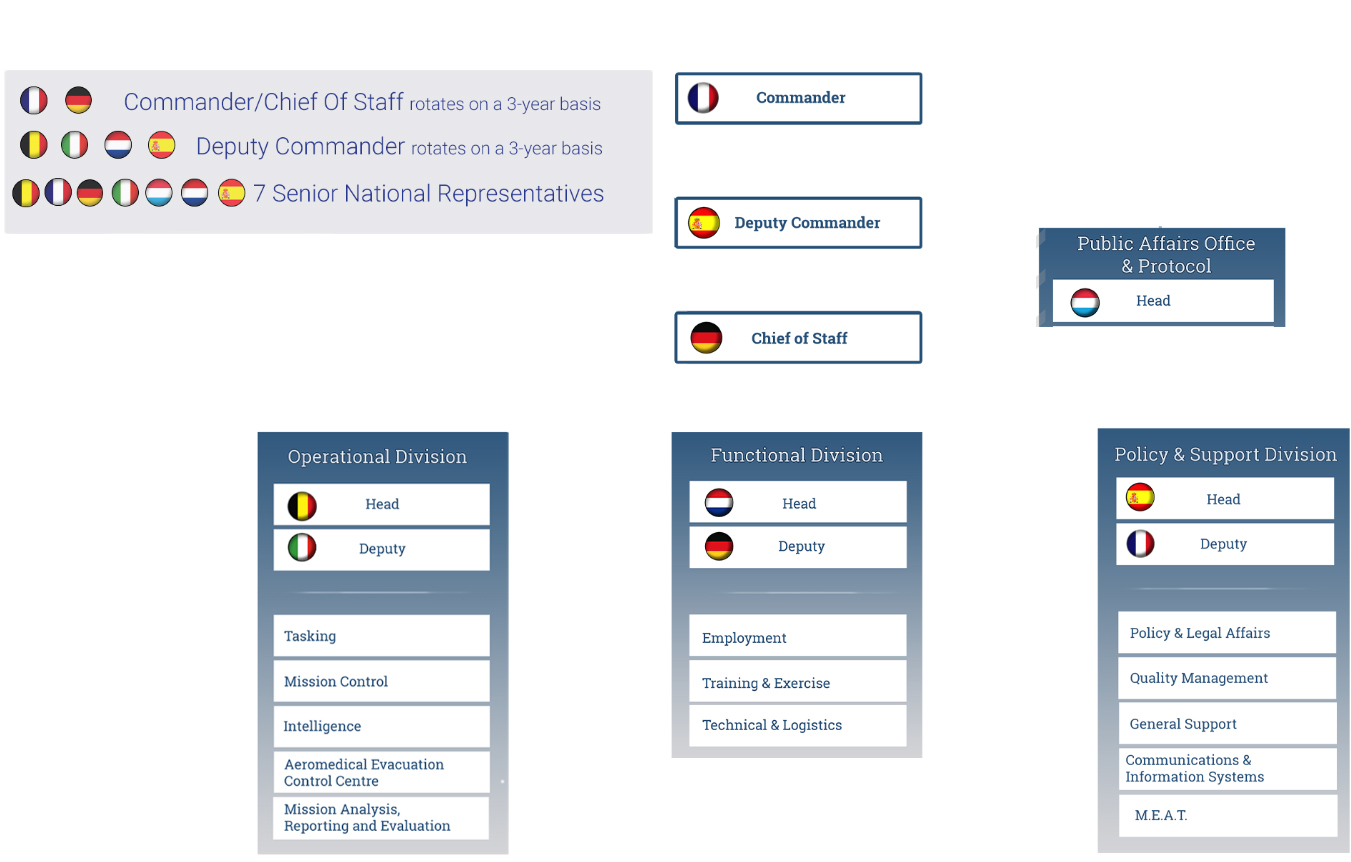
The seventh Franco-German Ministerial Council on 12 October 2006 took the decision. Belgium and the Netherlands signed on. An international implementation team based in Beauvechain, Belgium did the unglamorous work of writing the technical arrangement, and on 1 July 2010 the European Air Transport Command was formally established. The inauguration ceremony at Eindhoven on 1 September 2010 brought the political and military leaders of the four founding nations - France, Germany, the Netherlands, Belgium - to the same flight line. Germany dissolved its national Lufttransportkommando in Munster on 31 December 2010 and moved 65 of its staff to Eindhoven. Major General Jochen Both took the first command; by treaty, the post rotates biennially between French and German two-star generals.
Seven Flags, One Tower
Luxembourg acceded on 22 November 2012, Spain in July 2014, Italy in December 2014 with 37 aircraft. By January 2015 the EATC managed about 220 aircraft - C-160 Transalls, C-130 Hercules, KC-135 tankers, A310s, A400Ms - accounting for roughly 75 percent of all European military air-transport capacity. The command's coat of arms is a small piece of EU symbology in itself: an azure terrestrial globe encircled by twelve gold stars (the European Flag), a silver bridge across it, and the letters EATC. The bridge is the metaphor that matters - the core business of military air transport, as the blazon's text puts it, is creating connections and overcoming distance. The globe expresses the global reach of air bridges.
The Quiet Politics
EATC sits in a peculiar place inside European defence. It is not an EU institution. It is not part of the Common Security and Defence Policy. It is not a project of the Permanent Structured Cooperation (PESCO). It is a coalition of the willing, governed by a Technical Arrangement among its seven member states, that can - if the nations agree - contribute its assets as a multinational force under Article 42.3 of the Treaty on European Union. That ambiguity is the point. By staying outside the formal EU framework, EATC kept its decision loops short and its members in clear control of their own aircraft. The compromise is what made the experiment work. When a flood, an evacuation, or a deployment requires lift, the planes get there - and a small staff at Eindhoven gets quietly credited with one of post-Cold War Europe's more functional military experiments.
From the Air
EATC headquarters sits at 51.45°N, 5.37°E on Eindhoven Airbase (EHEH), shared with the civilian Eindhoven Airport. From the air, look for the military apron on the north side of the single 06/24 runway and the tall HQ building marked with EU stars. Active military traffic - look for A400Ms, C-130s, and visiting tankers. Nearby alternates: Volkel (EHVK) to the north and Geilenkirchen (ETNG) across the German border. Class C airspace; expect heavy IFR traffic mixing with KLM cityhoppers and Ryanair operations next door.