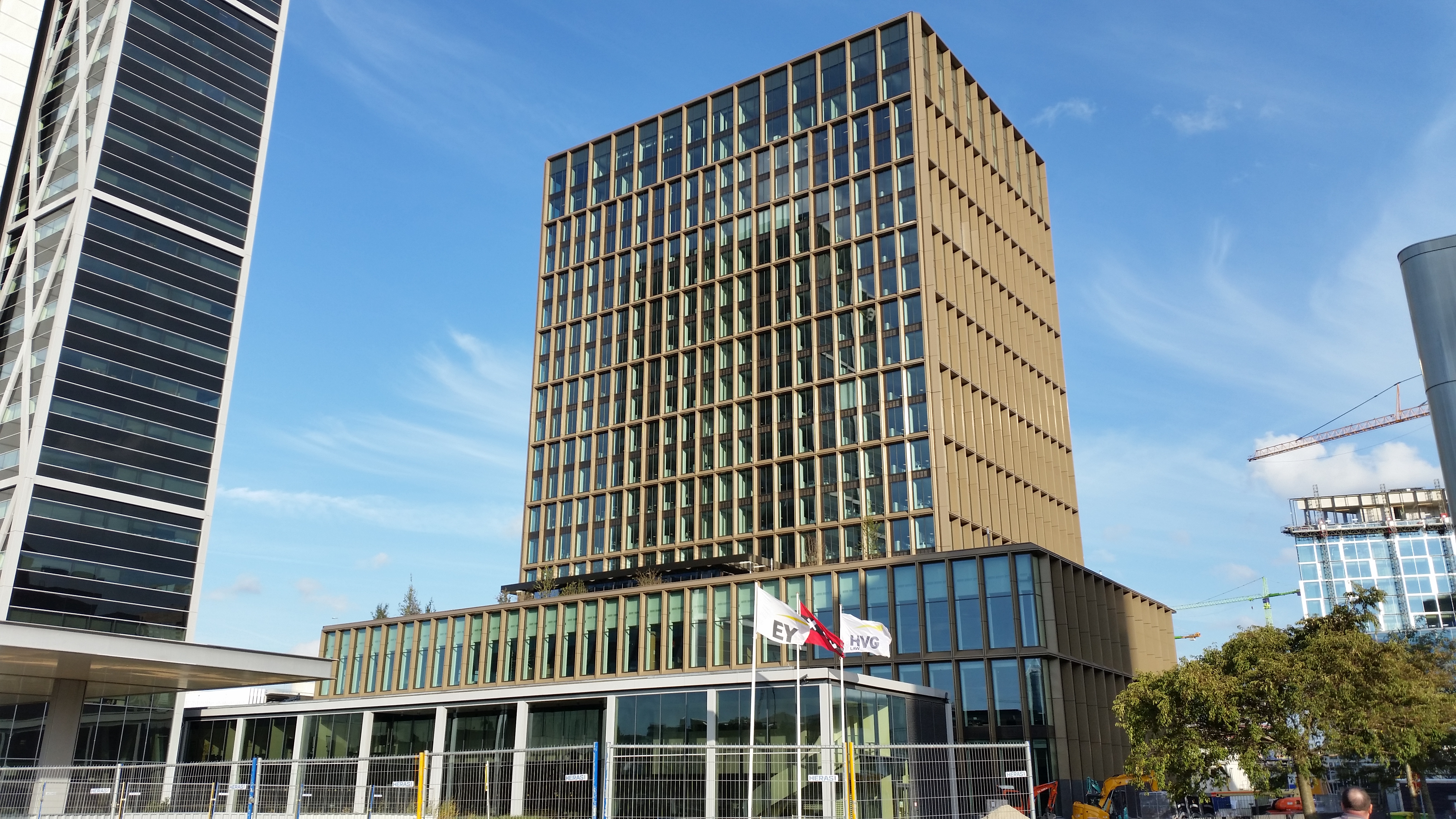
European Medicines Agency
In November 2017, EU ministers sat down in Brussels to settle a question nobody had ever expected to vote on: which European city would take the European Medicines Agency away from London. Nineteen capitals had submitted bids. The deciding round came down to Amsterdam and Milan, and when the tellers couldn't separate them on votes, the final selection was settled by drawing lots from a bowl. Amsterdam won. Within sixteen months, an agency that approved every novel medicine for 450 million people had to vacate a glass tower at 30 Churchill Place in Canary Wharf, hire new staff, build a new office in the Zuidas business district, and not miss a single drug evaluation in the meantime. The phrase moving an institution does not quite capture it.
What an Agency Like This Actually Does
When a pharmaceutical company wants to sell a new cancer drug, gene therapy, or vaccine across the European Union, it does not file twenty-seven applications with twenty-seven national regulators. It files one application with the EMA. A scientific committee of experts drawn from across the bloc has 210 days to evaluate the evidence and recommend either approval or rejection. The European Commission then turns that recommendation into a marketing authorization valid in every member state plus Iceland, Liechtenstein, and Norway. This is the centralized procedure, and it is compulsory for almost every interesting medicine of the twenty-first century: biotechnology products, advanced therapies like CAR-T cells and gene editing treatments, vaccines for HIV and cancer and neurodegenerative disease, orphan drugs for rare conditions affecting fewer than five people in ten thousand. Roughly six hundred staff at the EMA coordinate a working network of more than 4,500 expert scientists across forty national regulators. The American FDA is structurally similar, but the FDA does all its work in-house. The EMA does most of its work by distributing it.
The London Years
The agency was founded in 1995 after seven years of negotiation among EU governments, originally under the unwieldy name European Agency for the Evaluation of Medicinal Products. London hosted it from the start. The original premises were in Canary Wharf, a still-emerging financial district built on what had been derelict docks fifteen years earlier. The location made some sense in 1995: London had English as a working language, deep pharmaceutical industry expertise from companies like GlaxoSmithKline and AstraZeneca, and an international airport for the constant traffic of expert reviewers flying in for committee meetings. The EMA spent over two decades building its institutional habits there. By 2016 it occupied two floors of 30 Churchill Place, a thirty-story tower its lease ran through 2039.
23 June 2016
The Brexit referendum surprised the EMA along with most of London. The agency was an EU body. EU bodies do not operate from non-EU territory. The choice was immediate and unavoidable: relocate, or dissolve. In April 2017, nineteen capitals submitted formal bids to host the move. Each city promised real estate, transit links, English-speaking schools for staff children, and various financial sweeteners. The shortlist narrowed through three rounds of ministerial voting on 20 November 2017. Amsterdam and Milan tied in the final round. Drawing lots is the formal EU procedure for breaking such a tie, and the slip pulled from the bowl read Amsterdam. The Italian government called it absurd. The Dutch government got to work.
Amsterdam in Sixteen Months
EMA staff left their London offices in March 2019. Some moved to Amsterdam with their families. Others did not - estimates at the time suggested the agency would lose roughly a quarter of its workforce in the transition, an enormous knowledge loss for an organization whose work depends on individual scientific expertise. New hires came in. A temporary building near Amsterdam Sloterdijk station housed operations while a permanent headquarters went up at Domenico Scarlattilaan 6, in the Zuidas, the dense cluster of office towers around Amsterdam-Zuid station. The permanent move completed in January 2020. The first significant test of the transplanted agency arrived almost immediately. In March 2020, the World Health Organization declared COVID-19 a pandemic. Within nine months, the EMA had evaluated the Pfizer-BioNTech mRNA vaccine, survived a cyberattack that leaked internal review documents to the dark web, satisfied itself that the manufacturing quality was acceptable, and granted conditional marketing authorization on 21 December 2020. The agency that had spent the entire previous year unboxing files in a new country had just authorized one of the most consequential medicines in modern history.
Zuidas, Now
The EMA building today is glass and angular and architecturally unremarkable. Inside, scientific committees meet on schedules set by treaty - 210 days to evaluate, 30 days to convert to a Commission decision, ongoing pharmacovigilance for as long as the medicine remains on the market. The Zuidas district around it has become Amsterdam's de facto international business quarter, with ABN Amro, ING, the Akzo Nobel headquarters, and the EMA itself all within a few square blocks. The agency that ended up here did not choose this city. A referendum chose it, and then a slip of paper chose it, and now it is one of the largest medical regulators in the world. London still owns 30 Churchill Place. A British court ruled in 2019 that Brexit alone did not let the EMA walk away from its lease, and it remains a notable real estate asset somewhere on the corporate books of an organization that has not occupied it in years.
From the Air
The EMA headquarters sits at Domenico Scarlattilaan 6 in the Zuidas business district, coordinates 52.33 N, 4.88 E. From the air, Zuidas reads as a cluster of high-rise glass towers grouped along the A10 ring road south of central Amsterdam, immediately adjacent to Amsterdam-Zuid railway station. Distinctive landmarks nearby include the WTC Amsterdam, the curved Symphony building, and ABN Amro headquarters. Nearest airport: Schiphol (EHAM), 8 km southwest. Approach often passes directly over Zuidas. Class A airspace; busy approach corridor. Best viewing altitude 2,000-3,000 feet, with the building most identifiable by its position south of the A10 highway.