Europol
Europol officers do not carry handcuffs in the field. They cannot make arrests, cannot kick down doors, cannot run independent investigations. By design. When Helmut Kohl stood up at the Luxembourg Summit in June 1991 and called for a European version of the FBI, the rest of the European Council disagreed politely. Twenty-seven member states were never going to surrender their police powers to Brussels, or in this case to The Hague. What they would do, gradually, was build a clearing house: a place where Dutch detectives investigating a cocaine shipment could match it against Italian wiretaps and Spanish bank records, where a German cybercrime team could find out their suspect was already being watched in Romania. Europol started as a fax machine for cops. Three decades later it employs more than a thousand people and runs an annual budget over 200 million euros, all without the power of arrest.
From a Boys' School to a Headquarters
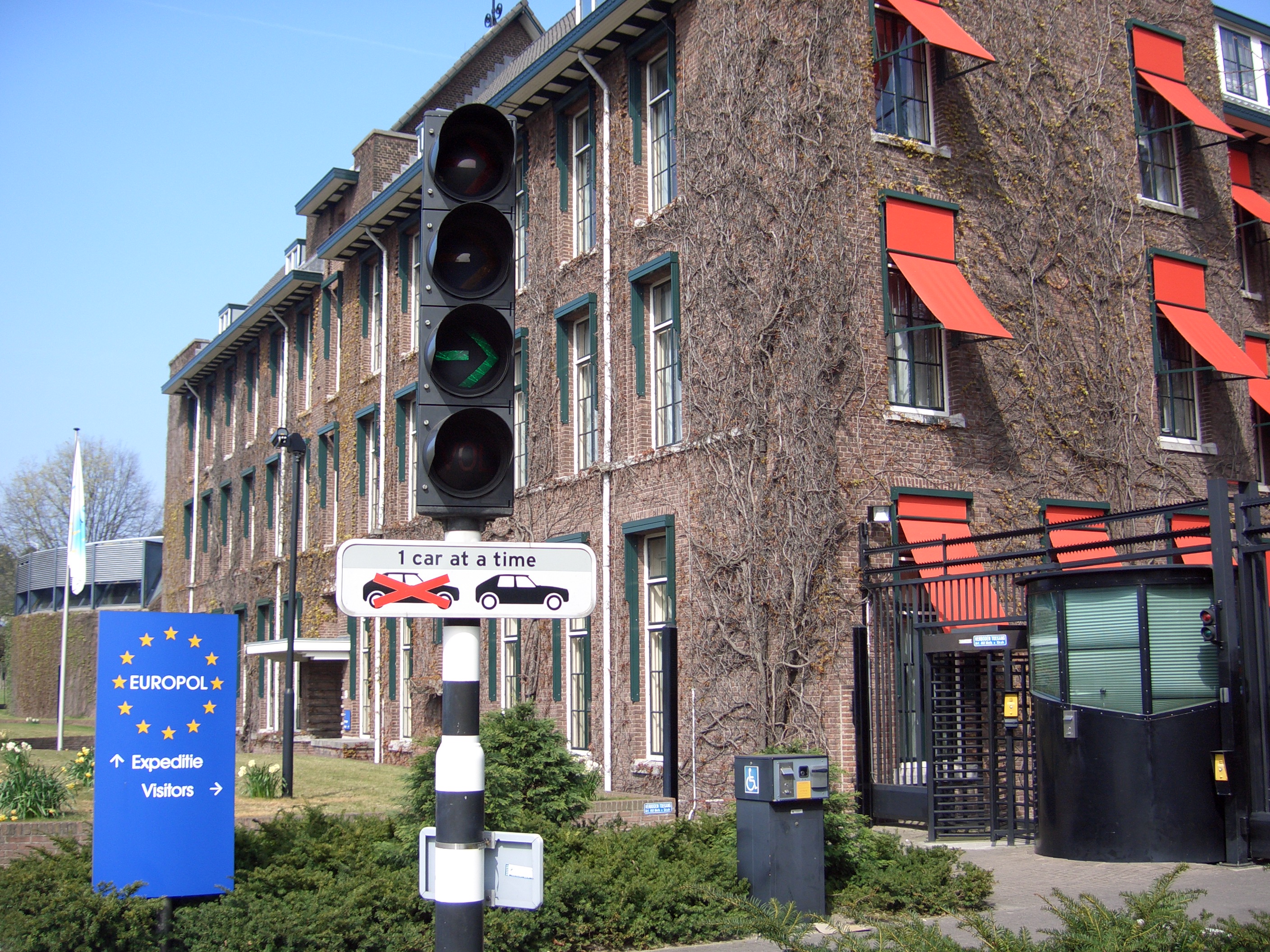
The first Europol office, then called the Europol Drugs Unit, opened in The Hague in January 1994 with a tiny staff under Jurgen Storbeck. The competition for a permanent location came down to The Hague, Rome, and Strasbourg. The Hague won, and Europol moved into a former Roman Catholic boys' school at Raamweg 47, a building constructed in 1910 that had been used during the Second World War by occupying police and intelligence services. After the war the Dutch State Intelligence Service worked from the same address. Europol moved in later in 1994 and officially commenced full activities on 1 July 1999. By 2011, the agency had outgrown the old school. Queen Beatrix opened a 32,000-square-metre headquarters at Eisenhowerlaan 73 on 1 July 2011. The new building sits in the international zone, deliberately placed beside the International Criminal Tribunal for the former Yugoslavia and the Organisation for the Prohibition of Chemical Weapons.
What an Intelligence Hub Actually Does
Europol's annual Serious and Organised Crime Threat Assessment is the document that drives most of its work. The 2017 edition identified eight priority areas: cybercrime, drug production and trafficking, migrant smuggling, organised property crime, human trafficking, money laundering, document fraud, and online trade in illicit goods. None of these crimes respects borders, and that is the point. When a French car-ringing operation reaches into Poland or a Dutch ransomware investigation traces back to Ukraine, national police forces need a shared analytical environment. Europol provides it: a database where intelligence can be deposited under controlled rules, analysts who connect the dots, joint investigation teams that pool prosecutors from multiple countries, and threat assessments that tell governments what to worry about next. The agency has no mandate to act on any of this without national approval, which is what keeps member states willing to share.
Centres Within the Centre
Three specialised centres have grown inside Europol over the past fifteen years. The European Cybercrime Centre, known as EC3, launched in January 2013 to coordinate cross-border action against online fraud, child sexual exploitation, and attacks on critical infrastructure. The European Counter Terrorism Centre opened in January 2016, two months after the Bataclan attacks in Paris, to track the movement of Europeans into and out of Syria and to monitor terrorist financing. The European Financial and Economic Crime Centre, the newest, opened in May 2020 to focus on money laundering, asset recovery, and the systematic use of financial investigation. The Stop Child Abuse - Trace an Object campaign launched in 2017 crowdsources identification of background details in abuse images. As of May 2024, fourteen Victim Identification Task Force events organised through Europol had led to over 700 children being identified and rescued, with about 230 offenders arrested.
The Politics of Sharing
Because Europol depends on member-state trust, every political quake in Europe is felt at Eisenhowerlaan 73. When the United Kingdom triggered an opt-out from the area of freedom, security, and justice in 2014, it requested and was granted continued Europol participation. Denmark, after a December 2015 referendum rejected conversion of its opt-out, faced being cut off entirely; an emergency cooperation deal was signed on 29 April 2017, two days before the deadline. Brexit eventually severed full British participation, replaced by a separate cooperation arrangement. Europol now has operational agreements with countries from Albania to Australia, the United States to Ukraine, and strategic agreements with China, Brazil, and Russia. Executive Director Catherine De Bolle, in office since 2018, leads an organisation whose authority comes not from coercive power but from the simple fact that organised criminals coordinate, and police forces, if they want to keep up, must coordinate too.
From the Air
Europol headquarters is located at Eisenhowerlaan 73, The Hague, at approximately 52.093 N, 4.282 E, within The Hague's international zone. From cruise altitude in clear weather you can identify the international zone as the cluster of large modern buildings west of the historic centre, between the city and the dunes of Scheveningen. Nearest airports: Rotterdam The Hague (EHRD) about 12 km south, Amsterdam Schiphol (EHAM) about 35 km northeast. Approach the Randstad with awareness of busy controlled airspace; Schiphol and Rotterdam departures overlap above The Hague.