Eurosonic Noorderslag
For four days in mid-January, when the canals of Groningen freeze and the wind off the North Sea cuts through wool coats, the city becomes the most important place in European pop music. Eurosonic Noorderslag is not a stadium festival. It is something stranger: a sprawl of nearly 400 acts playing tiny venues, bars, art galleries, and pubs scattered across the medieval city centre, while several thousand industry professionals chase rumours from stage to stage. Booking agents, radio programmers, and festival curators wear the same lanyards. Somewhere in one of those rooms, the next year's breakthrough is being heard for the first time.
A Battle Becomes a Festival
It started as a fight. On 4 January 1986, De Oosterpoort venue in Groningen staged the "Holland-Belgium festival" - a deliberately combative showcase pitting Dutch pop bands against Belgian ones. The provocation worked. The following year the organisers ran it again under a new name, Noorderslag, this time framed as the north of the Netherlands against everyone else. By 1988 the battle conceit had been quietly dropped and the event simply called itself a festival. The numbers stayed modest through the early 1990s, a few thousand visitors squeezing into a single venue. Then, in 1990, someone added a seminar for music industry professionals. That decision, almost an afterthought, was the one that mattered.
The Eurosonic Half
By 1999 the European showcase that grew up alongside Noorderslag had settled into its name: Eurosonic. The split formalised what the festival already was - three days of artists from across Europe at the start of the week, one closing day reserved for Dutch acts. Each year the organisers nominate a focus country, and that country sends a delegation of its most promising young bands. Hozier played here in 2014 before he was Hozier. Dua Lipa appeared in 2016 in a room that, by industry estimates, held a few hundred people. The 2012 edition sold out in ten minutes. Tickets are not the point, though - the point is the lanyard, and who is wearing one next to you at the back of the room.
Streets Turned Stages
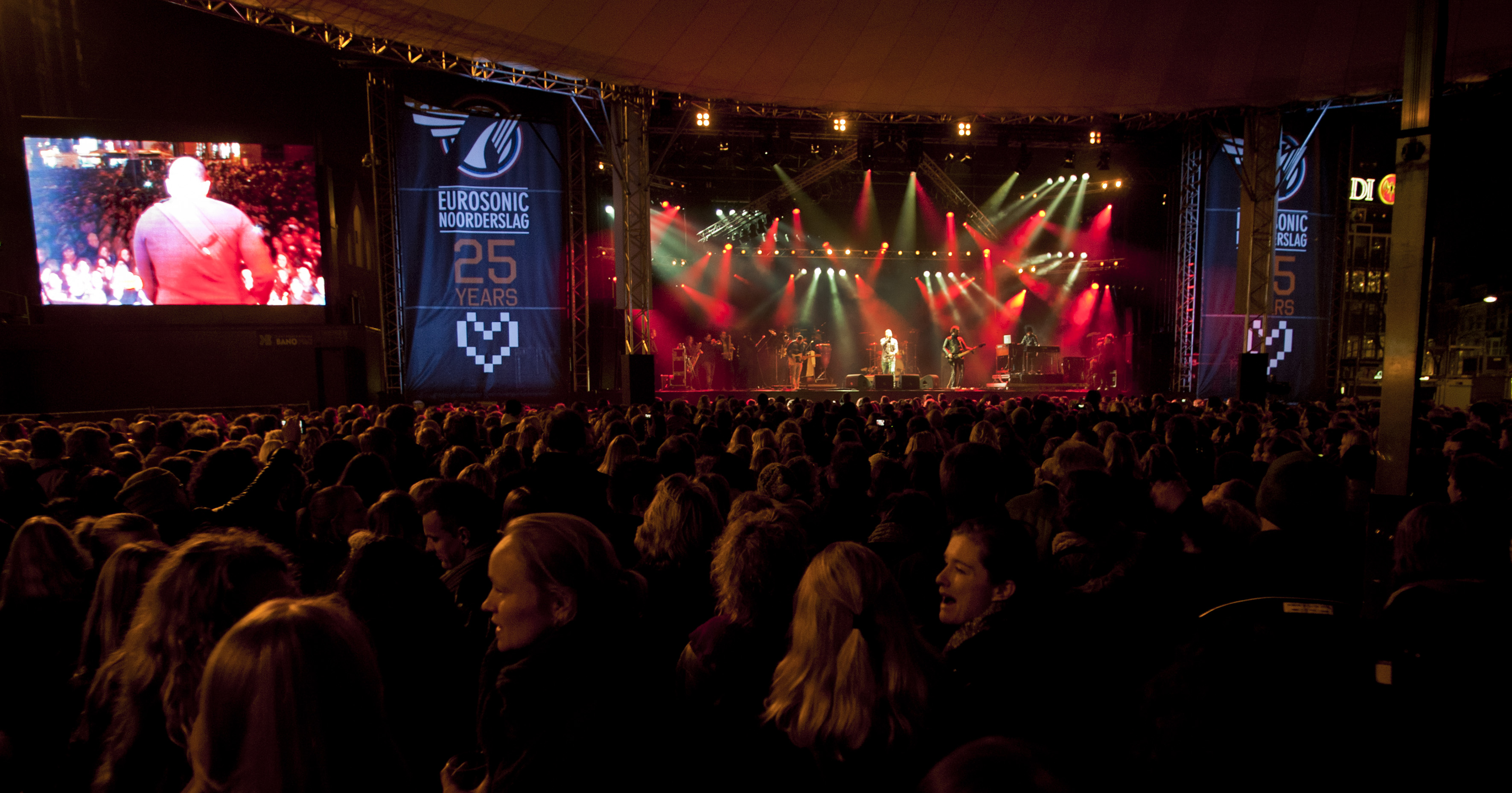
The festival's geography is part of its charm and part of its difficulty. Performances happen in dozens of venues threaded through the diepenring, the canal ring that defines old Groningen. Some are proper concert halls. Many are bars with a corner cleared. In 2011, to mark the festival's twenty-fifth year, the organisers added Eurosonic Air - a free open-air stage on the Grote Markt, sheltered by a large tent against the January weather. That same year Grunnsonic also took shape, a parallel programme reserved for artists from Groningen itself, free to attend without a festival pass. The result, by the 2010s, was a city that for four nights ran on a kind of curated chaos: forty thousand visitors moving between stages on foot or by bicycle, programme guide in one hand, beer in the other.
What Gets Recognised
Eurosonic Noorderslag has become, almost incidentally, the place where the European music industry hands out its awards. The Music Moves Europe Talent Awards are presented here. So are the European Festivals Awards, the Pop Media Prijs, and the Buma Cultuur Pop Award, which has been announced at Noorderslag every January since 1992. In December 2015 the independent label trade body IMPALA gave the festival its Outstanding Contribution to Independent Music Award - an unusual recognition for an event rather than an artist or a label. The 2016 edition drew 42,100 visitors and 4,100 industry professionals to a city of just over 200,000 people. For one week each year, Groningen reverses its usual ratio: more people listening than living.
The Week David Bowie Died
On the morning of 11 January 2016, between the announcement of the upcoming Eurosonic edition and its opening night, the news broke that David Bowie had died of cancer at the age of 69 - passing away the previous evening in New York. The Groninger Museum, only a few minutes' walk from most of the festival's venues, was running its acclaimed "David Bowie is" exhibition at the time. The museum, normally closed on Mondays, opened its doors that day, set out a condolence register, and let visitors in for free. By midweek the festival had begun. Bowie's death and Eurosonic's noise filled the same small streets at the same time - the city remembering one career while listening for the next.
From the Air
Eurosonic Noorderslag is centred on Groningen, Netherlands, at 53.216°N, 6.568°E. The festival's home venue De Oosterpoort sits just south of the diepenring canal ring. Nearest airport: Groningen Airport Eelde (EHGG), 4.8 nautical miles south. Schiphol (EHAM) is 2.5 hours by direct train. Recommended viewing altitude 2,000-3,000 feet over the flat Groninger countryside; the Martinitoren tower and the brightly coloured Groninger Museum are useful daylight landmarks for orientation.