Eveleth, Minnesota
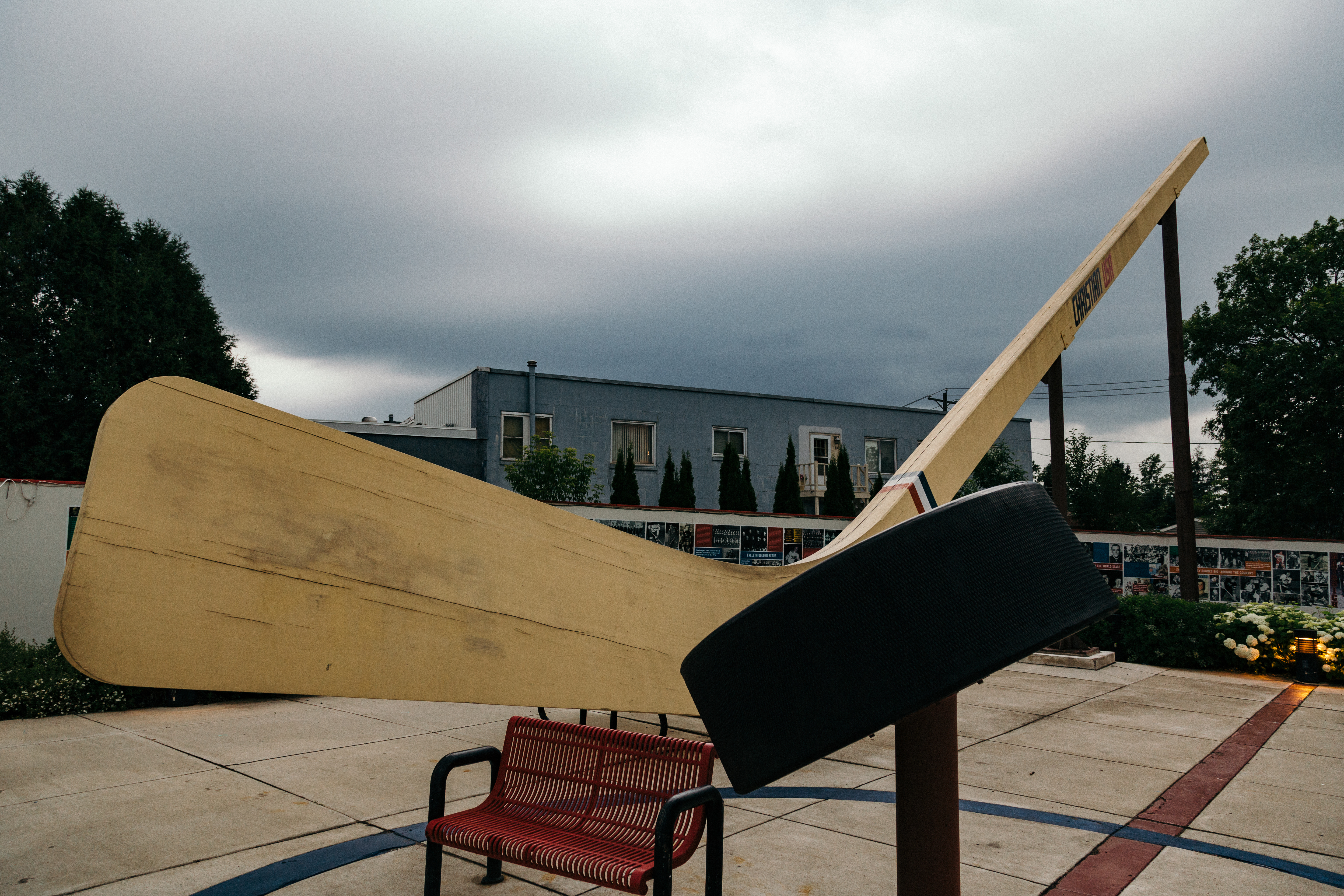
The world's largest authentic hockey stick stands 107 feet tall on the main drag of a town with fewer than 3,500 people. The stick weighs three tons and looks frankly absurd against the flat boreal landscape of northeastern Minnesota, but that is precisely the point. Eveleth exists because of iron ore, but it endures because of ice. This small city on the Mesabi Range has produced more Olympic and professional hockey players per capita than anywhere else in the country, earned itself the United States Hockey Hall of Fame, and along the way became the site of America's first sexual harassment class-action lawsuit. For a mining town platted in 1893 and physically relocated seven years later when ore was discovered beneath its streets, Eveleth has punched well above its weight.
A Town That Moved
Eveleth was platted on April 22, 1893, named after Erwin Eveleth, a prominent timber company employee in the area. The original town site sat about a mile southwest of its present location, on land that turned out to be part of the Adams-Spruce Mine. When iron ore was discovered directly beneath the village in 1895, the community faced a choice that would become familiar across the Iron Range: dig or move. Eveleth moved. By 1900, the entire village had relocated to its current site. It was incorporated as a city in 1902 and grew by annexing surrounding communities -- Fayal, Alice Mine Station, and Genoa -- as the mines expanded. The population drew heavily from European immigrants: Finns, Germans, Norwegians, Italians, Slovenes, and Swedes all settled here, creating a cultural mix that still defines the Iron Range.
Iron Beneath Everything
Eveleth sits squarely on the Mesabi Range, the largest iron ore district in the United States. Throughout the 20th century, the city's fortunes rose and fell with the mines. Activity peaked during World War II, when wartime demand for iron ore meant full employment and growth. The postwar decades brought steady decline as high-grade ore deposits thinned. Today, the Thunderbird Mine operates within the city limits, processing crude iron ore from the Paleoproterozoic Biwabik Iron Formation into 5.5 million tons of taconite pellets per year. The ore is crushed on-site and shipped by rail to the Fairlane Plant in Forbes, Minnesota, for concentrating and pelletizing. A brief demand spike between 2005 and 2007 brought modest improvements, but the fundamental story of the Iron Range remains one of adaptation -- mining communities learning to build economies that can survive between booms.
The Ice Factory
The United States Hockey Hall of Fame was established in Eveleth in 1973, and the town's claim as the birthplace of American hockey is difficult to dispute. During the 1950s, the Eveleth Golden Bears dominated Minnesota high school hockey with a run that still holds state records: four consecutive state championships from 1948 to 1951, five consecutive championship game appearances from 1948 to 1952, and twelve straight tournament appearances from 1945 to 1956 -- all from a district with a tiny population. The list of Eveleth-born hockey talent reads like a hall of fame unto itself: John Mariucci, who played in and later coached the NHL; Frank Brimsek, an NHL goalie; John Mayasich, who won gold at the 1960 Winter Olympics; and Mark Pavelich, a key member of the 1980 'Miracle on Ice' team. A few blocks from the giant hockey stick, the Eveleth Hippodrome remains Minnesota's oldest hockey arena still in use.
The Case That Changed the Workplace
In 1988, Eveleth entered a very different kind of national spotlight. Lois Jenson and other women working at Eveleth Taconite Company filed what became Jenson v. Eveleth Taconite Co., the first sexual harassment class-action lawsuit in the United States. The case exposed the hostile conditions women miners endured and dragged on through years of litigation before resulting in a landmark settlement. The story was dramatized in the 2005 film North Country, starring Charlize Theron, which was filmed on location in Eveleth, Virginia, Chisholm, and Hibbing. An earlier film, Wildrose (1984), had also used Eveleth and the surrounding Iron Range as its setting, telling the story of a divorced woman working as a heavy machinery operator in an all-male mine. Together, these films gave the outside world a window into Iron Range life -- its toughness, its insularity, and its capacity for change.
Beyond the Mines
Eveleth today is part of Minnesota's Iron Range Quad Cities, alongside Virginia, Gilbert, and Mountain Iron. Tourism and outdoor recreation have become significant economic drivers: Giants Ridge Golf and Ski Resort generates approximately $55 million annually and supports over 300 tourism-related jobs. The 'Wander the Range' visitor program guides travelers through local attractions, museums, and natural landscapes. Heritage tourism -- visitors drawn to the region's mining history, immigrant culture, and dramatic open-pit landscapes -- forms a core part of this new economy. But the hockey stick still looms over everything, a reminder that Eveleth's most lasting contribution to American culture came not from what was pulled out of the ground, but from what happened on the frozen surfaces above it.
From the Air
Located at 47.46°N, 92.54°W in northeastern Minnesota's Mesabi Range at approximately 1,500 feet MSL. From altitude, look for the elongated scars of open-pit iron mines stretching across the landscape and the characteristic red-brown tailings ponds. Eveleth is part of the Quad Cities cluster with Virginia, Gilbert, and Mountain Iron, all visible within a few miles of each other. The Eveleth-Virginia Municipal Airport (KEVM) serves the area. Range Regional Airport (KHIB) in Hibbing offers the nearest commercial service. The 107-foot hockey stick monument may be visible at lower altitudes near the town center. The terrain is gently rolling boreal forest with numerous lakes scattered across the landscape. Best viewed at 3,000-6,000 feet AGL for the full Iron Range mining landscape context.