Everett Massacre
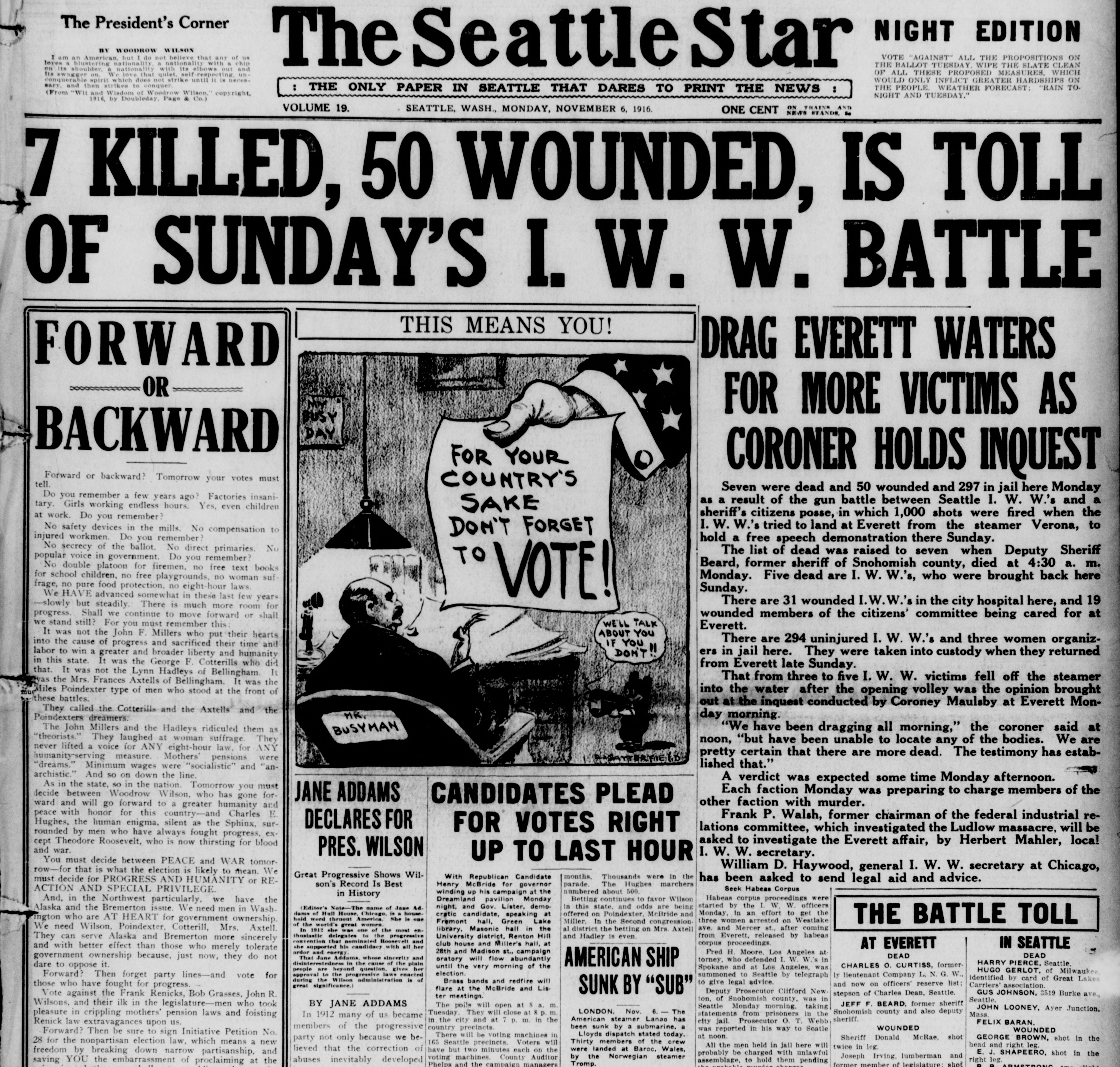
"Boys, who's your leader?" Snohomish County Sheriff Donald McRae called out across the water as the steamer Verona nudged against the Everett dock on the afternoon of November 5, 1916. From the crowded deck, roughly 300 members of the Industrial Workers of the World -- the Wobblies, as everyone called them -- laughed and shouted back: "We're all leaders!" It was the last moment of defiance before everything collapsed into gunfire. Within minutes, at least five workers lay dead, two deputized citizens had been killed by their own side's crossfire, and the bloodied Verona was racing back toward Seattle with its wounded. The Everett Massacre, as it came to be known, lasted about ten minutes. Its echoes in American labor history have lasted more than a century.
A Mill Town on Edge
Everett in 1916 was a port city of about 35,000 people, built on timber and shingle mills along the shore of Puget Sound. An economic downturn had tightened the screws on everyone, but the shingle weavers felt it worst. These were the men who fed cedar bolts into screaming saws, losing fingers at a rate that made the trade one of the most dangerous in the Pacific Northwest. On May 1, they walked off the job. For months, the strike ground on while tensions between labor organizers and local business interests escalated into street confrontations. Law enforcement, firmly aligned with the mill owners, met rallies with arrests and beatings. Sheriff McRae had built a reputation for targeting Wobblies specifically, hauling them in on whatever pretext was handy. When 41 IWW organizers arrived by ferryboat on October 30 to support the strikers, the message from Everett's establishment was blunt: you are not welcome here.
Two Steamers North
The Wobblies came back anyway. On the morning of November 5, about 300 IWW members gathered at their hall in Seattle and marched to the docks, where they boarded two steamers: the Verona and the Calista. As the Verona approached the Everett dock in the early afternoon, the passengers sang "Hold the Fort," a labor anthem that carried across the harbor. They did not know what was waiting. Local business interests, warned of the Wobblies' return, had stationed armed men on the dock and aboard the tugboat Edison, anchored nearby. More than 200 vigilantes, deputized under McRae's authority and calling themselves citizen deputies, had positioned themselves to create a killing field. The Verona's passengers, most of them unarmed, were sailing into a trap.
Ten Minutes of Gunfire
Someone on the Verona threw a line over a bollard. McRae stepped forward with his challenge. After the Wobblies' defiant reply, a single shot cracked through the afternoon air -- from which side, no one ever determined. Then came ten minutes of sustained gunfire, most of it pouring from the dock and the Edison into the Verona. Over 175 bullets pierced the pilot house alone. Captain Chance Wiman survived only by ducking behind the ship's safe. Passengers scrambled to the far side of the vessel, tilting it so severely that the rail gave way. Workers tumbled into the cold water of Puget Sound. How many drowned is still unknown, and whether some of those who went overboard had already been shot remains an open question. When the chaos subsided enough for Engineer Shellgren to throw the engines into reverse, the bowline parted and the Verona lurched free. Out in the harbor, Wiman waved off the approaching Calista and fled south.
The Dead and the Charged
The IWW officially listed five dead and twenty-seven wounded, though historians estimate as many as twelve workers may have perished -- some lost to the harbor and never recovered. On the dock, two deputized citizens lay dead, both shot in the back by fellow deputies in the crossfire, their wounds unrelated to any Wobbly gunfire. Sheriff McRae himself was among the sixteen to twenty wounded on shore. Despite this, it was the Wobblies who faced justice. Seventy-four workers were arrested upon returning to Seattle, including IWW leader Thomas H. Tracy, and charged with the murder of the two deputies. Governor Ernest Lister dispatched militia companies to both Everett and Seattle to maintain order. The trial lasted two months. On May 5, 1917, a jury acquitted Tracy. The charges against the remaining seventy-three defendants were dropped shortly after, and they walked free.
What Remained
The question of who started the shooting at the Everett dock has never been settled. Some historians have pointed to evidence that a private detective, working as a labor spy, had infiltrated IWW meetings and advocated violent action -- potentially provoking the very confrontation that business interests then used to justify the slaughter. What is clear is that unarmed workers died in large numbers at the hands of deputized citizens acting under the authority of a sheriff who had already established a pattern of harassment and violence against labor organizers. The Everett Massacre became a rallying point for the labor movement, a cautionary tale about the weaponization of law enforcement against workers, and a permanent scar on a mill town that had bet everything on the side of the owners. The dock where it happened still faces the same stretch of Puget Sound, and the water still holds whatever it took that day.
From the Air
Located at 47.979N, 122.220W on the Everett waterfront along Puget Sound. The dock area is visible along the western edge of downtown Everett. Nearest airport is Paine Field/Snohomish County Airport (KPAE), approximately 3 nm to the south-southwest. Best viewed at 1,500-2,500 ft AGL approaching from over Puget Sound to the west, where the waterfront and dock area are clearly visible against the backdrop of the city.