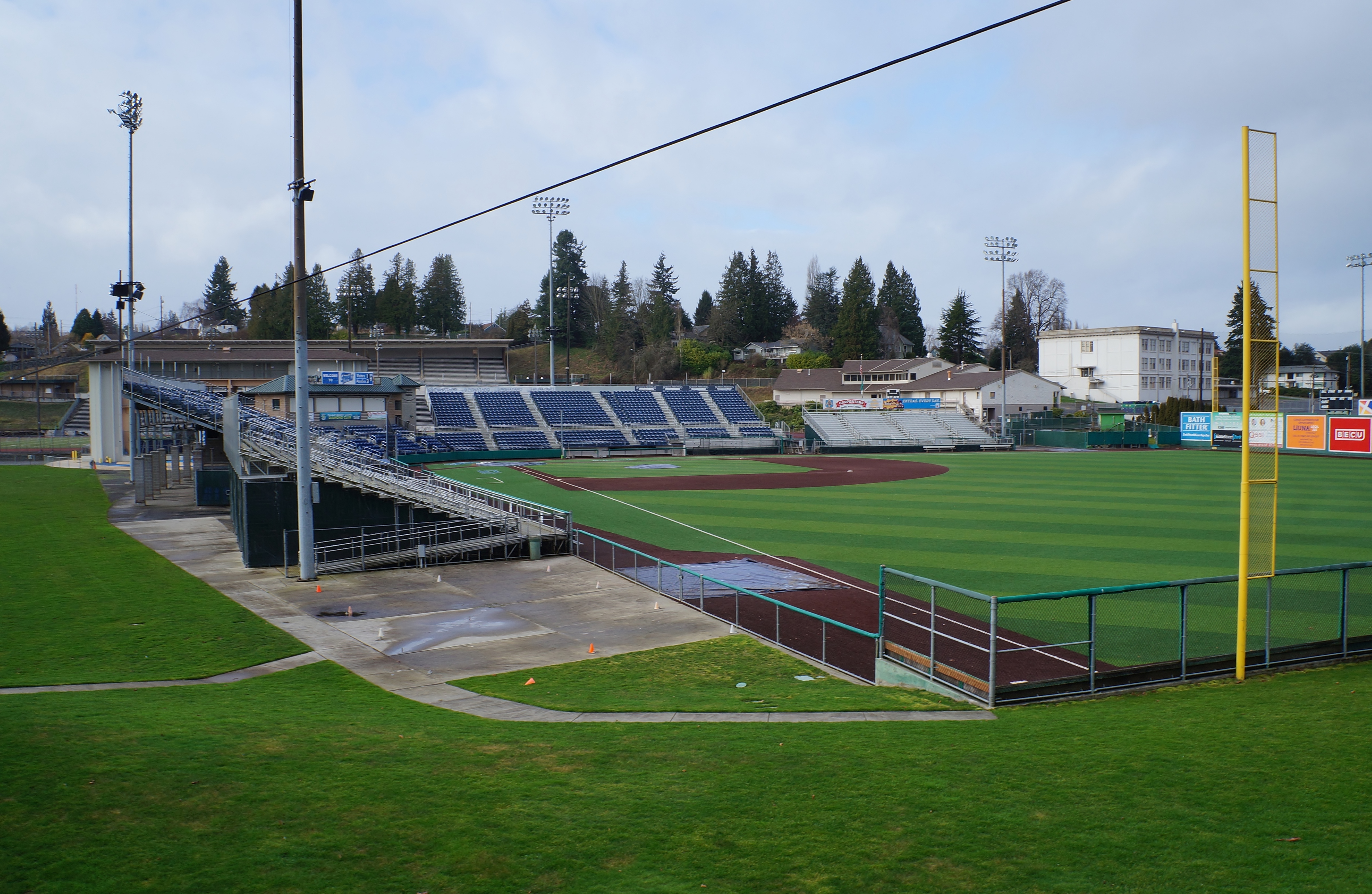
Everett Memorial Stadium
On June 17, 1987, a seventeen-year-old outfielder for the Bellingham Mariners stepped to the plate at Everett Memorial Stadium. With 3,122 fans watching, Ken Griffey Jr. launched a ball over the left field wall, sending it clear into the street roughly 387 feet from home plate. A plaque on the sidewalk now marks where it landed. The home run was his first as a professional, a small prologue to a Hall of Fame career -- but for Everett Memorial Stadium, it was just another chapter in a story that began with a war memorial, a fraternal lodge, and a patch of donated land on the east side of town.
Built on Gratitude
The stadium exists because of the Everett Lodge of Elks 479. In 1947, the lodge donated land to the Everett School District for a facility dedicated to the memory of Everett citizens who had died serving in World War II. The memorial aspect was not an afterthought tacked onto a sports venue -- it was the purpose. The complex that rose on the site reflected a postwar American instinct: honor the dead by building something the living could use. What the school district built was a dual-purpose facility with a football stadium seating 12,000 and a separate baseball diamond, both serving the district's athletic programs. For decades, it was simply the place where Everett played its games, a community anchor whose origins in grief gave every Friday night under the lights a quieter resonance.
Unexpected Visitors
Memorial Stadium has a knack for attracting unlikely guests. On July 9, 1967, the BC Lions and Edmonton Eskimos played a Canadian Football League preseason game there -- one that started 45 minutes late because Edmonton's aircraft had trouble getting to nearby Paine Field. The 6,248 spectators who stuck around saw a defensive slog that ended 7-2 with no touchdowns scored by either side. Eight years later, on April 5, 1975, the Seattle Sounders of the original North American Soccer League brought professional soccer to the stadium with an exhibition against the Los Angeles Aztecs. Defender Bernie Fagan scored the only goal in front of 6,614 fans, a crowd that suggests Everett was curious about the sport even before the Pacific Northwest became soccer country. These were one-off events, but they gave a school district stadium a surprisingly cosmopolitan resume.
Where the Minors Play
Professional baseball arrived to stay in 1984 when the Everett Giants of the Northwest League took the field. Their first home game, on June 19 against the Bellingham Mariners, drew 3,527 fans to a ballpark that already carried nearly four decades of wear. The stadium's age became part of its charm. Dating to 1947, it is one of the oldest active ballparks in Minor League Baseball, a distinction that speaks as much to thrift and affection as to architectural significance. The Everett Giants gave way to the Everett AquaSox, who have called the park home since 1995. In 1998, a $5 million renovation funded by a state-approved motel-hotel tax expanded the baseball seating by 1,400 seats to 3,682 and added concessions and lighting that brought the facility closer to modern standards. Two decades later, in 2019, local toymaker Funko signed a $1.1 million naming deal, and the ballpark became Funko Field -- a name that would have baffled the Elks Lodge members who donated the land.
Turf Wars and a Pandemic Parking Lot
By 2017, the natural grass on the baseball field had deteriorated to the point that Everett High School and Everett Community College could barely play on it. The switch to artificial turf, completed in April 2018, made it one of just three synthetic-surface ballparks in the Northwest League. The track stadium received its own renovation in 2022, reopening with a new surface. Then came March 2020, and the parking lot found an entirely different use: a COVID-19 testing center operated by the Snohomish Health District. In its brief run from March 23 to April 16, the site processed 2,500 people -- a reminder that community facilities serve purposes their builders never imagined.
A New Diamond Downtown
The stadium's next chapter may be its last. Updated Minor League Baseball standards and the AquaSox's promotion to High-A have spurred plans for a replacement. In December 2024, the Everett City Council selected a downtown site between Pacific and Hewitt avenues for a new multipurpose stadium that could also host a United Soccer League team. The estimated cost sits at a minimum of $102 million, largely from public funding. If it opens for the 2027 season as hoped, the original Memorial Stadium will likely retire after eight decades of service -- from war memorial to Ken Griffey Jr.'s first homer to Funko Field to whatever comes next. The Elks Lodge land, donated in an era when communities built things to honor sacrifice, will have served Everett well.
From the Air
Located at 47.967N, 122.203W in east-central Everett, Washington. The stadium complex is visible from the air as an oval track and adjacent baseball diamond surrounded by residential neighborhoods. Nearest airport is Paine Field/Snohomish County Airport (KPAE), approximately 2 nm to the south. Angel of the Winds Arena is visible nearby to the west-northwest in downtown Everett. Best viewed at 2,000-3,000 ft AGL on approach to or departure from KPAE.