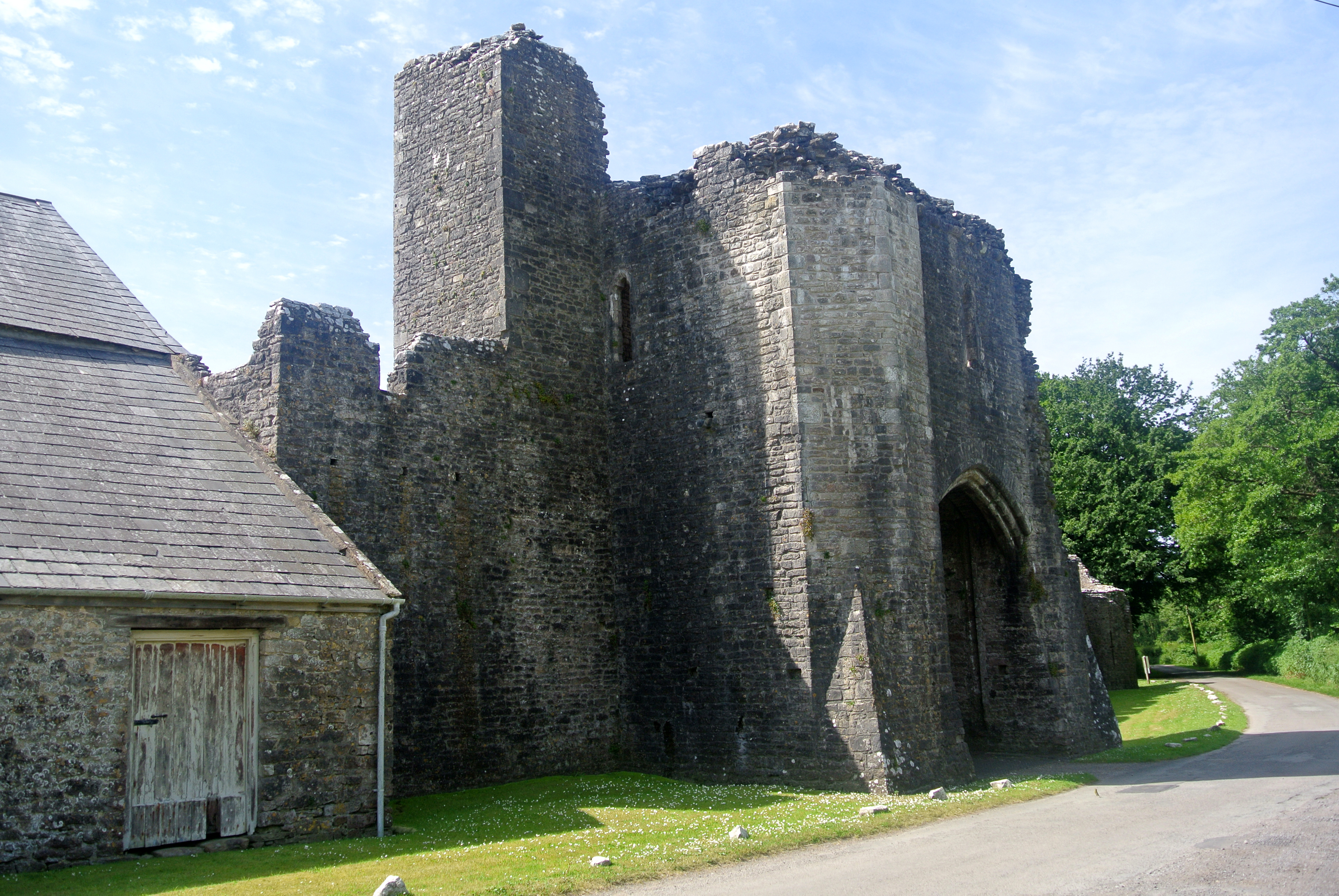
Ewenny Priory
Why would a handful of monks need castle walls? That question has nagged at historians since they first turned serious attention to Ewenny Priory, a small Benedictine house tucked into the Vale of Glamorgan beside the Ewenny River. Founded in 1141, the priory never held more than a modest community, yet someone lavished it with gatehouses, towers, and curtain walls that would not look out of place around a frontier fortress. The architectural historian John Newman called it "the most complete and impressive Norman ecclesiastical building in Glamorgan" -- and the mystery of its defences only deepens the compliment.
From Celtic Saint to Norman Stone
Long before the Normans arrived, this bend in the river held a monastic cell of the Celtic church, dedicated to a Welsh saint called Eguenni and recorded in the 12th-century Book of Llandaff. When William de Londres, one of the Norman knights who carved up Glamorgan after the Conquest, began plundering the site to build a castle, Pope Honorius II intervened with a threat of excommunication dated 12 April 1128. The sacred ground was spared. William's son Maurice finished what the Church demanded instead: in 1141 he granted the Norman church of St Michael to the abbey of St Peter at Gloucester, founding a proper Benedictine priory. The cruciform church he built remains a rare and remarkably intact example of Romanesque architecture, with rounded arches, barrel vaulting, and geometric carvings that still feel crisp nearly nine centuries later.
Walls Without a War
The priory's most striking feature is also its most perplexing. A rectangular precinct enclosed by substantial walls, pierced by north and south gatehouses and anchored by three towers, surrounds a community that never numbered more than a handful of monks. Historian Michael Salter has pointed out that there is no defensive ditch, the positioning is weak, and the circuit is far too large for a small community to defend. Elisabeth Whittle agrees, describing the walls as "a facade, a show of strength built only to impress." Newman concurs but confesses bewilderment at why "such a small and relatively poor community felt it should put on such an expensive show." Whatever the motive, the result endures: the walls remain among the best-preserved medieval precinct defences in Wales.
A Diplomat's Country House
When Henry VIII dissolved the priory in 1536, only three monks remained. Sir Edward Carne, a lawyer and diplomat who served at the courts of Henry VIII and his successors, leased the property that same year and purchased it outright in 1545. He wove a gentleman's residence into the medieval fabric, establishing deer parks for fallow and red deer on the grounds. The Carne family held the estate for generations, though by the late 18th century the Elizabethan house had decayed into what the diarist John Byng dismissed as a "miserable mansion" in 1787. Between 1803 and 1805, the old house came down and a Georgian replacement rose in its place, built by the Turbervill descendants who still own the property today. The Picton-Turbervill family now operates Ewenny Priory House as a wedding venue, while St Michael's Church continues to serve as the village parish church.
Turner's Eye and a Glass Screen
J. M. W. Turner painted the priory during his third tour of Wales in 1795, drawn by the same interplay of ruin and living worship that still characterizes the place. The priory complex is now cared for by Cadw, Wales's historic environment service, and boasts a remarkable number of listed structures -- Grade I designations for the church, the original west doorcase, the gatehouses, and the north tower, with the house, a medieval fish pond, and a barn earning Grade II*. In 2004, a glass screen by Alexander Beleschenko was installed to divide the active parish church from the unused eastern portion of the building. The critic Simon Jenkins lamented that it broke the "spatial integrity of the interior," but the screen also lets light play through the nave in ways the Norman builders could never have imagined -- a modern addition that, like the fortress walls themselves, provokes argument about what belongs in a sacred space.
From the Air
Located at 51.49N, 3.57W in the Vale of Glamorgan, south Wales. The priory sits on the southern bank of the Ewenny River. Best viewed at 2,000-3,000 ft. Nearest airport: Cardiff (EGFF), approximately 12 nm to the east. The fortified precinct walls are visible from the air as a rectangular enclosure around the church.