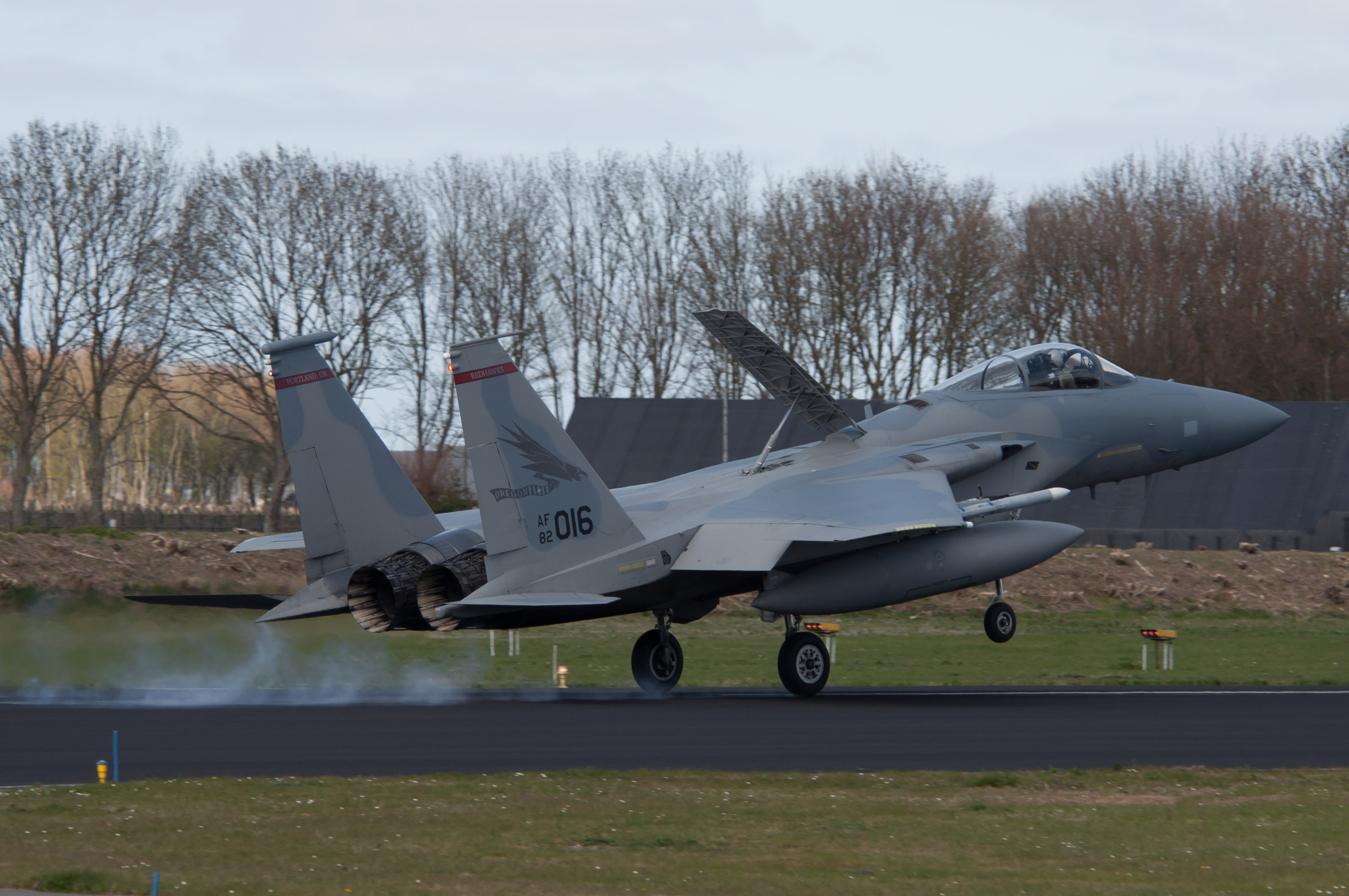
Exercise Frisian Flag
Blue versus Red. Twice a day for two weeks, on a piece of sky above the North Sea and the flat green provinces beneath it, the rules of the world invert. F-16s become aggressors. Falcon 20s pretend to jam. SA-6 emplacements in the dunes of Vlieland - a range NATO calls Cornfield - paint the friendlies and force evasive manoeuvres. Nobody fires anything that explodes, but everything else is as close to a high-intensity war as peacetime training gets. The exercise is named for the province below the cockpits: Frisian Flag, hosted from Leeuwarden Air Base.
From DIATIT to Frisian Flag
The exercise was born in 1992, in the immediate wake of NATO's intervention in Bosnia and Herzegovina, when the alliance suddenly needed a way to train its members to fight together in something more complex than a Cold War interception. The Royal Netherlands Air Force took the assignment. Their 323 Tactical Training Evaluation and Standardization Squadron - whose nickname was DIANA - cobbled together the awkward original name DIATIT, three letters from DIANA and three from Tactical Integrated Training. By 1999 someone reasonably decided the alliance deserved a better name. They borrowed the naming convention from the American Red Flag and the Canadian Maple Flag and reached for the province where Leeuwarden sits. Frisian Flag has stuck for a quarter century since.
Seventy Aircraft in a Crowded Sky
On a busy Frisian Flag day, more than seventy aircraft launch in waves - morning and afternoon, weekdays only, with the weekends and evenings reserved for ground rest. F-16s from a dozen NATO and Partnership for Peace nations form up over the North Sea. AWACS controllers from NATO Air Base Geilenkirchen and ground-based controllers in Dutch and German CRCs orchestrate the engagement. The European Air Refuelling Training exercise rides shotgun, with French, Dutch, Italian and German tankers cycling out of Eindhoven to top off the fighters mid-mission. JTACs on the ground coordinate close air support strikes against simulated targets. Combat search and rescue elements practice extracting downed pilots. The complexity is the point - this is not a dogfight clinic, this is preparation for the kind of contested airspace nobody in the alliance has flown into in earnest in a generation.
Red Air
The opposing force is what makes the exercise feel real. Some of the friendly aircraft swap colours and become Red. Beyond that, Discovery Air Defence brings in Douglas A-4 Skyhawks - those small, fast Vietnam-era attack jets - to fly as adversaries. British contractor Cobham provides Dassault Falcon 20s to broadcast electronic jamming and try to blind the Blue Force's radars. The Royal Norwegian Air Force has flown its own EW Falcon 20s in past iterations. In 2013 a Dutch company called Skyline Aviation showed up with a Gates Learjet 36A to play hostile jammer. The Red Force learns to think like a sophisticated adversary, and the Blue Force has to fight through electronic blindness, surface-to-air threats, and aggressive enemy fighters all at once.
Cornfield and the Ground Threat
The most distinctive feature of Frisian Flag is the ground. Dutch Patriot batteries, NATO SAM units at the Marnewaard training area in Groningen, and the Vliehors range on the island of Vlieland - codename Cornfield - simulate the threats pilots would face penetrating defended airspace. Soviet-era SA-6 Gainful systems and the Franco-German Roland short-range missile lock onto inbound aircraft. Smokey Sam rockets, small fireworks-like surface launches, mimic real missile shots and force pilots to break and defeat them. The result is a training environment where you cannot just win the air war by being a better dogfighter. You have to keep one eye on the ground the entire time.
The View From Above
From cruising altitude on a Frisian Flag morning, the airspace north of the Netherlands looks busier than usual on a flight tracker. Contrails braid across the North Sea. Tankers track racetrack patterns near the coast. The fighters themselves rarely show, but their playground is enormous: roughly a triangle bounded by the Dutch coast, the German Bight, and southern Denmark. Below it all sits Leeuwarden Air Base - Frisia's quiet provincial capital with one of the most internationally trafficked military runways in Europe for two weeks each year. Then the exercise ends, the visitors fly home, and the dairy cows reclaim the soundscape.
From the Air
Leeuwarden Air Base (EHLW) is located at 53.23 N, 5.76 E, on the northern edge of the city of Leeuwarden in Friesland. The exercise typically uses airspace over the North Sea and the skies above the Netherlands, Germany and Denmark. Nearby diversion airfields include Groningen Airport Eelde (EHGG) 50 km east, Amsterdam Schiphol (EHAM) 105 km south-southwest, and Bremen (EDDW) 200 km east in Germany. Best altitude for understanding the layout is 6,000 to 10,000 feet - high enough to see the coast, the Wadden Sea islands including Vlieland (Cornfield range), and the Marnewaard training area to the east. During exercise periods (typically late March to mid-April) check NOTAMs carefully; large temporary reserved airspace activates over the North Sea.