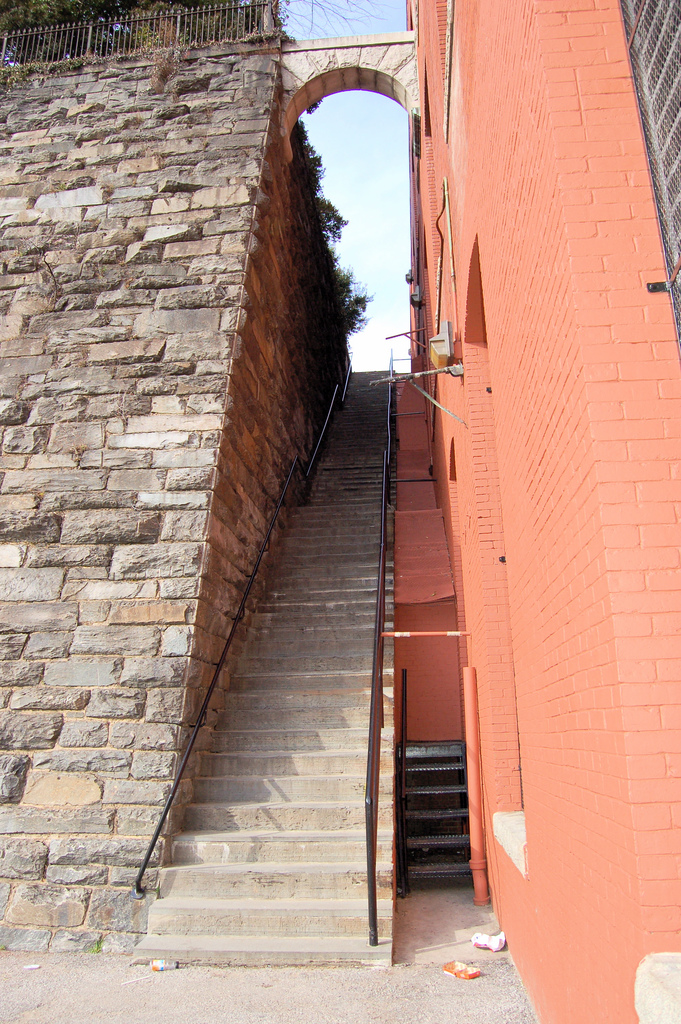
Exorcist Steps
Before anyone ever called them the Exorcist steps, locals knew these 75 concrete stairs wedged between M Street and Prospect Street in Georgetown as the "Hitchcock steps." That earlier nickname hints at something the staircase has always possessed: an atmosphere of cinematic dread. Built in 1895 as a practical connection between Georgetown's upper bluffs and the canal-era waterfront below, the stairs descend at a vertiginous pitch beside a rough stone retaining wall, hemmed in on one side by a row of townhouses and on the other by the old Capital Traction Company car barn. Even in broad daylight, there is something about the narrowness of the passage and the steepness of the drop that makes the throat tighten. William Friedkin recognized it the moment he saw it.
A Staircase Born from Handshakes and Cable Cars
The steps owe their existence to Georgetown's streetcar era. In the 1890s, the Capital Traction Company built a large barn for cable cars along the waterfront at the base of the bluffs. The stairs were constructed around 1895 as a continuation of 36th Street NW, providing a pedestrian right-of-way and a lightwell for the adjacent buildings. George Killeen, a prominent local Democratic figure, oversaw the construction of the heavy stone retaining wall that borders the staircase. According to family legend, the wall was built on nothing more than a handshake agreement, and Killeen was never paid for the work. That kind of informal dealing was common in Georgetown at the time, but it left the wall with a folk-history charm that only deepened as the decades passed and the cable cars disappeared.
Padding the Fall
When director William Friedkin and screenwriter William Peter Blatty chose Georgetown as the setting for their 1973 film The Exorcist, the steep stairs beside the house at 3600 Prospect Street became the scene of the story's devastating climax. In the film, Father Damien Karras hurls himself through a window and tumbles down the full length of the staircase to his death. To film the sequence safely, the crew padded every step with half-inch-thick rubber. Because the actual house sat slightly back from the top of the stairs, they built an eastward extension with a false front, creating the illusion that the window opened directly above the precipice. Stuntman Charles Waters performed the fall, and the sequence was shot with multiple cameras capturing the body's terrible, bouncing descent. The scene seared these stairs into the memory of every viewer who watched it, transforming a utilitarian Georgetown walkway into one of the most recognizable locations in horror cinema.
Pilgrimage and Recognition
For decades after the film's release, the steps existed in a strange liminal space: beloved by horror fans and film tourists, yet lacking any official acknowledgment from the city. That changed on Halloween weekend in 2015, when Mayor Muriel Bowser gathered with Friedkin and Blatty at the base of the staircase for a ceremony that designated the Exorcist steps as an official D.C. landmark and tourist attraction. A commemorative plaque was unveiled, recognizing the stairs' importance to both Washington, D.C., and film history. The event was fitting both in its timing and its cast of characters. Blatty, who had written the novel on which the film was based, and Friedkin, who had directed the adaptation, stood together at the site where their collaboration had achieved its most visceral expression.
Climbing Into Cinema History
The Exorcist steps belong to a select group of staircases that have become famous through film. The Potemkin Stairs in Odessa are inseparable from Eisenstein's 1925 Battleship Potemkin. The Rocky Steps in Philadelphia will forever be associated with Sylvester Stallone's triumphant run. The Joker Stairs in the Bronx drew crowds after the 2019 Joaquin Phoenix film. But the Georgetown staircase may be the most atmospheric of them all. Standing at the bottom and looking up, you see the narrow channel of weathered stone, the uneven concrete treads, the houses looming above. The stairs themselves have not changed since 1895. They still serve as a public right-of-way, still connect the upper neighborhood to the waterfront. Joggers use them for exercise. Students trudge up them on their way to class. And visitors from around the world pause at the base, look up, and feel the unmistakable chill of recognition.
From the Air
Located at 38.91N, 77.07W in the Georgetown neighborhood of Washington, D.C., along the Potomac River waterfront. The steps are tucked between buildings and not visible from altitude, but the Georgetown waterfront and Key Bridge nearby are strong visual references. Nearest airport: KDCA (Ronald Reagan Washington National Airport), approximately 3 nautical miles south. Best viewed at low altitude approaching from the Potomac River corridor. The adjacent former Capital Traction Company car barn (now Georgetown Car Barn) is a larger rooftop landmark.