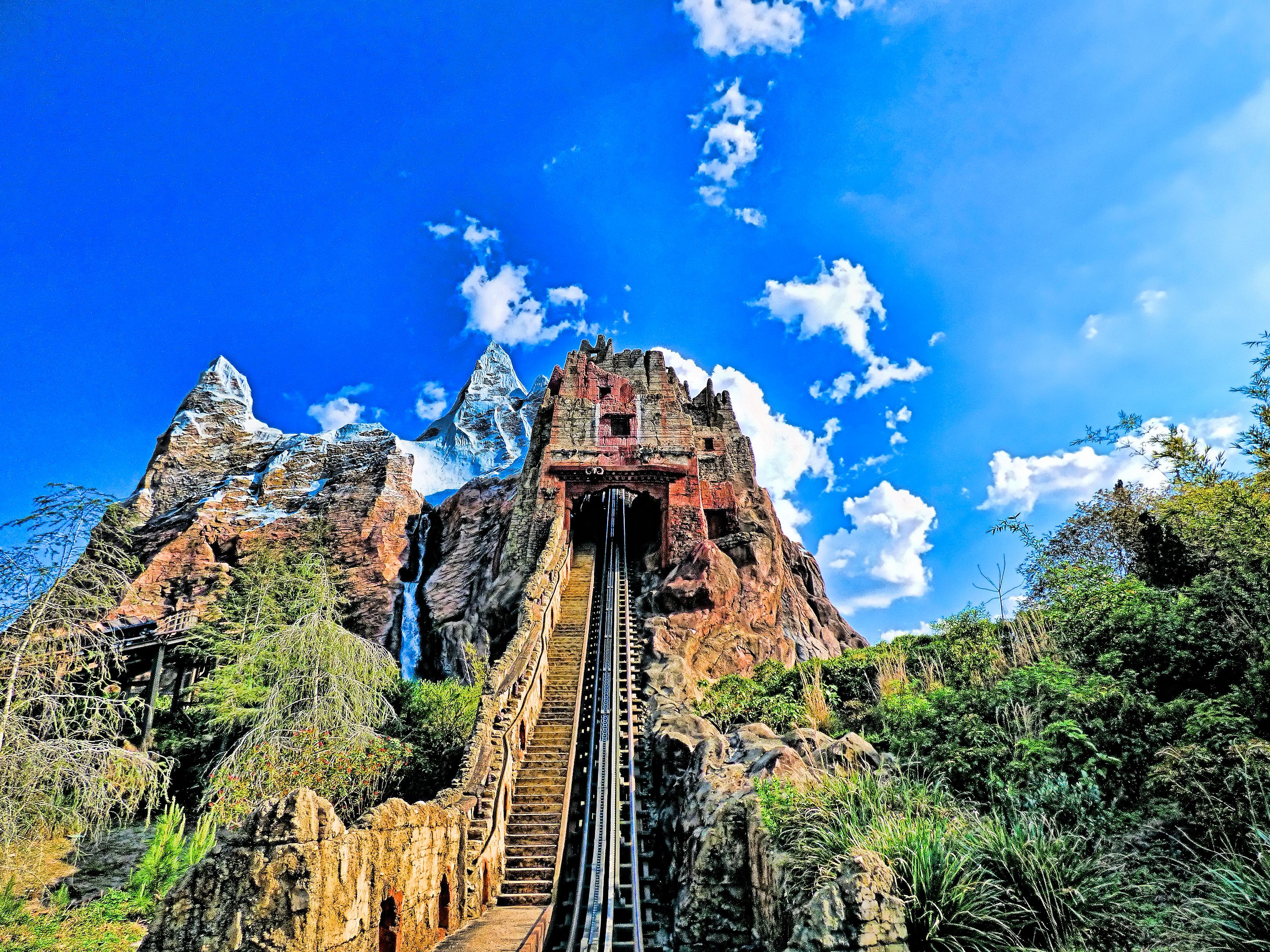
Expedition Everest
Joe Rohde made a promise he could not keep. The Walt Disney Imagineer who spent six years and $100 million building Expedition Everest at Disney's Animal Kingdom swore publicly at the 2013 D23 Expo that he would fix the ride's legendary yeti animatronic. Eight years later, he retired from Walt Disney Imagineering without ever doing so. That broken promise sits at the heart of what makes Expedition Everest one of the most fascinating theme park attractions ever built: a steel roller coaster designed by Vekoma that became the tallest attraction at Walt Disney World, the most expensive roller coaster in Guinness World Records history, and a monument to ambitions that outpaced the engineering meant to support them.
A Mountain Made of Three Strangers
The artificial mountain rising above Disney's Animal Kingdom is not Mount Everest. It is a fictional peak called the Forbidden Mountain, guarded by a yeti in the story Walt Disney Imagineering created for the attraction. Everest itself is represented by the barren peak on the far right of the structure, rendered in forced perspective to appear impossibly distant. The entire edifice consumed 1,800 tons of steel, 10,000 tons of concrete, 5,000 tons of structural steel, and 2,000 gallons of paint. But the most remarkable engineering detail is invisible: the mountain facade, the roller coaster track, and the yeti animatronic are three completely independent structures. Each one reaches ground level on its own. None touches the other two. This separation was achieved using 4-D scheduling software that choreographed the exact construction sequence so that steel, concrete, and machinery could be threaded together without ever physically connecting. It is three buildings wearing one disguise.
Forward, Then Backward
Expedition Everest was announced on April 22, 2003, the fifth anniversary of Disney's Animal Kingdom. Construction had already been underway for a month. Three years later, riders boarded trains themed as the Anandapur Rail Service, six cars per train, 34 riders seated two abreast, designed to look old and rusty. The ride begins as a forward climb into the mountain, then halts at a section of destroyed track. Automatic switches rotate the rail behind the train, and suddenly riders are traveling backward, spiraling down through the mountain's interior. A second track switch redirects the train forward again, sending it past the on-ride camera and plunging down the main drop into a 250-degree turn before a helix carries it back inside the mountain one final time. The full ride lasts two minutes and fifty seconds. It was the first Disney roller coaster to switch between forward and backward travel during the same ride, a distinction that required two separate sets of track switches and engineering that no previous Disney attraction had attempted.
The Yeti Problem
The centerpiece of Expedition Everest was supposed to be a massive audio-animatronic yeti that lunges toward riders during the final cave drop. For a brief period after the ride's 2006 opening, it worked as intended. Then something broke. The prevailing theory is that damage occurred to the animatronic itself, though speculation has long circled a flaw in the 4-D scheduling software that may have prevented adequate curing of a portion of the yeti's concrete foundation before the surrounding mountain and track were fabricated on top of it. The result is the same either way: the yeti sits atop a 46-foot tower in the center of a finished building, and reaching it for repairs would require major disassembly of the superstructure around it. Disney fans coined the term Disco Yeti for the compromise solution, a strobe light effect that flashes around the static figure to create an illusion of movement. At the 2013 D23 Expo, Rohde acknowledged the problem with characteristic directness: 'It's a giant complicated machine sitting on top of, like, a 46-foot tall tower in the middle of a finished building. So, it's really hard to fix.' He retired on January 4, 2021, the yeti still frozen in place.
Eight Thousand Artifacts and One Real Expedition
The queue line at Expedition Everest is a museum in its own right. Approximately 8,000 artifacts collected during research trips to Nepal fill the standby line, creating a fictional narrative about the Anandapur Royal Tea Company and a legendary creature guarding the mountain paths. In 2005, Disney partnered with Discovery Networks and Conservation International to conduct actual scientific and cultural research expeditions in remote areas of the Himalayas. Joe Rohde participated alongside scientists from Conservation International and Disney's Animal Kingdom. Three documentaries broadcast on Discovery's cable channels in April 2006 chronicled the expeditions and the making of the attraction. During construction, the Imagineers bypassed traditional scaffolding entirely, using interior poles that poked through the outside of the mountain and were connected by wooden platforms. Disney keeps the height of every attraction at Walt Disney World under 200 feet because aviation regulations require taller structures to carry blinking red warning beacons, which would shatter the theming. Expedition Everest reaches 199.5 feet, the tallest attraction in the resort, edging out the Twilight Zone Tower of Terror by the thinnest of margins.
From the Air
Located at 28.3582N, 81.5863W within Disney's Animal Kingdom at Walt Disney World Resort. A permanent FAA Temporary Flight Restriction (TFR) covers the Walt Disney World complex, prohibiting general aviation within 3 nautical miles up to 3,000 feet AGL. At 199.5 feet, Expedition Everest is the tallest structure in the resort, kept deliberately below the 200-foot FAA threshold requiring aircraft obstruction lighting. Nearest airports include Orlando Executive (KORL) approximately 15nm east and Orlando International (KMCO) roughly 20nm southeast. The artificial mountain is a prominent visual landmark against Central Florida's flat terrain.