Exploratorium
Frank Oppenheimer's career in physics ended because of politics. His career in education ended because of death. In between, he built something that changed how museums work worldwide. Oppenheimer, who had worked on the Manhattan Project alongside his brother J. Robert, was forced to resign from the University of Minnesota in 1949 after the House Un-American Activities Committee came calling. Blacklisted from every academic position in the country, he retreated to a Colorado cattle ranch for nearly a decade. When he finally returned to science, he did not go back to the laboratory. He built the Exploratorium.
A Rancher's Second Act
A 1965 Guggenheim Fellowship sent Oppenheimer to Europe, where three museums reshaped his thinking. The Palais de la Decouverte in Paris used student demonstrators to teach scientific concepts -- a practice that would directly inspire the Exploratorium's High School Explainer Program. The South Kensington Museum of Science and Art in London offered breadth. The Deutsches Museum in Munich, the world's largest science museum, had interactive displays that electrified the Oppenheimers. Back in America, he was invited to plan a new Smithsonian branch but turned it down to pursue his own vision in San Francisco. He and his wife moved there in 1967, carrying a written proposal and handmade exhibits from meeting to meeting, visiting scientists, businesses, school officials, and friends. A $50,000 grant from the San Francisco Foundation made the museum possible.
Smell the Oil
In late August 1969, the Exploratorium opened at the Palace of Fine Arts with no fanfare. Oppenheimer simply opened the doors. When someone proposed building a wall between the workshop where exhibits were being developed and the visitor areas, he refused. He wanted visitors to experience "the way a shop smells when you burn the wood in a saw, or smell the oil from a lathe." The workshop sat right next to the main entrance, and the boundary between making and learning was deliberately erased. Oppenheimer directed the museum until his death in 1985, establishing a philosophy that has since inspired an international network of participatory museums. Over a thousand exhibits invited visitors to touch, spin, pull, listen, and discover -- not through reading labels but through physical engagement with phenomena.
From Palace to Pier
In April 2013, the Exploratorium relocated from the Palace of Fine Arts to Piers 15 and 17 along the San Francisco Embarcadero, between the Ferry Building and Pier 39. The historic piers, built in 1912 and 1931, required extensive renovation. The infill between them, paved over since 1954, was removed to restore open water and public plazas. The new campus comprises 330,000 square feet of indoor and outdoor exhibit space and 1.5 acres of freely accessible public areas. Pier 15 extends over 800 feet into the bay. Architect EHDD designed the space to achieve net-zero energy: 5,874 rooftop photovoltaic panels generate more electricity than the museum uses annually. Bay water flowing beneath the pier is filtered and pumped through titanium heat exchangers to heat and cool the building, with 27 miles of radiant tubing creating 82 separate climate zones. The museum earned LEED Platinum certification in January 2014.
Fog and Phenomena
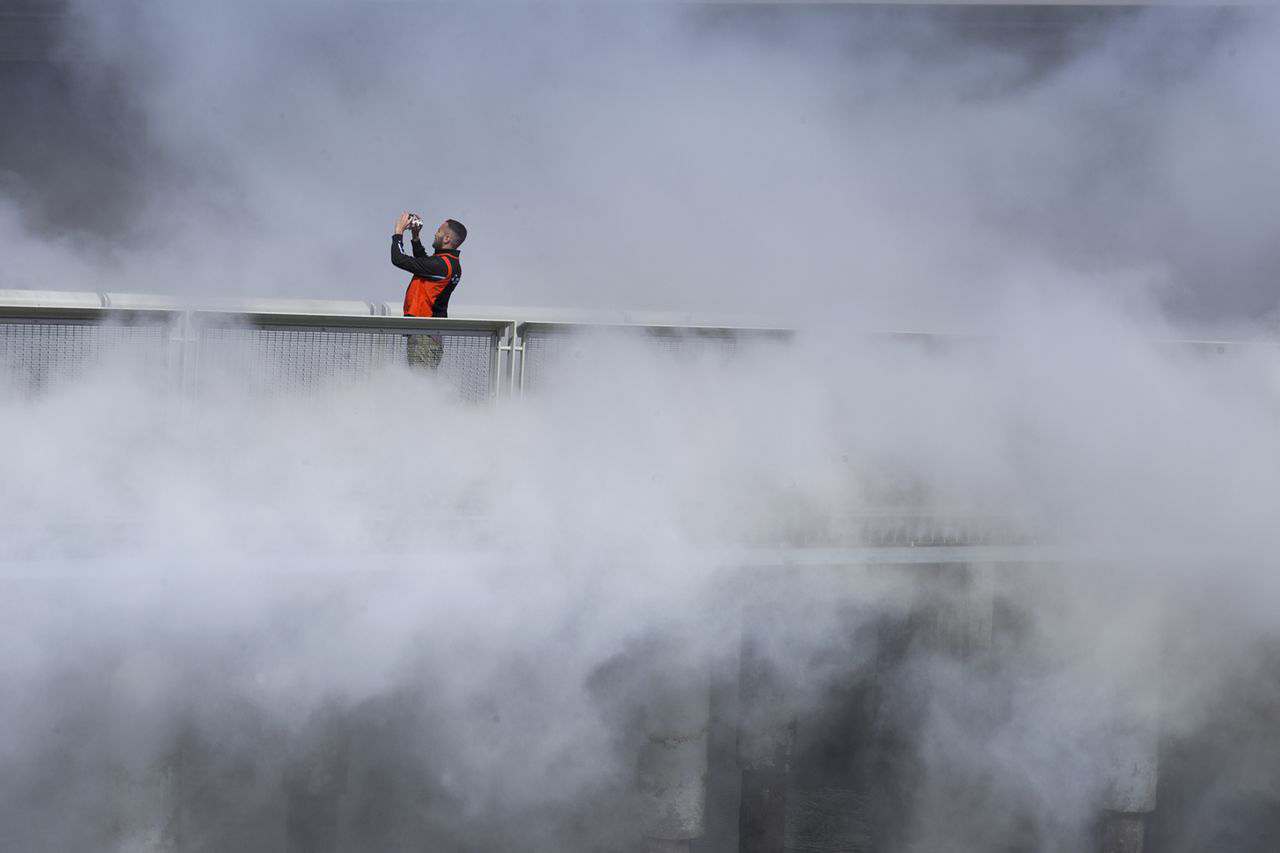
The outdoor galleries make the bay itself an exhibit. Artist Fujiko Nakaya's Fog Bridge, a 150-foot installation using 800 nozzles to create bursts of manufactured fog every half hour, was originally temporary but became permanent -- an irresistible echo of San Francisco's most famous weather pattern. Visitors can spin disks filled with bay mud and sand, observe barnacles grown on glass plates submerged in the water below, or use the Wired Pier sensors streaming real-time data about air quality, tides, and weather. Inside, the Tactile Dome offers a pitch-black maze navigated entirely by touch. Gallery 2 carries on Oppenheimer's workshop philosophy, placing the museum's exhibit-building shop in full view of visitors. A 22-foot clock by artist Tim Hunkin unfolds figurines on the hour. A sculpture of Bay Area landmarks built from over 100,000 toothpicks, assembled over 37 years by artist Scott Weaver, lets visitors roll a ping-pong ball through miniature San Francisco.
From the Air
The Exploratorium is located at 37.8017N, 122.3975W on Piers 15 and 17 along the San Francisco Embarcadero waterfront. The long pier structure extending into the bay is identifiable from 2,000-3,000 feet AGL, with the distinctive rooftop solar panel array covering the pier shed. Nearby airports: KSFO (San Francisco International, 11nm S), KOAK (Oakland International, 7nm E). Within San Francisco Class B airspace.