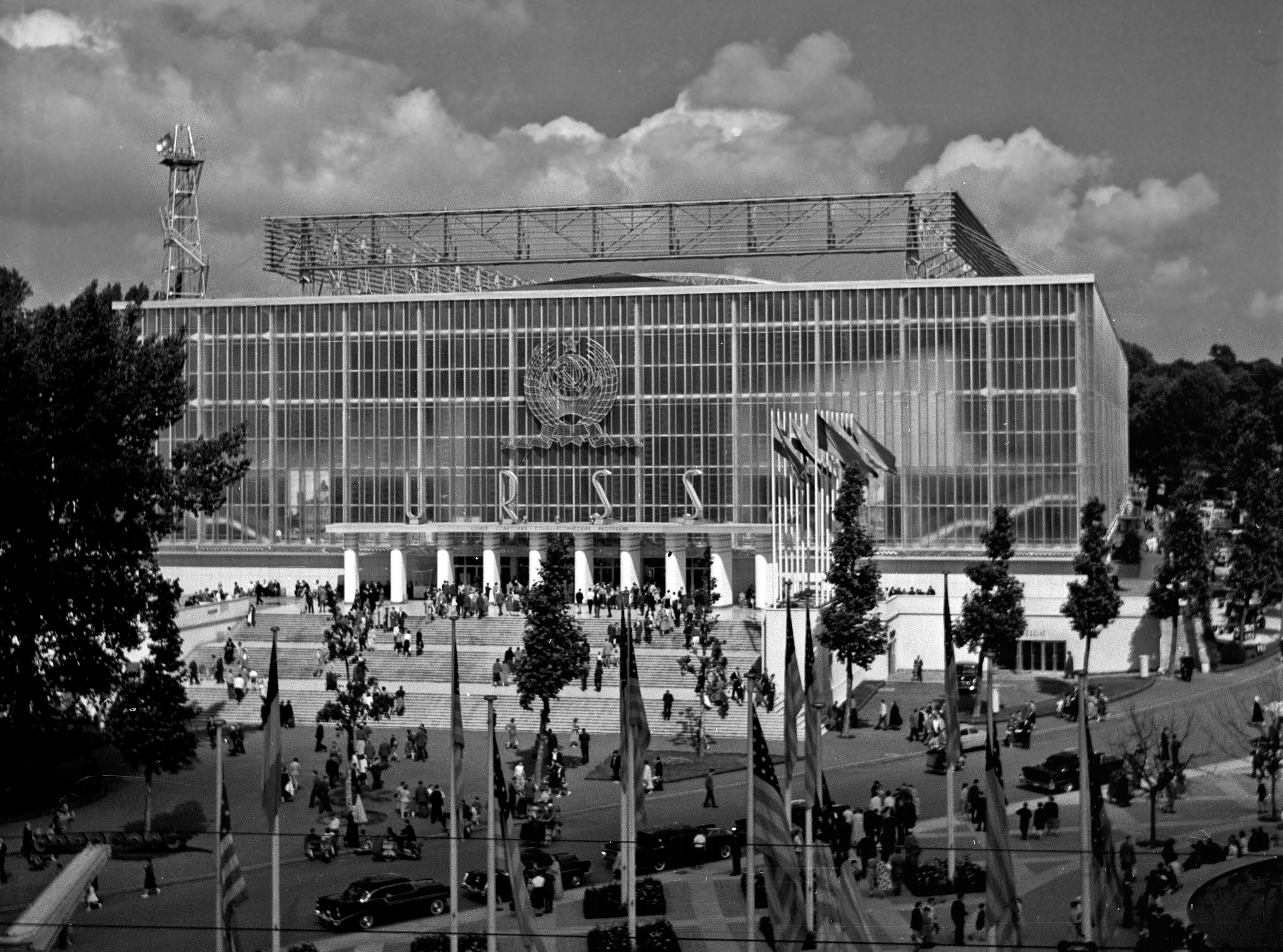
Expo 58
Andre Waterkeyn was an engineer for a Belgian metalworks company when he sketched the Atomium on a piece of paper in 1955. The shape was nine spheres connected by tubes, an iron crystal magnified 165 billion times. The idea was that visitors would ride elevators through the connecting tubes from sphere to sphere, like electrons. It was a structure no one had ever built, and it was supposed to last six months. Sixty-eight years later it is still there, 102 meters above the Heysel Plateau in Brussels, somehow exactly as silly and exactly as moving as it must have looked in 1958, when the world came to see whether the future was something to celebrate or something to fear.
The First Fair After the Cemeteries
Expo 58 was the first major world's fair registered under the Bureau International des Expositions after the Second World War. The previous one in Brussels had been the 1935 exposition, and many of its buildings were still standing on the Heysel Plateau, ready to be reused. Belgium won the bid in 1953, beating Paris and London, and spent three years building. Nearly 15,000 workers laid out a two-square-kilometer site seven kilometers northwest of central Brussels. The theme, in French, was "Bilan du monde, pour un monde plus humain" - an evaluation of the world, for a more humane world. It was the kind of phrase a generation that had seen Hiroshima and the camps could write with absolute earnestness, knowing exactly what they meant by humane and exactly why the world might not become it.
The Atom as Architecture
The Atomium was supposed to embody the optimistic case for atomic power. Each of the nine stainless-steel-clad spheres was 18 meters across. The tubes connecting them held the longest escalators in Europe at the time. King Baudouin opened the structure with a speech about world peace and economic progress, framing the atom as a tool for prosperity rather than annihilation. The fair sat in the strange interval between Hiroshima and Cuba: thirteen years after the bomb, four years before the missile crisis. Visitors climbed inside an enlarged iron crystal because the people who designed the fair believed, or wanted to believe, that the science that had ended the war could also fuel cities and cure diseases. The Atomium was meant to come down at the end of October 1958. It never did. Its outer aluminum coating was eventually replaced with stainless steel in 2006, and it has become to Brussels what the Eiffel Tower is to Paris.
Cold War on the Heysel Plateau
Forty-one and a half million people came through the gates between 17 April and 19 October 1958, second only to the 1900 Paris exposition. They came to see Le Corbusier's Philips Pavilion, where Edgard Varese's Poeme electronique played from 425 loudspeakers placed by Iannis Xenakis. They came to see the USSR pavilion, which displayed full-scale replicas of Sputnik 1 and Sputnik 2, the satellites that had launched into orbit only months before. The Soviet pavilion was packed; the United States pavilion answered with a fashion show, a 360-degree Disney film called America the Beautiful, and an electronic computer that demonstrated a knowledge of history. The two pavilions stood within walking distance of each other on the Heysel Plateau, and the visitors who walked between them were performing, without quite realizing it, the central choreography of the next thirty years.
The Village Indigene
Near the Atomium, on 7.7 hectares, Belgium built a section dedicated to its colonial holding in central Africa. The Belgian Congo was still, in 1958, a Belgian colony; it would not gain independence until June 1960. The exhibit's centerpiece was something called the village indigene, an open-air enclosure where 598 Congolese people were displayed to the public. They were not warriors or villagers, as the staging implied. They were urban professionals, the people Belgian colonial language called evolues, but they were dressed in costume and watched from behind a barrier by armed guards. The Congolese protested. By mid-July, they demanded to be sent home and the exhibit closed early, condemned as a human zoo by some European newspapers and defended by others. Today the term used is unambiguous. Six decades on, Belgium is still publicly reckoning with what was on display in 1958: not only the Africans in the enclosure, but the colonial mindset that put them there and called it civilizing work.
What Remains
Belgium has not hosted a world's fair since. The Yugoslav pavilion, designed by Vjenceslav Richter as a celebration of his country's six republics, was sold after the fair and rebuilt as a school in the Belgian town of Wevelgem, where it still stands. The Brussels airport gained the new terminal in Zaventem that gives the airport its modern name, built specifically to handle the expected influx of visitors. Several tram lines built for the fair still run. The autograph manuscript of Mozart's Requiem was displayed during Expo 58, and at some point someone tore off the bottom right corner of the second-to-last page, taking with them the words "Quam olim d: C:" The fragment has never been recovered, the thief never identified. The Atomium remains, still surreal at 102 meters, still impossible to mistake for any other monument in any other city. From cruising altitude over Brussels you can see it as a small silver constellation, nine spheres arranged in a pattern only crystallographers would immediately recognize.
From the Air
The Atomium and Heysel Plateau lie at 50.90°N, 4.34°E, seven kilometers northwest of central Brussels. Brussels Airport (EBBR) is approximately 14 km east. From cruising altitude in clear weather the Atomium is identifiable as a small reflective cluster of spheres near the Heysel exhibition halls; the King Baudouin Stadium sits immediately south of the structure.