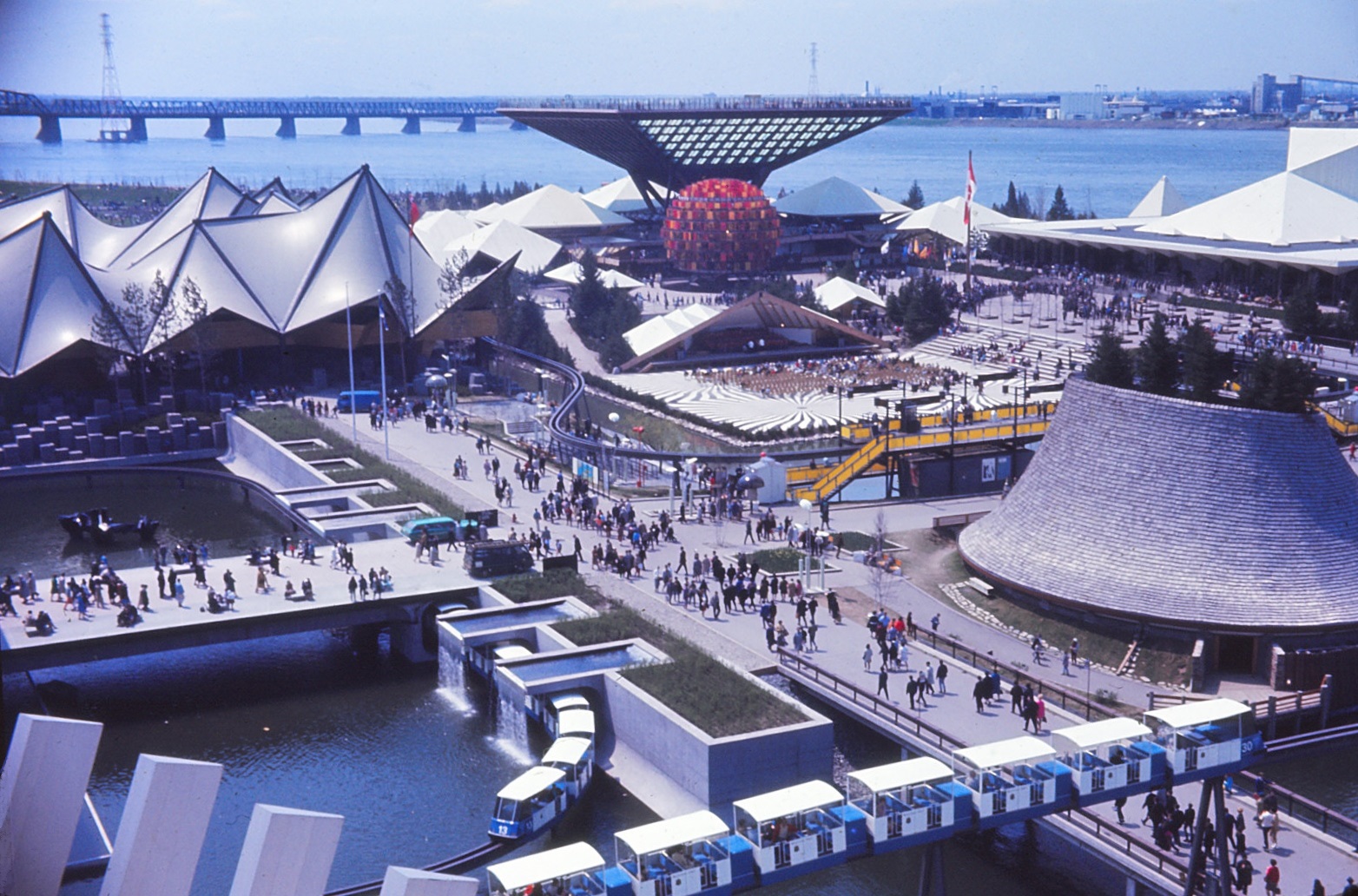
Expo 67
A computer said it couldn't be done. In 1963, organizers fed the construction timeline into a program and received an unambiguous answer: there was no way to build a world's fair on artificial islands in the St. Lawrence River by April 1967. Mayor Jean Drapeau ignored the machine. On April 28, 1967, Expo 67 opened on schedule, sprawling across islands that hadn't existed four years earlier, welcoming 62 nations and eventually drawing over 50 million visitors - at a time when Canada's entire population was only 20 million. It remains the per-capita attendance record for any world's fair, a figure no subsequent exposition has matched. The Soviet Union had originally been awarded the 1967 fair to celebrate the Russian Revolution's 50th anniversary, but financial constraints and security concerns led Moscow to cancel. Canada swooped in, and what was meant to be a Soviet triumph became the most ambitious undertaking in Canadian history.
Islands from Nothing
The boldness of Expo 67 started with its site. Several locations were proposed, including Mount Royal Park north of downtown. But Drapeau wanted something unprecedented: new islands in the St. Lawrence. Engineers enlarged the existing Saint Helen's Island and created the entirely artificial Ile Notre-Dame, requiring 25 million tons of fill. Some 10 to 12 percent of that material came from the Montreal Metro's excavations, already under construction. The rest arrived from quarries across Montreal and the South Shore, and even that proved insufficient - lakes and canals were carved into both islands to reduce the fill required. Construction began ceremonially on August 13, 1963, when Prime Minister Lester Pearson pulled a lever to signal the first dump of earth, and Quebec Premier Jean Lesage spread the fill with a bulldozer. The entire island-building effort, including the new Concorde Bridge and the Expo Express transit system, cost more than the Saint Lawrence Seaway had just five years prior - and that was before a single pavilion went up.
Terre des Hommes
The theme emerged from a three-day meeting in May 1963 at the Seigneury Club in Montebello, Quebec, where a gathering of Canadian intellectuals - novelist Hugh MacLennan, novelist Gabrielle Roy, geophysicist John Tuzo Wilson, and National Gallery director Alan Jarvis among them - settled on 'Man and His World,' drawn from Antoine de Saint-Exupery's 1939 book Terre des Hommes. The theme gave structure to seventeen exhibition elements spanning human health, creativity, exploration, and community. Among its most radical expressions was Habitat 67, architect Moshe Safdie's modular housing complex of stacked concrete units, still occupied today as private residences. The logo, designed by Montreal artist Julien Hebert, used an ancient pictogram of a human figure, paired and repeated in a circle to represent 'friendship around the world.' As historian Pierre Berton observed, the fair's success depended on the cooperation between Canada's French- and English-speaking communities - 'the Quebecois flair, the English-Canadian pragmatism' - briefly bridging the nation's famous 'Two Solitudes.'
The World Arrives
Governor General Roland Michener declared the exhibition open after Prime Minister Pearson ignited the Expo flame before 7,000 guests and 53 heads of state. The first person through the gates was Al Carter, a 41-year-old jazz drummer from Chicago, who received a gold watch for his feat. What followed was six months of spectacle. Queen Elizabeth II rode the minirail. Charles de Gaulle visited - and infamously declared 'Vive le Quebec libre' from Montreal's city hall balcony during the same trip. Thelonious Monk, the Grateful Dead, Jefferson Airplane, and the Supremes performed. The Soviet Union's pavilion drew the most visitors - about 13 million - followed by the Canadian Pavilion at 11 million, the United States at 9 million, France at 8.5 million, and Czechoslovakia at 8 million. On its third day alone, 569,500 people passed through the gates, setting a single-day attendance record for any world's fair.
Ruins of Tomorrow
The pavilions were never built to last, and they didn't. After the fair closed in October 1967, the site limped on as 'Man and His World,' a summer exhibition that ran until 1984. In 1975, fire destroyed the Ontario pavilion. The following year, another fire consumed the acrylic outer skin of Buckminster Fuller's iconic geodesic dome - the American pavilion - leaving only its steel skeleton. Abandoned pavilions were vandalized, and the site took on the look of a ruined futuristic city. Most structures were demolished between 1985 and 1987. The French pavilion was refurbished into the Montreal Casino. Fuller's dome skeleton became the Montreal Biosphere, an environmental museum. La Ronde amusement park, which began as the fair's entertainment zone, was leased to Six Flags in 2001. In 2000, the park encompassing both islands was renamed Parc Jean-Drapeau, honoring the mayor whose audacious vision had conjured them from the river.
A Country's Coming of Age
Expo 67 left marks that go far beyond architecture. Major League Baseball's 1969 expansion team, the Montreal Expos - now the Washington Nationals - took its name from the fair. The Czechoslovak pavilion was shipped to Newfoundland and reassembled as the Grand Falls Arts and Culture Centre, now the Gordon Pinsent Centre for the Arts. A Vaporetto water taxi that once shuttled fairgoers eventually ended up giving harbor tours in Charlottetown, Prince Edward Island. Even the Expo 67 parking lot had an afterlife, briefly becoming Victoria STOLport, an experimental short-takeoff airport in the 1970s. For Canadians, though, the deepest legacy is emotional. Expo 67 was the moment a young, often self-doubting nation proved it could build something extraordinary - defying both a computer's calculations and the world's expectations. The Berri-UQAM Metro station still displays an original 'Man and His World' welcome sign above the entrance to the Yellow Line, a quiet reminder of the six months when Montreal felt like the center of the universe.
From the Air
Located at 45.52°N, 73.54°W on Ile Sainte-Helene and Ile Notre-Dame in the St. Lawrence River, Montreal. The two islands are clearly visible from altitude, sitting between the Old Port of Montreal to the north and the South Shore suburbs. Look for the distinctive skeleton of Buckminster Fuller's geodesic dome (Montreal Biosphere) on Saint Helen's Island and the Montreal Casino (former French pavilion) on Notre-Dame Island. La Ronde amusement park's rides are visible on the eastern tip of Saint Helen's Island. The Circuit Gilles Villeneuve Formula 1 track loops around Notre-Dame Island. Nearest major airport is Montreal-Pierre Elliott Trudeau International (CYUL), approximately 18 km west. Montreal/Saint-Hubert (CYHU) lies 12 km southeast. Best viewed at 3,000-5,000 ft AGL for island detail. The Jacques Cartier Bridge passes directly over Saint Helen's Island.