Expo '70: When Japan Invited the World to the Future
Somewhere beneath the grounds of Osaka Castle Park, a time capsule waits to be opened in the year 6970. Buried during the 1970 World Exposition, it contains 2,098 items chosen to represent the sum of human civilization at the moment Japan announced itself to the world. That capsule captures the ambition of Expo '70 perfectly: nothing less than everything. Between March 15 and September 13 of that year, 64,218,770 visitors streamed through the gates of a 330-hectare fairground in the Senri Hills northwest of Osaka -- making it the best-attended world's fair in history at the time. Seventy-seven nations participated. The theme was "Progress and Harmony for Mankind," and for six months, the future had an address.
A Tree Made of Steel and Light
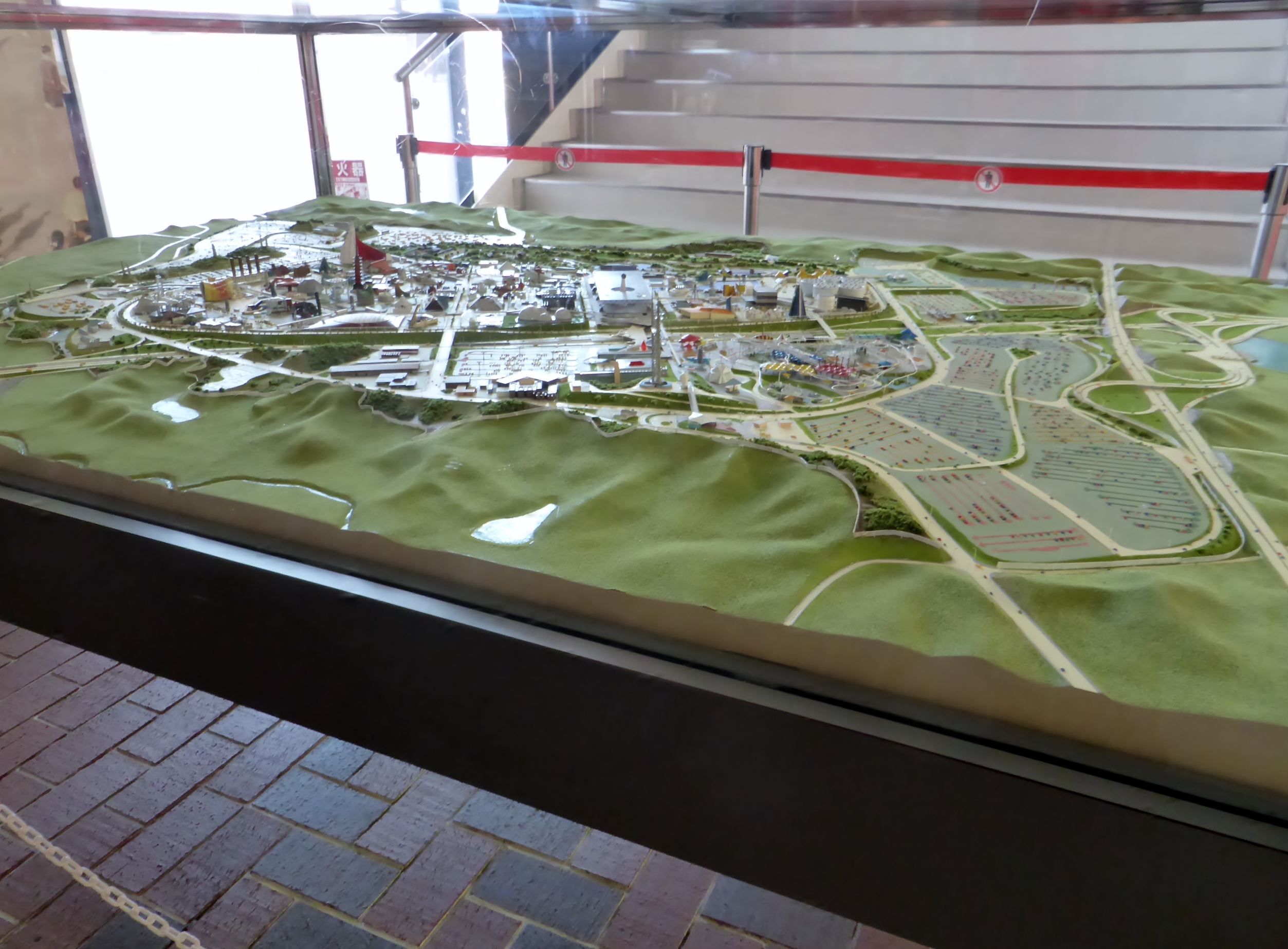
Architect Kenzo Tange designed the fair as a living organism. At its heart ran the Symbol Zone, a north-south spine connecting every corner of the grounds. Tange compared it to a tree trunk, with moving pedestrian walkways and sub-plazas branching outward like limbs. The national pavilions were the flowers -- each in its own colors chosen by its home country's architects -- while the trunk and branches were painted plain white. The Festival Plaza, sheltered beneath the world's first large-scale transparent membrane roof, could seat anywhere from 1,500 to 10,000 people depending on how its flexible terraces were arranged. That roof, designed by Tange and structural engineer Yoshikatsu Tsuboi, measured 75.6 meters wide and 108 meters long, soaring 30 meters high on just six lattice columns. Beneath it, artist Taro Okamoto divided the Theme Space into three levels: the underground representing humanity's past, the surface representing the present, and the space frame above representing the future.
The Tower That Refused to Leave
Okamoto's most audacious contribution was the Tower of the Sun, a 70-meter sculpture that punched straight through the space frame roof as if refusing to be contained by architecture. With its wide outstretched arms and a golden mask face staring into the distance, the tower became the defining image of Expo '70. Three faces adorned it: a golden face on the top representing the future, a frontal face for the present, and a black sun face on the back for the past. When the fair ended and nearly every pavilion was demolished, the Tower of the Sun remained. It still stands in what is now Expo Commemoration Park, its strange silhouette visible from across the Osaka suburbs -- a monument to a moment when Japan believed tomorrow could be designed.
Firsts on Every Floor
The fair was a showcase of technological firsts. The United States pavilion, an air-supported dome designed by architects Davis Brody and structural engineer David H. Geiger, displayed a Moon rock brought back by Apollo 12 astronauts in 1969 -- lines to see it stretched for hours. The Fuji Group pavilion premiered the first IMAX film ever made, a Canadian production called Tiger Child. Demonstrations of conveyor belt sushi, early mobile phones, local area networking, and magnetic levitation train technology gave visitors a taste of inventions that would reshape daily life over the coming decades. The West German pavilion, designed by Fritz Bornemann, housed the world's first spherical concert hall. Inside, 50 loudspeaker groups arranged in seven rings surrounded the audience while composer Karlheinz Stockhausen performed five-and-a-half-hour live programs every day for 183 days, reaching a total audience of roughly one million listeners.
What the Grounds Remember
Almost everything was torn down. The dazzling pavilions, the membrane roof, the pedestrian walkways -- gone. Today the site is Expo Commemoration Park, a green expanse of walking paths and gardens where families picnic beneath cherry trees. Part of the grounds became ExpoCity, a shopping mall anchored by the Redhorse Osaka Wheel, a giant Ferris wheel. A fragment of Tange's Festival Plaza roof survives. The time capsule donated by The Mainichi Newspapers and Matsushita Electric Industrial -- now Panasonic -- sits sealed underground, not to be disturbed for five thousand years. And the Tower of the Sun still stands at the center, arms outstretched, as though waiting for the next fair. Osaka hosted Expo 2025 on Yumeshima island in Osaka Bay, but the original park was left untouched -- a preserved memory of the six months in 1970 when this hillside was the center of the world.
From the Air
Located at 34.809°N, 135.535°E in Suita, northwest of central Osaka. The Expo Commemoration Park and Tower of the Sun are visible from altitude as a large green space amid dense suburban development. The Redhorse Osaka Wheel (Ferris wheel) at the adjacent ExpoCity mall provides an additional visual reference. Osaka Itami Airport (RJOO) lies approximately 3 nautical miles to the west-southwest, making this site easily visible on approach or departure from Itami. Kansai International Airport (RJBB) is roughly 30 nautical miles to the south. At 3,000-5,000 feet AGL, the park's distinctive oval shape and the Tower of the Sun's silhouette are identifiable against the surrounding urban grid.