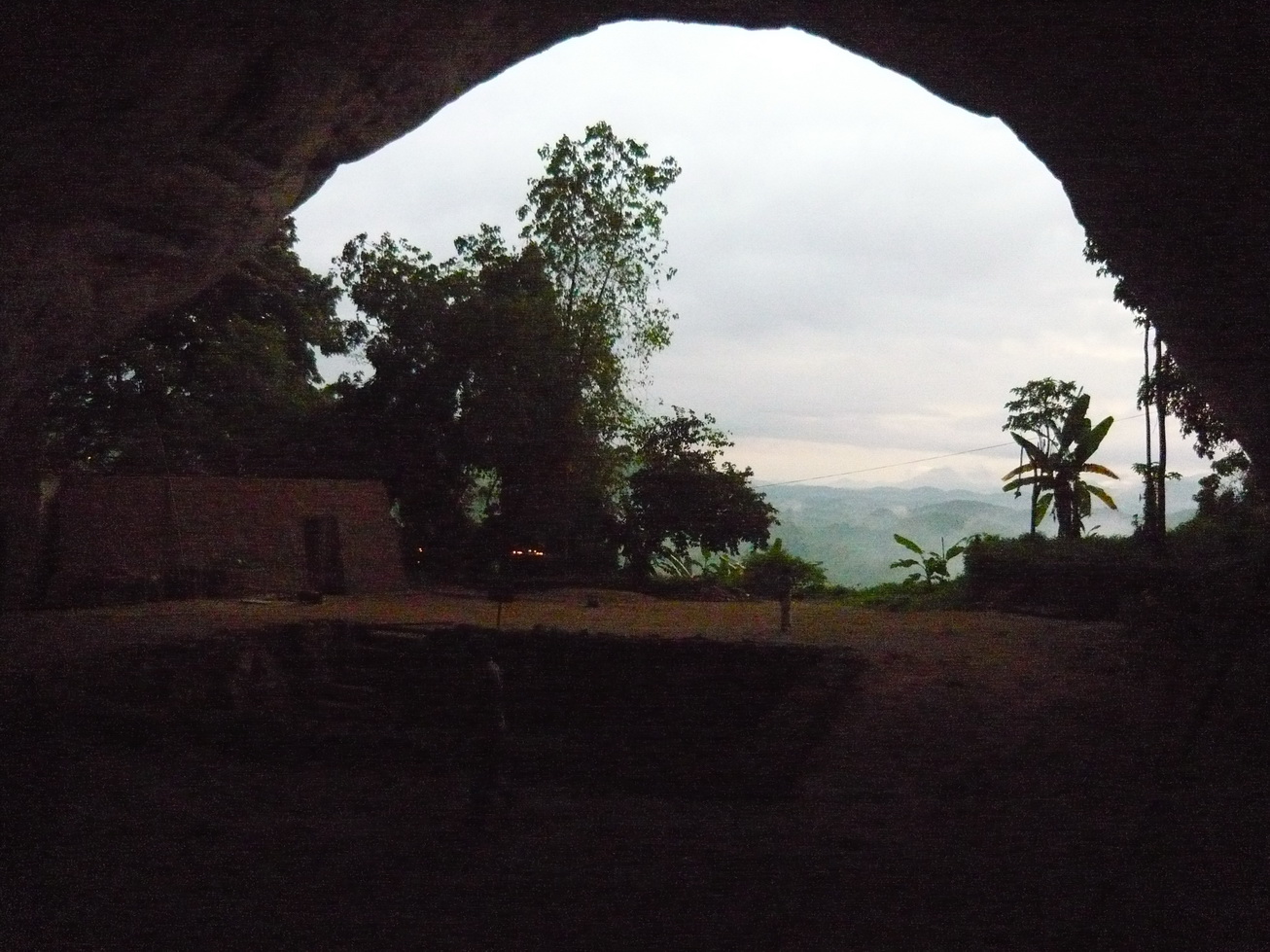
Fa Hien Cave
Forty-eight thousand years ago, someone in this cave shaped a bone point, lashed it to a shaft, and launched it with a bow. That act, recorded in the archaeological layers of Fa Hien Cave in Sri Lanka's Kalutara District, represents the oldest known use of bow-and-arrow technology outside of Africa. The cave itself, also called Pahiyangala, is enormous: the largest natural stone cave in South Asia, capable of sheltering 3,500 people at once. Its limestone walls, carved by hundreds of thousands of years of water erosion, have witnessed an unbroken thread of human habitation stretching from the Late Pleistocene to the Neolithic.
Deep Time Under Stone
Radiocarbon dating places the earliest human occupation of Fa Hien Cave at roughly 33,000 years ago, though some evidence suggests habitation extending back as far as 60,000 years. The cave's occupants were contemporaries of European Cro-Magnon populations, yet they developed technologies independently. Excavations begun in 1968 by Siran Upendra Deraniyagala of the Sri Lankan Department of Archaeology, and continued with W. H. Wijepala in 1988, revealed layer upon layer of human activity: microlith stone tools, the charred remains of ancient firepits, floral material, and the bones of the people who lived and died here. Their remains were later analyzed at Cornell University by Kenneth A. R. Kennedy and his graduate student Joanne L. Zahorsky, providing a detailed picture of a population that maintained a hunter-gatherer lifestyle until approximately the 8th century BCE.
The People of Pahiyangala
Among the oldest skeletal fragments recovered from the cave are the remains of three children, a juvenile, and two adults. These individuals were given secondary burials, meaning their bodies were first exposed to natural decomposition before the bones were carefully collected and placed in graves. This deliberate funerary practice speaks to a community with cultural rituals, a sense of obligation to their dead that required time and attention. Later remains include a young child dated to about 6,850 years before present and a young woman whom archaeologists came to call Kalu-Menika, dated to approximately 5,400 years ago. Both were also secondary burials. Studies of teeth from the cave reveal that these early Sri Lankans processed food by grinding nuts, seeds, and grains using stone querns, a diet supplemented by hunting and the sea fish and shark teeth they obtained, likely through trade networks.
Bows, Beads, and Long-Distance Trade
In June 2020, research by the Max Planck Institute, Griffith University, and the Sri Lankan Department of Archaeology reshaped understanding of early human innovation. The team demonstrated that Fa Hien's inhabitants had developed bow-and-arrow technology 48,000 years ago, the earliest such evidence outside the African continent. The same archaeological layers yielded tools associated with freshwater fishing and fiber working, suggesting the production of nets or clothing. Perhaps most evocative were the beads: colored mineral ochre fashioned into ornaments, and shell beads refined with a sophistication that matched similar social-signaling materials found across Eurasia and Southeast Asia roughly 45,000 years ago. Lead researcher Michelle Langley of Griffith University noted that these coastal shell beads had been traded inland to the cave, evidence of exchange networks operating across considerable distances in deep prehistory.
One Cave Among Many
Fa Hien Cave does not stand alone. It belongs to a constellation of prehistoric sites across Sri Lanka that together document tens of thousands of years of continuous human presence on the island. Batadombalena cave, near Kuruwita, holds remains approximately 28,500 years old. Belilena cave, near Kitulgala, dates to about 12,000 years ago. The open-air site at Bellanbandi Palassa in Rathnapura pushes the record to around 6,000 years before present. Sri Lanka has also yielded the earliest known microliths, tiny, precisely shaped stone tools that did not appear in Europe until the Early Holocene, thousands of years later. The cave's name carries its own layer of history: local legend attributes it to the Chinese Buddhist monk Faxian, who traveled through Sri Lanka in the 5th century CE, though no archaeological evidence connects him to this particular site. The name persists regardless, linking deep prehistory to the historical period through a story that may be apocryphal but has become inseparable from the place.
From the Air
Fa Hien Cave (Pahiyangala) sits at 6.60N, 80.22E in the Kalutara District of Sri Lanka's Western Province, amid the wet-zone hill country. The cave entrance is set into a large limestone cliff face that may be visible from low altitude as a prominent rock outcropping amid dense tropical vegetation. The surrounding terrain is hilly and forested. Nearest major airport: Bandaranaike International (VCBI) approximately 80 km to the north-northwest. Ratmalana Airport (VCCC) is closer at roughly 50 km northwest. Best viewing altitude: 1,500-3,000 feet AGL, though the cave entrance itself is difficult to spot without local knowledge of the terrain.