Faculty of Theology, Catholic University of Leuven
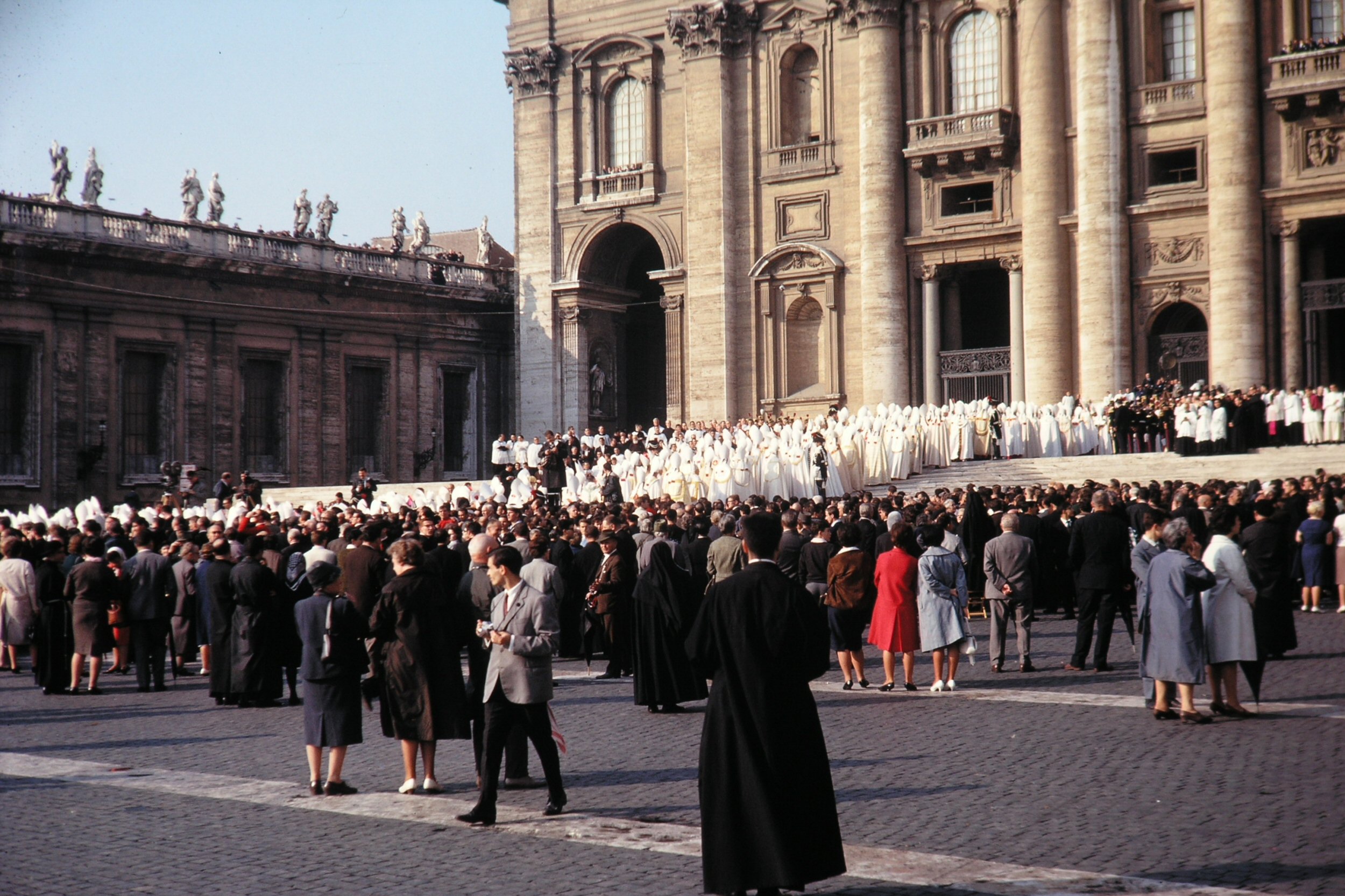
Of all the people who have stood in St. Peter's Basilica during the Second Vatican Council, the most consequential were not the bishops in their mitres or the popes on their thrones. They were the periti - the theological experts whose drafts and footnotes shaped the documents the bishops eventually voted on. A surprising number of those periti had a single return address: the Faculty of Theology of the Catholic University of Leuven. Belgium is a country of eleven million people. Leuven is a university town smaller than Boise, Idaho. Yet for most of the twentieth century the theology faculty there was one of the half-dozen places in the world where Catholic thinking actually moved, and during the council it became, more or less openly, the writing room of Vatican II.
A Theology Faculty With Deeper Roots
The current faculty traces its formal birth to 1834, when the Belgian bishops founded the Catholic University of Belgium in Mechelen. The institution moved to Leuven the next year and took the name Catholic University of Leuven. But the theological tradition behind the new faculty was much older. The Old University of Leuven, founded in 1425 and suppressed by French revolutionary law in 1797, had been one of the principal theological schools of late medieval and early modern Europe. The 1834 faculty considered itself the heir to that older Old Faculty, founded in 1432 - although Belgian courts, in three separate rulings in 1844, 1855, and 1861, declared that the new university was not legally the same institution. Theological continuity, however, is not the same as legal continuity. The faculty inherited the books, the building stones, much of the curriculum, and most of the institutional memory of the pre-revolutionary school. From its earliest years it admitted students who had already completed two years of philosophy and four years of theology elsewhere, mostly seminarians completing advanced degrees before ordination. Canon law was taught here too, until the 1929 papal constitution Deus scientiarum Dominus separated the two programs.
The Historical Turn
The decisive shift in the faculty's character came at the end of the nineteenth century. In 1890, the rector Jean Baptiste Abbeloos appointed the German priest Bernard Jungmann to teach a new course in practical church history. Edmond Reusens began offering Christian Archaeology. The Flemish biblical scholar Albin van Hoonacker introduced a course in historical criticism of the Old Testament in 1889 - in the same years that similar work in Germany was provoking the Modernist Crisis. Eleven years later, Alfred Cauchie founded the Revue d'histoire ecclesiastique, the journal that would for a century be one of the most cited publications in Catholic church history. By 1900 the Leuven faculty had a quiet but firm commitment to historical-critical method that distinguished it from most other Catholic theology programs in Europe. When Pope Pius X cracked down on Modernism between 1907 and 1914, censuring scholars who applied modern historical methods to the Bible, Leuven theologians were largely spared. The protection came from one man: Cardinal Desire-Joseph Mercier, the formidable Belgian primate and former Leuven philosopher, who interceded directly with Rome on his colleagues' behalf. The faculty kept its scholars and its method. The cost to the rest of European Catholic scholarship was very high.
Writing Vatican II
When Pope John XXIII summoned the Second Vatican Council in 1962, the Leuven theology faculty was uniquely well placed. Its scholars had spent two generations doing exactly the kind of historical and biblical work that the council would now ratify. Cardinal Leo Joseph Suenens, the Belgian primate, led the country's episcopal delegation. Behind him came a procession of Leuven faces. The Belgian biblical scholar Lucien Cerfaux. The dogmatic theologians Charles Moeller and Gerard Philips. The patristics scholars Joseph Lebon and Rene Draguet - the latter having been condemned in 1942 for his sympathy with the Nouvelle Theologie, only to live long enough to see his condemned positions become council teaching. The church historian Roger Aubert. The moral theologian Louis Janssens. Gerard Philips became adjunct-secretary of the Doctrinal Commission, which made him the principal architect of Lumen gentium, the council's Dogmatic Constitution on the Church. Leuven contributions are detectable in Sacrosanctum Concilium (the liturgy), Gaudium et spes (the church in the modern world), Dei verbum (revelation and scripture), and Nostra aetate (non-Christian religions). The French Dominican Yves Congar, ejected from his teaching position in Paris in the 1950s for his ecumenical writing, was offered lodging at the Pontifical Belgian College in Rome during the council. Few seminaries in Catholic history have left such direct fingerprints on a single global event.
The Painful Years
And then, like the rest of the university, the theology faculty was split in two. The 1968 Leuven crisis pitted Flemish students against the French-speaking academic establishment that had run the institution since 1834. The university could not remain unified. The decision was made in June 1968 and implemented over the next two years. The Dutch-language theology faculty remained in Leuven as part of the new KU Leuven. The French-language professors and students moved south to the brand-new campus of Louvain-la-Neuve, becoming the Faculty of Theology of UCLouvain. The professorial corps was divided like the library - by alternating lines on a list. The acrimony lasted decades. Old students of the unified faculty would point out, accurately enough, that the small group of scholars who had effectively written Vatican II could never have been assembled in either half of the divided institution. Both new faculties carried on, separately and competently, but the unique critical mass of the prewar Leuven was gone.
The Faculty Today
The post-split Leuven theology faculty took a deliberate turn outward. A new library opened in 1974 - now called the Maurits Sabbe Library, after a long-serving librarian - housing one of the most extensive theological collections in the world, including the archives of the Centre for the Study of the Second Vatican Council. The faculty became increasingly international and increasingly English-speaking; by the 2022-23 academic year, the 338 international students slightly outnumbered the roughly 300 Dutch-language students, and around 160 doctoral candidates were writing dissertations under Leuven supervision. The center of gravity of Catholic theological scholarship in English, which for most of the twentieth century had been split between Washington, Rome, and a handful of German universities, now has a serious Belgian competitor. The faculty teaches under the 1979 apostolic constitution Sapientia Christiana, awards both state degrees in theology and canonical pontifical degrees, and increasingly serves a student body that includes lay theologians from across the world - many of them from places, like sub-Saharan Africa and South Asia, where Catholic intellectual life is now growing fastest. The historical-critical method that got Leuven theologians into trouble a century ago is now, in part because of their work, the normal grammar of Catholic biblical study.
From the Air
The Faculty of Theology occupies the Maurits Sabbe Library complex on Charles Deberiotstraat in central Leuven, at approximately 50.877 N, 4.701 E - immediately east of the Mgr. Ladeuzeplein. Brussels Airport (EBBR) lies 25 km to the northwest. On approach to runway 25L, central Leuven is visible on the left side of the aircraft, marked by the distinctive brick tower of the Warren library. Louvain-la-Neuve, where the French-speaking theology faculty relocated after 1968, sits 30 km south at 50.668 N, 4.612 E.