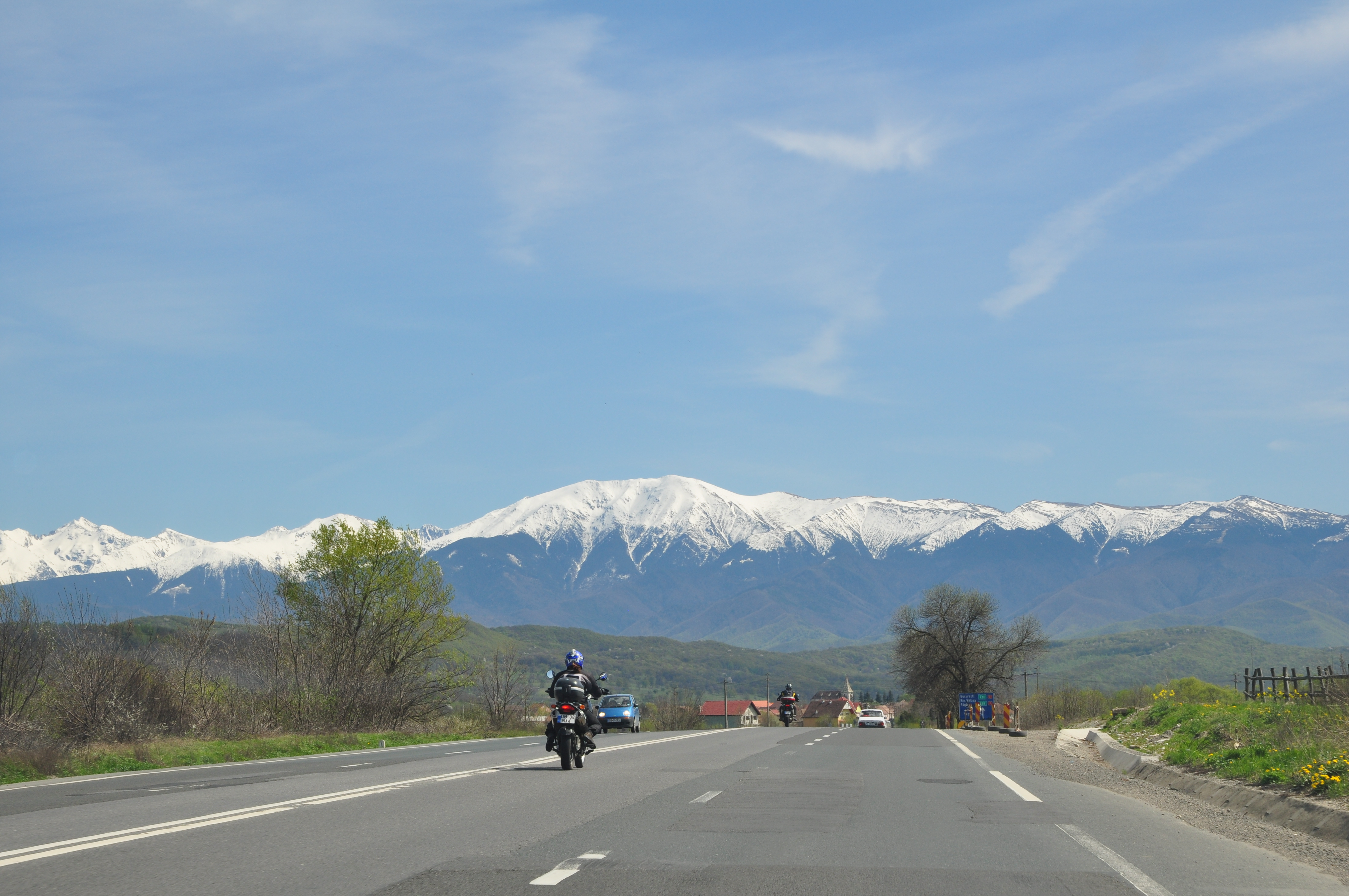
Făgăraș Mountains
Somewhere around trail marker three on the ridge called Custura Sărății, the path narrows to a blade of rock with exposure on both sides and nothing but air below. Hikers call this stretch "Three Steps from Death." It is not a metaphor. The Făgăraș Mountains, the highest range in the Southern Carpathians, do not ease visitors into their landscape. They rise abruptly from the rolling Transylvanian plateau -- a wall of granite and schist that tops out at Moldoveanu Peak, Romania's highest point. No major settlements exist within the range itself. The nearest cities, Sibiu and Brașov, sit at a respectful distance, as if the mountains had drawn a boundary and the towns agreed to honor it.
Ice-Carved Amphitheaters
Glaciers shaped these mountains into a series of cirques and hanging valleys, then retreated and left their calling cards: dozens of alpine lakes scattered across elevations above 2,000 meters. Lake Bâlea, the largest at 46,508 square meters, sits at 2,034 meters and draws the most visitors, largely because the Transfăgărășan road passes near it. But the deeper rewards belong to those willing to walk. Podragu, at 2,140 meters, is the deepest glacial lake in the range, plunging 15.5 meters into dark water. Capra sits even higher at 2,230 meters, tucked into a cirque that holds snow well into July. These are not decorative lakes. They are cold, still, and indifferent -- remnants of an ice age that sculpted the ridgeline into the jagged profile visible from Sibiu on a clear day.
The Road That Shouldn't Exist
In the 1970s, Nicolae Ceaușescu ordered a military highway built across the highest section of the Făgăraș range. The Transfăgărășan, as it came to be known, climbs to over 2,000 meters through a series of switchbacks so tight they seem to fold back on themselves. It is open only from June through September -- snow and ice close it for the rest of the year. The road was built for strategic reasons, to allow rapid troop movement across the Carpathians in the event of a Soviet invasion, but the strategic value has long faded. What remains is one of the most spectacular mountain drives in Europe, a ribbon of asphalt that corkscrews past waterfalls and tunnels through raw rock. At its highest point, the road meets Lake Bâlea, where a lodge sits at the edge of the water and the mountains close in on all sides.
Walking the Spine
The main ridge trail runs roughly 70 kilometers along the crest of the Făgăraș, connecting peaks that rarely drop below 2,400 meters. Moldoveanu rises to the east, followed by Negoiu at 2,535 meters, Viștea Mare, and Lespezi -- the summits stacking up like vertebrae along a spine. Most hikers access the ridge from the town of Victoria on the northern side, or from Arpașu de Jos and Porumbacu de Jos to the south. The terrain near Negoiu turns rocky and technical, with sections of exposed scrambling where steel cables provide the only handhold. Strunga Dracului -- the Devil's Gorge -- offers one of the more challenging approaches to the summit. None of this is casual walking. The Făgăraș demand fitness, route-finding ability, and respect for weather that can shift from clear skies to whiteout conditions within an hour.
A Contested Wilderness
In 2016, the Romanian government moved to designate the Făgăraș Mountains as a national park, with some advocates calling it a future "European Yellowstone." The decision proved deeply controversial. Local communities along the range's perimeter depend on access to timber and forest products for their livelihoods, and the prospect of restrictions triggered fierce opposition. The land tenure arrangements within the range are tangled -- a mix of state, communal, and private ownership that defies simple boundaries. Only a portion of the range could be designated initially, with private conservation investment filling some of the gaps. Meanwhile, proposals for a ski resort have split opinion further: conservationists warn of irreversible damage to fragile alpine ecosystems, while residents of surrounding towns see economic opportunity in a region where good jobs remain scarce. The mountains, as always, remain indifferent to the argument.
From the Air
Located at 45.60N, 24.73E in central Romania. The Făgăraș range extends roughly east-west for 70 km, forming a dramatic wall visible from both the Transylvanian plateau to the north and the Wallachian plain to the south. Moldoveanu Peak (2,544 m / 8,346 ft) is the highest point. The Transfăgărășan road is visible as a winding line crossing the range. Maintain safe altitude above 9,000 ft MSL. Nearest airports: Sibiu International (LRSB), approximately 40 nm northwest. Brașov-Ghimbav International (LRBV), approximately 50 nm east.