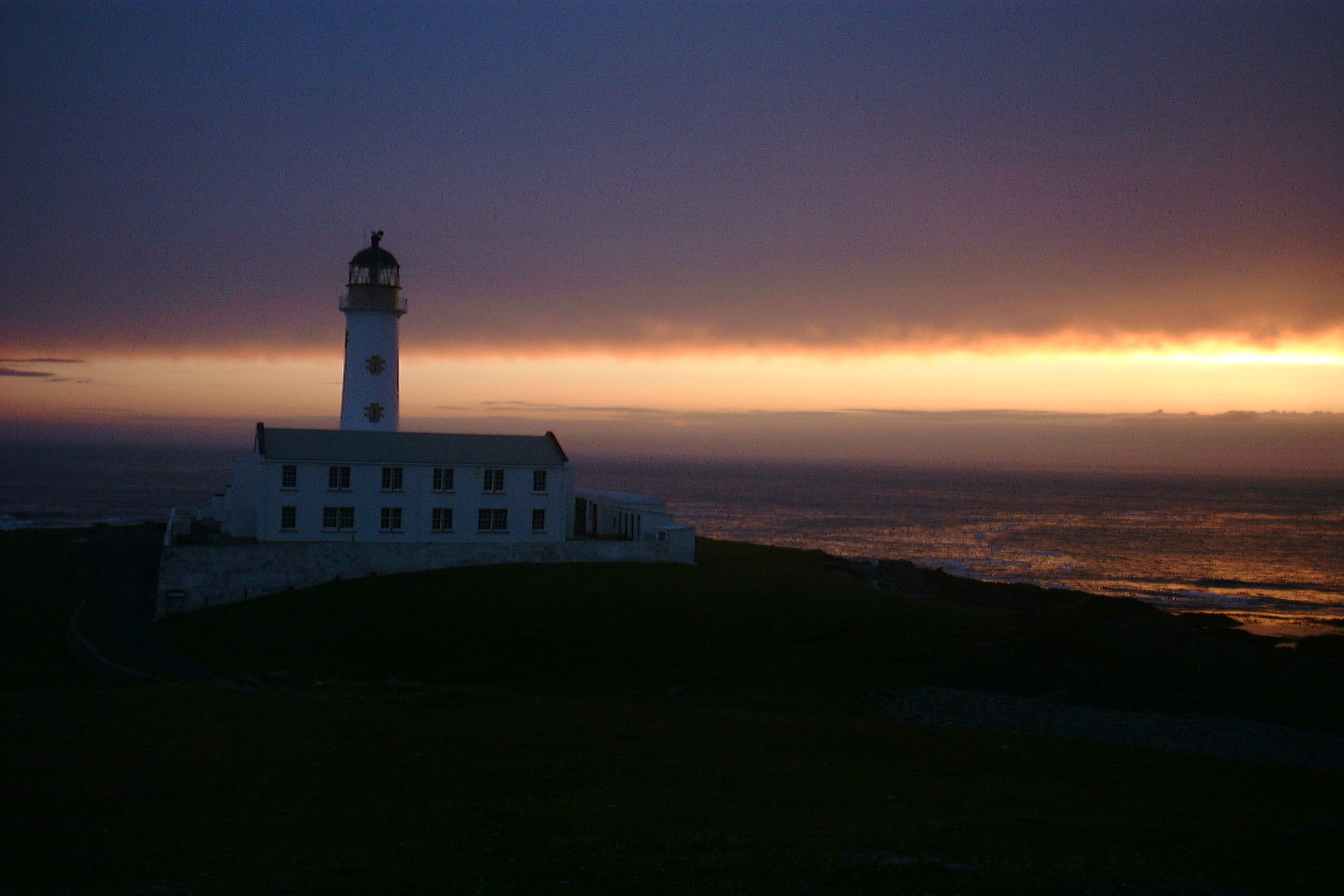
Fair Isle
Nearly 280 hungry Spanish sailors and soldiers landed on an island of seventeen families. It was 27 September 1588, and El Gran Grifon, flagship of the Armada's supply squadron of Baltic hulks, had just been wrecked in the cove of Stroms Hellier on Fair Isle. An anonymous Spaniard kept a diary: 'We found it populated by up to seventeen neighbours in small houses that were more like huts than anything else; a savage people. They eat mostly fish and they do not have bread, or very little, and cakes baked from barley.' By mid-November, fifty of the Spaniards had died, most of hunger. The diary ends there, mid-sentence, the writer's fate unknown.
Between Two Worlds
Fair Isle sits in the gap between Shetland and Orkney, roughly equidistant from Sumburgh Head to the northeast and North Ronaldsay to the southwest, where the North Sea meets the Atlantic. It is the most remote inhabited island in the United Kingdom. The western coast rises in cliffs up to 200 metres high; Ward Hill, the highest point, reaches 217 metres. Most of the islanders live in crofts on the gentler southern half, while the northern half consists of rocky moorland. The population was 223 at the end of the 19th century. In 1862, around 40 percent migrated to New Brunswick. By 2001, 69 people remained. Fair Isle has been owned by the National Trust for Scotland since 1954, when George Waterston, founder of the bird observatory, sold it to ensure the island's future.
Radar, Raids, and the War
Fair Isle's isolation made it strategically valuable during the Second World War. The Royal Navy built two radar stations on top of Ward Hill, operational from early 1940, which played a critical role in detecting German bombers approaching the Royal Navy's anchorage at Scapa Flow in April of that year. Supplies reached the summit via a cable-operated narrow-gauge railway whose rusted remains can still be traced. The island was bombed repeatedly. The wife of a lighthouse assistant keeper was killed in a raid in 1941, and her daughter injured. In 1942, the wife and daughter of another keeper also died in an attack. A German Heinkel He 111 crashed on the island in January 1941; wreckage remains at the crash site. A Spitfire made an emergency landing in July 1941 after a reconnaissance mission over Norway -- the pilot survived, and the aircraft eventually flew again.
Patterns in Wool
Fair Isle's global fame rests on something quieter than warfare or shipwreck: knitting. The distinctive Fair Isle technique -- colourful geometric patterns worked in stranded colourwork -- has become one of Scotland's most recognisable textile traditions. Whether the technique arrived with the Spanish sailors, as local legend suggests, or evolved from Norse and Scottish traditions already present on the island is debated. What is certain is that the patterns became synonymous with the island's name, carried worldwide by knitwear that has been prized for its warmth, beauty, and the skill required to produce it. The island is equally renowned among birdwatchers: the Fair Isle Bird Observatory, founded by Waterston, has documented rare and migrating species for decades.
The Remotest Community
Living on Fair Isle has always required self-reliance. In the 1950s, there was no electricity and only some homes had running water. Twenty-four-hour power did not arrive until 2018. The island today functions as a relay point for television, radio, telephone, and military communications between Shetland, Orkney, and the Scottish mainland, continuing its historic role as a signal station linking remote island groups to the rest of the country. Fair Isle has 14 scheduled monuments, from the earliest signs of human activity to the remains of the wartime radar stations. Full fibre broadband reached the island in 2023, setting a new Openreach record for remoteness. The island endures, as it has since Neolithic times, by combining isolation with connection -- a speck of inhabited land in one of the most turbulent stretches of sea in the British Isles.
From the Air
Located at 59.53N, 1.63W in the Fair Isle Gap between Shetland and Orkney. The island is clearly visible as a distinct landmass from altitude, with dramatic western cliffs. Nearest airports: Sumburgh (EGPB) on Shetland approximately 38 km northeast, Kirkwall (EGPA) on Orkney approximately 60 km southwest. Fair Isle has its own small airstrip (EGEF).